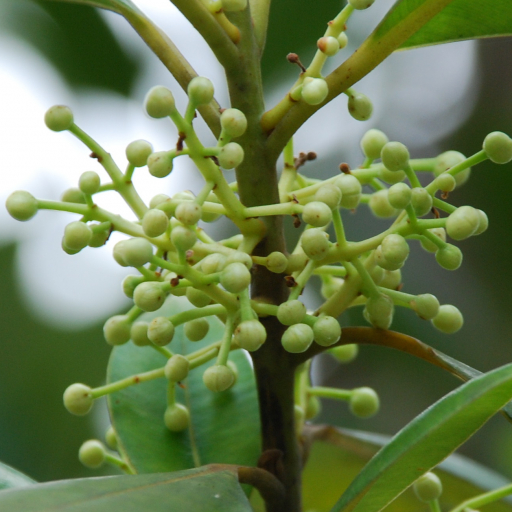
Plant Overview
Known in its native Brazil as Jacareúba—which translates to "alligator wood" due to its bark's resemblance to reptile skin—Calophyllum brasiliense is a majestic evergreen that rules the tropical riverbanks. Often called the Santa Maria tree, it is revered both for its incredibly durable timber and its healing oils. In the wild, it acts as a sturdy anchor for rainforest ecosystems, providing a dense canopy that shelters diverse wildlife.
🔍 How to Identify
- 🍃 The "Comb" Leaves: Look closely at the dark green, leathery leaves; they feature extremely fine, closely spaced parallel veins that run straight from the center to the edge, resembling the teeth of a fine comb.
- ⚪ Fragrant Blooms: It produces delicate clusters of small, white-to-cream flowers that release a sweet, citrus-like perfume, drawing in local pollinators.
- 🟢 Spherical Fruit: The tree drops hard, globose fruits about the size of a walnut. These green fruits contain a single large seed rich in thick, yellowish oil.
🏡 In Your Garden
- 💧 The Water Lover: This tree is "hydrophilous," meaning it thrives with its feet wet. In a landscape setting, it is perfect for areas with poor drainage or near ponds, as it naturally grows in swampy, riparian zones.
- 🌱 Slow and Steady: Don't expect a privacy screen overnight. Jacareúba focuses its energy on developing a massive, deep root system and high-density wood, making it exceptionally resistant to wind and storms once established.
- 🌍 Acidic Soil Preference: It performs best in nutrient-rich, acidic clay soils. If your garden soil is too alkaline, the leaves may begin to yellow (chlorosis), signaling it isn't absorbing iron properly.
⚠️ Safety & Toxicity
- ✅ Generally Safe: This plant is not considered high-risk for casual contact, and it is frequently used in traditional medicine.
- 💧 Latex Sensitivity: Like many members of its family, the tree contains a yellowish milky sap (latex). While not deadly, this sap can cause mild skin irritation or "dermatitis" in sensitive individuals or curious pets if the bark or leaves are snapped.
- 🐾 Seed Caution: While bats and some wildlife eat the fruit pulp, the seeds are very high in tannins and oils; keep them away from dogs who might try to use them as chew toys.
✨ Fun Fact
The wood of the Jacareúba is so resistant to rot and water damage that it was historically the "gold standard" for shipbuilding in Central and South America. It was specifically sought after for making the masts of large sailing vessels because it could withstand the salt and spray of the open ocean for decades!

Detailed Care Instructions
To grow Calophyllum brasiliense (commonly known as Brazilian beauty-leaf) plant, follow these steps:
- Choose a suitable location: Calophyllum brasiliense prefers tropical or subtropical climates. It grows best in full sun to partial shade, with a well-draining soil.
- Obtain seeds or seedlings: You can obtain seeds or seedlings from a local nursery, online seed sellers, or even by collecting seeds from mature fruit. If starting from seeds, soak them overnight in warm water to enhance germination.
- Germination: Plant the seeds in small pots or seed trays with a well-draining potting mix. Cover the seeds with a thin layer of soil and keep them consistently moist. Place the pots in a warm area with a temperature between 70-85°F (21-29°C). Germination can take around 2-4 weeks.
- Transplanting: Once the seedlings have grown a few inches tall and have developed a few sets of true leaves, they can be transplanted into larger pots or directly into the ground. Ensure proper spacing if planting multiple plants.
- Soil and watering: Calophyllum brasiliense prefers a soil mix that is rich in organic matter and well-draining. Water the plants regularly, keeping the soil moist but not waterlogged. Be careful not to overwater, as this can lead to root rot.
- Fertilization: Apply a balanced slow-release fertilizer during the growing season (spring to fall). Follow the instructions on the fertilizer package for the correct application rate. Avoid over-fertilizing, as it can damage the plant.
- Pruning: Regular pruning can help maintain the desired size and shape of the plant. Prune any dead or damaged branches and remove any excessive growth to promote a bushier, compact shape.
- Pests and diseases: Calophyllum brasiliense is generally pest and disease-resistant. However, keep an eye out for common garden pests like aphids or scales, and treat them accordingly with organic or chemical insecticides if necessary.
- Mulching: Apply a layer of organic mulch around the base of the plant to help retain moisture, suppress weed growth, and provide additional nutrients as it decomposes.
- Patience: Growing a Calophyllum brasiliense plant may take time and patience, as it can have a slow growth rate. Be consistent with your care routine and provide the plant with the necessary conditions for optimal growth.
Remember to research specific care instructions for your specific region or consult with local gardening experts for additional guidance.
The best way to water this plant is to ensure that the soil is consistently moist but not waterlogged. You should avoid watering the plant too frequently, as this can lead to root rot and other issues. Instead, water deeply and thoroughly when the soil feels slightly dry to the touch, and allow the excess water to drain away. It is also important to use a well-draining potting mix to prevent water from pooling around the roots. Additionally, avoid getting water on the leaves or flowers of the plant, as this can promote the growth of fungal diseases.
To fertilize this plant, you should first ensure that it is planted in well-draining soil. Use a balanced, slow-release fertilizer with equal parts nitrogen, phosphorus, and potassium. Apply the fertilizer once every three months, during the growing season. Be sure to follow package instructions carefully, as over-fertilizing this plant can lead to root burn and damage. Water the plant thoroughly after fertilizing to ensure that the nutrients are absorbed properly.
The ideal soil for this plant should be well-draining and acidic in nature. The pH level of the soil should be between 5.5 and 6.5. The soil should be rich in organic matter and should have good water retention capacity. The plant prefers a soil that is slightly loamy with good aeration for healthy root growth. The ideal soil should be a mixture of sand, clay, and organic matter. Avoid using heavy soils that retain water for too long, as this can cause root rot. Additionally, make sure to fertilize the plant regularly with a balanced fertilizer to maintain its growth and overall health.
Calophyllum Brasiliense is a flowering plant that belongs to the family Calophyllaceae. It is native to certain regions of South America, and is a commonly used plant for medicinal purposes. There are different ways to propagate Calophyllum Brasiliense, and two of the most common are through seed propagation and vegetative propagation.
Seed propagation:
- Obtain fresh seeds: Collect the seeds from a mature and healthy Calophyllum Brasiliense plant. Make sure that the seeds are fresh and free from any damage or disease.
- Clean the seeds: Remove any debris from the seeds, and soak them in water overnight. This will soften the seed coat and increase the chances of germination.
- Sow the seeds: Fill a seed tray with well-draining soil and sow the seeds, covering them lightly with soil. Keep the tray in a warm and humid place, and water the soil regularly to keep it moist.
- Germination: The seeds may take up to several weeks to germinate. Once they have germinated, remove any weaker seedlings and transplant the stronger ones into individual pots.
Vegetative propagation:
- Select a healthy parent plant: Choose a healthy and disease-free parent plant that you wish to propagate.
- Take cuttings: Take 10-cm cuttings from the parent plant. Make sure that the cuttings are taken from the current season's growth, and that they have one or two leaf nodes.
- Prepare the cuttings: Remove the lower leaves from the cuttings, and dip the cut end in rooting hormone powder.
- Rooting: Place the cuttings in well-draining soil in a pot. Keep the pot in a warm and humid place, and mist the leaves regularly to keep them moist.
- Transplanting: Once the cuttings have developed roots, transplant them into individual pots.
Both of these methods can be used to propagate Calophyllum Brasiliense, and can result in strong and healthy plants.








