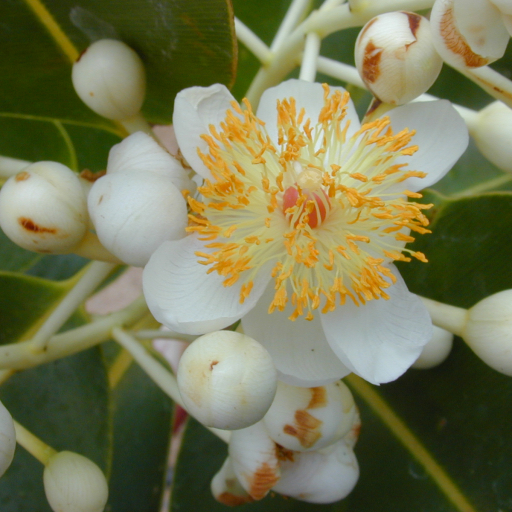
Plant Overview
Often called the Tamanu or Alexandrian Laurel, this coastal giant is a true treasure of the Pacific and Indian Oceans. Known for its glossy, evergreen canopy and fragrant, snow-white flowers, it has been revered for centuries by seafaring cultures for both its shade and its "miracle" healing oil. It is a slow-growing symbol of resilience, often found leaning gracefully over turquoise waters.
🔍 How to Identify
- 🍃 The Foliage: Large, leathery, oval leaves with a distinct "penniveined" pattern—fine, parallel veins running straight from the midrib to the leaf edge.
- 🌼 The Blooms: Sweetly scented white flowers that appear in clusters, featuring snowy petals and a bright "pom-pom" of golden-yellow stamens in the center.
- 🎾 The Fruit: Smooth, round green drupes about the size of a golf ball, which eventually turn brown and wrinkled as they dry to reveal a hard-shelled nut.
🏡 In Your Garden
- 🏖️ Coastal Warrior: This tree is incredibly salt-tolerant and wind-resistant. It thrives in seaside gardens where salt spray and sandy soil might cause other plants to wither.
- 🪴 The Taproot Factor: Calophyllum develops a deep, sturdy taproot early in life. Because of this, it hates being transplanted. If you are growing one, choose its "forever home" carefully while it is still a sapling.
- 🌳 Space Requirements: While it can be kept in a large pot for a few years, it eventually wants to be a majestic shade tree. Give it plenty of room to spread its wide, horizontal branches.
⚠️ Safety & Toxicity
- 🚫 Non-Edible: While the "Tamanu oil" extracted from the seeds is a holy grail in skincare, the raw fruit, seeds, and leaves are toxic and should never be ingested by humans or pets.
- 💧 Sticky Sap: The bark and leaves produce a milky latex sap. This can cause mild skin irritation or dermatitis in sensitive individuals, so wear gloves when pruning.
✨ Fun Fact
For centuries, the dense, water-resistant wood of this tree was the primary material for building traditional Polynesian voyaging canoes. Its naturally curved branches were specifically harvested to create the "knees" and ribs of the boats, making it the backbone of ancient maritime exploration.

Detailed Care Instructions
| Humidity | Dry |
| Lighting | Full Sun |
| Difficulty | Medium |
| Hibernation | Cold Period |
| Temperature | 28°C - 35°C |
| Hardiness Zones | 10 - 12 |
To grow Calophyllum inophyllum, also known as tamanu tree or beauty leaf tree, you can follow these steps:
- Source seeds or young plants: Look for reputable nurseries or online sellers that offer Calophyllum inophyllum seeds or young plants.
- Select a suitable location: Calophyllum inophyllum prefers full sun but can tolerate partial shade. Choose a location in your garden that provides these conditions.
- Prepare the soil: Calophyllum inophyllum thrives in well-draining soil. If your soil is heavy or clayey, amend it with organic matter like compost to improve drainage.
- Plant the seeds or young plants: If you have seeds, sow them directly into the prepared soil at a depth of about ½ inch (1.3 cm). Alternatively, if you have young plants, dig a hole slightly larger than the root ball, place the plant in the hole, and backfill with soil. Space multiple plants at least 10-15 feet (3-4.5 meters) apart to allow for adequate growth.
- Water regularly: Keep the soil evenly moist but not waterlogged. Water the plant deeply once or twice a week, especially during dry periods, to encourage healthy root development.
- Mulch around the plant: Apply a layer of organic mulch, such as wood chips or straw, around the base of the plant. Mulch helps retain soil moisture, suppress weeds, and provide essential nutrients as it decomposes.
- Prune if needed: Calophyllum inophyllum generally has a rounded, dense canopy. If you want to maintain a specific shape or remove dead or damaged branches, you can prune the tree. Prune during late winter or early spring before the new growth starts.
- Fertilize sparingly: Calophyllum inophyllum usually doesn't require frequent fertilization. However, if your soil is lacking in nutrients, you can apply a slow-release, balanced fertilizer during the growing season, following the instructions on the package.
- Monitor for pests and diseases: While Calophyllum inophyllum is generally resistant to pests and diseases, watch out for signs of trouble like leaf spots, aphids, or mealybugs. Proper watering, good air circulation, and maintaining overall plant health can help prevent these issues.
- Be patient: Calophyllum inophyllum is a slow-growing tree, and it may take several years to reach its full size. Patience is key when growing this plant.
Remember to check the specific requirements of Calophyllum inophyllum in your location, as some variations can exist based on climate and soil conditions.

Place in a window with dappled sun or a spot in the middle of a room. Or directly in a window facing west or east.

The plant should be watered consistently, but not excessively. It is important to ensure that the soil is properly drained, as the plant does not tolerate standing water. Checking the soil moisture level regularly will help to determine when it needs to be watered. Water the plant deeply until the soil is moist, but not saturated. It is recommended to allow the top layer of soil to dry out between waterings to prevent root rot. Avoid getting water on the leaves, as this can lead to fungal diseases. Additionally, it is important to fertilize the plant regularly to maintain healthy growth.
To fertilize this plant, use a balanced fertilizer with an N-P-K ratio of 10-10-10 or 20-20-20. Apply the fertilizer every 4-6 weeks during the growing season, which is typically from spring to fall. Do not over-fertilize, as this can lead to nutrient burn and damage the roots. Water the plant thoroughly after fertilizing.
Calophyllum Inophyllum plant prefers well-drained soil that is slightly acidic with a pH between 6 and 7.5. The soil should be rich in nutrients and organic matter to support healthy growth and development. A mixture of sandy loam soil and organic compost is ideal for Calophyllum Inophyllum plant. The soil should also be well-aerated to promote root development and prevent waterlogging. Adding perlite or vermiculite to the soil mixture can help improve soil aeration. Avoid using heavy clay soils or soils that are prone to waterlogging, as this can lead to root rot and other diseases. It is important to ensure that the soil is moist but not waterlogged, as overwatering can also cause root rot.
To propagate this particular plant, one can take stem cuttings that are around 6 inches long and have 3-4 leaves each. These cuttings should be taken from a healthy and mature plant, and it is important to sterilize the cutting tool with alcohol or a flame to avoid any contamination. A rooting hormone can also be applied to the cut end of the stem to encourage root growth.
Once the cuttings are prepared, they can be planted in a well-draining soil mix and kept in a warm and humid environment, such as a greenhouse or a covered propagation tray. It is important to keep the soil moist but not waterlogged, and to provide some shade to the cuttings to avoid direct sunlight.
Roots should start to develop within a few weeks, and once they are well-established, the cuttings can be transplanted into individual pots or directly into the ground. It is important to keep the newly rooted plants well-watered and protected from direct sun until they are fully established.
Common pests of the indian-laurel include Scale insect, mealybugs, spider mites, thrips. Make a habit of checking your indian-laurel frequently for pests so that any infestations can be caught and managed early.








