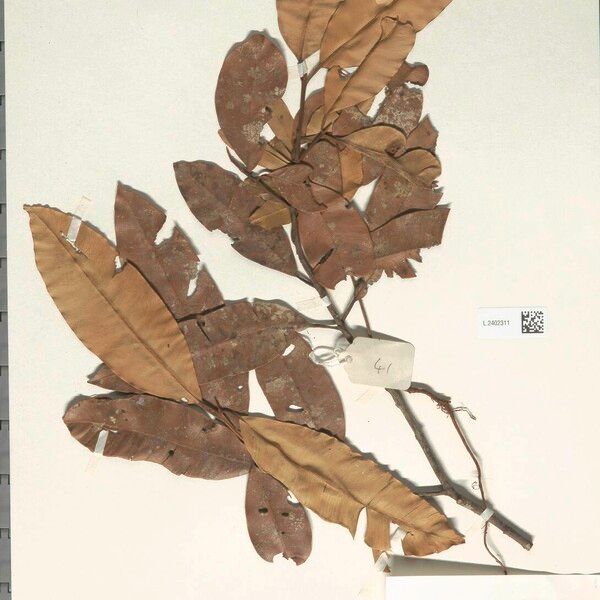
Plant Overview
Often called the Bintangor tree, Calophyllum sundaicum is a stalwart of the Southeast Asian peat swamps and lowland forests. Its name stems from the Malay word for "star," referring to the way its dense, glossy canopy catches the light or perhaps the delicate shape of its white blossoms. While it is prized for its high-quality timber, it is also a biological powerhouse currently being studied for its incredible potential in modern medicine.
🔍 How to Identify
- 🍃 Pinstriped Foliage: The leaves are thick, leathery, and glossy, featuring a unique "venation" where hundreds of fine, parallel veins run perfectly straight from the midrib to the edge.
- 🌼 Fragrant Blooms: It produces small, delicate clusters of white flowers with a "pom-pom" of bright yellow stamens at the center, emitting a sweet, subtle scent.
- 🟢 Marble-like Fruit: The fruit is a smooth, green, globe-shaped drupe (resembling a large marble) that turns brownish-yellow as it matures and contains a single oily seed.
🏡 In Your Garden
- 💧 The "Wet Feet" Specialist: Unlike most garden plants that rot in standing water, this tree thrives in waterlogged, acidic soils. It is a perfect choice for coastal gardens or areas with poor drainage where other species fail.
- 🌳 Slow and Steady: This is not a "fast-fix" screen plant. It grows slowly, investing its energy into incredibly dense, durable wood and a deep root system that makes it highly resistant to strong winds and storms.
⚠️ Safety & Toxicity
- 🛡️ Status: Generally safe to be around, but handle the sap with caution.
- 🧴 Irritant Potential: The bark and leaves contain a milky, yellowish latex (sap). While not deadly, this sap can cause mild skin irritation or "dermatitis" in sensitive individuals and should be kept away from the eyes.
- 🐾 Pet Safety: While there is limited data on its toxicity to domestic animals, the high oil content in the seeds suggests they should not be ingested by curious dogs or cats.
✨ Fun Fact
Scientists have discovered that certain Calophyllum species contain "calanolides," natural compounds that have shown a remarkable ability to inhibit the replication of the HIV-1 virus, making these swamp-dwelling trees a major focus of pharmaceutical research!

Detailed Care Instructions








