Plant Overview
Known as the "Takamaka" or the "Tacamahac tree," this coastal guardian is a legendary fixture of the Mascarene Islands. With its sturdy, often twisted trunk and thick, waxy foliage, it has shielded tropical shorelines from ocean storms for centuries. In local folklore, its fragrant resin was prized as a "holy balsam" for healing, earning it a reputation as a tree of protection and utility.
🔍 How to Identify
- 🍃 Venation: The most striking feature is the leaves—closely spaced, parallel veins run perfectly straight from the midrib to the edge, looking almost like fine pinstripes.
- 🌳 Textured Bark: The bark is thick and grayish, often developing deep, attractive vertical fissures as the tree matures.
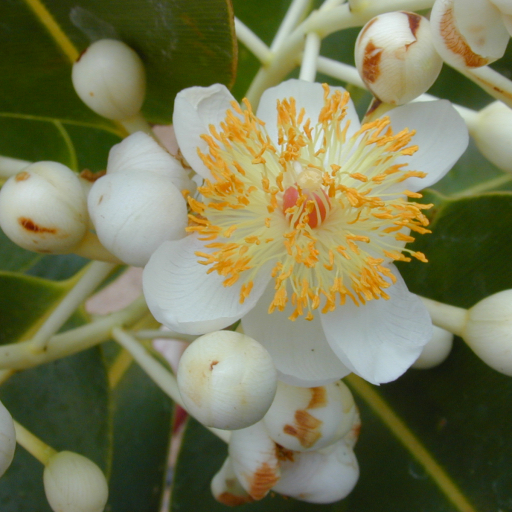
- 🌸 Fragrant Blooms: It produces delicate, snow-white flowers with a bright cluster of yellow stamens in the center, which eventually turn into round, green-to-brown fruits.
🏡 In Your Garden
- 🏝️ Coastal Warrior: This tree is exceptionally salt-tolerant and wind-resistant. It is the gold standard for tropical "maritime" gardening where salt spray would kill more sensitive species.
- ⏳ Slow & Steady: It is a slow grower that invests its energy into creating incredibly dense, heavy timber. Because of this, it doesn't require frequent pruning but does need deep, well-draining soil to establish its massive root system.
⚠️ Safety & Toxicity
- 🐾 Mild Concern: While the tree is not considered highly toxic, the seeds and fallen fruits contain chemical compounds that can cause digestive upset if ingested by curious pets or livestock.
- 💧 Sticky Sap: The tree produces a yellowish resin (latex) when cut. This sap is very sticky and can cause mild skin irritation or allergic reactions in sensitive individuals.
✨ Fun Fact
The wood of the Takamaka is so dense and resistant to rot that it was historically the primary material used to build traditional "pirogues"—the iconic fishing boats of the Indian Ocean—allowing them to last for decades in harsh saltwater.

Detailed Care Instructions
To grow Calophyllum Tacamahaca, also known as Alexandrian Laurel, follow these steps:
- Choose the right location: This plant prefers full sun to partial shade. Select a spot in your garden that receives at least 6 hours of sunlight a day. It also prefers well-draining soil.
- Prepare the soil: Calophyllum Tacamahaca prefers a slightly acidic soil pH between 6.0 and 6.5. Amend the soil with organic matter, such as compost, to improve its fertility and drainage.
- Propagation: Calophyllum Tacamahaca can be propagated from seeds, cuttings, or air layering. Seeds should be soaked in warm water for 24 hours before planting. If using cuttings or air layering, ensure that the cutting has at least two nodes and remove any leaves from the lower portion of the stem.
- Planting: Dig a hole slightly larger than the root ball. Place the plant in the hole, ensuring that the top of the root ball is level with the soil surface. Backfill the hole with soil and gently firm it around the plant to eliminate air pockets.
- Watering: Water the plant deeply after planting and continue to keep the soil evenly moist during the growing season. However, avoid overwatering as it may lead to root rot.
- Fertilizing: Feed the plant with a balanced slow-release fertilizer in early spring or use a liquid fertilizer every month during the growing season.
- Pruning: Calophyllum Tacamahaca can grow into a large tree, but it can also be pruned to maintain a desired shape and size. Prune any dead, damaged, or crossing branches to improve the overall health and appearance of the plant.
- Protection: In colder regions, it is advisable to protect young Calophyllum Tacamahaca plants from frost during the winter months. Mulching around the base can help insulate the roots.
With proper care, Calophyllum Tacamahaca can thrive and provide beautiful evergreen foliage and fragrant flowers.
The ideal watering practice for this plant is to keep the soil evenly moist but not waterlogged. You can achieve this by giving just enough water to dampen the soil without causing any standing water or runoff.
One way to determine when it's time to water is by feeling the top layer of soil with your finger. If it feels dry to the touch, you can proceed to water the plant. However, if it still feels moist, you can hold off on watering for a few more days.
Watering should also be adjusted according to the environmental conditions. For example, when the weather is hot and dry, the plant may need more frequent watering to prevent the soil from drying out. Conversely, in low-light conditions or during the winter months, the plant may need less watering.
It's important to avoid overwatering the plant as this can lead to root rot and other diseases. Additionally, standing water in the soil can attract pests and create a breeding ground for bacteria and fungi.
In summary, the key to proper watering for this plant is to keep the soil consistently moist, but not waterlogged, adjust the watering schedule based on environmental conditions, and avoid overwatering to prevent root rot, pests, and disease.
To fertilize the Calophyllum Tacamahaca plant, follow these instructions:
- Choose a balanced, slow-release fertilizer with an NPK ratio of around 10-10-10. This ratio indicates the amounts of nitrogen (N), phosphorus (P), and potassium (K) in the fertilizer.
- During the plant's active growth period, typically in spring and summer, dilute the fertilizer according to the package instructions. In general, mix 1 tablespoon of fertilizer with 1 gallon of water.
- Apply the diluted fertilizer mixture to the soil around the base of the plant. Avoid directly applying it on the leaves or stems.
- Water the plant thoroughly after fertilizing to help the nutrients reach the roots.
- Repeat the fertilization process every 4-6 weeks during the growing season, or as recommended by the fertilizer package.
- During the plant's dormant period, usually in fall and winter, suspend fertilization to allow the plant to rest.
Remember, it's important to always read and follow the specific instructions provided on the fertilizer packaging, as different brands and formulations may have slightly different application rates or schedules.
The best soil type for the Calophyllum Tacamahaca plant should be well-draining, slightly acidic and nutrient-rich. The soil should have a pH level between 5.5 and 6.5. A mix of peat moss, perlite, and vermiculite will ensure good drainage while retaining moisture. Organic matter such as compost or aged manure can be added to enrich the soil. The plant prefers slightly moist soil, so it's important to avoid waterlogging. The soil should be aerated and free of any pest or fungal infestation. Regular fertilization with a balanced fertilizer will help the plant grow healthy and promote flowering.
Calophyllum Tacamahaca is a plant that can be propagated through various methods, including seeds, stem cuttings, and air layering. Here are the details on its propagation:
- Seed propagation: Collect ripe seeds from the plant. Clean and remove any pulp or debris from the seeds. Soak the seeds in water for about 24 hours to soften the seed coat. Sow the seeds in well-draining potting soil, lightly covering them with a thin layer of soil. Maintain a warm and humid environment with a temperature between 70-85°F (21-29°C) and provide indirect light. Keep the soil moist but not waterlogged. Germination may take several weeks to a few months.
- Stem cutting propagation: Select a healthy, young stem from the plant. Using a clean, sharp knife or pruning shears, cut a 6-8 inch (15-20 cm) section of the stem just below a node (where a leaf is attached). Remove any leaves or flowers from the lower half of the cutting. Dip the cut end in rooting hormone to enhance rooting. Insert the cutting into a well-draining rooting medium such as perlite, vermiculite, or a mixture of peat moss and sand. Make sure at least two nodes are buried in the medium. Place the cutting in a warm and humid environment with indirect light. Mist the cutting regularly to maintain humidity. Rooting may take several weeks to a few months. Once the cutting has rooted, it can be transferred to a pot with regular potting soil.
- Air layering propagation: Select a healthy stem on the plant and make a small upward cut, about 1/3 of the way through the stem, just below a node. Keep the cut open using a toothpick or similar object. Apply rooting hormone to the exposed area. Surround the cut with moist sphagnum moss or a similar rooting medium. Wrap plastic wrap around the moss, securing it with a string or rubber band at both ends. Keep the moss consistently moist by misting regularly. Roots should form within a few weeks to a few months. Once the roots are well-developed, cut the air-layered section below the rooting medium and pot it in regular potting soil.
It's important to note that while these methods are commonly used, success rates may vary. It's always beneficial to research and understand the specific requirements and preferences of Calophyllum Tacamahaca for propagation, as it may differ slightly from other plants.








