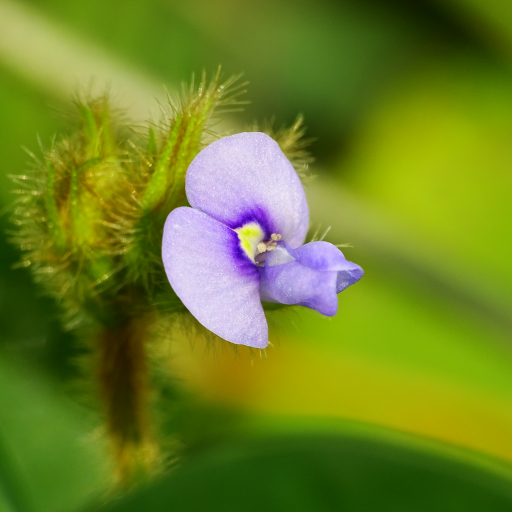
Plant Overview
Commonly known as Calopo or the Wild Groundnut, this vigorous, trailing legume is the "green carpet" of the tropics. Originally from Tropical America, it has traveled the world as a champion of soil health, acting as a natural fertilizer and a protective shield for the earth. While it might look like a simple weed to some, farmers and soil enthusiasts treasure it for its ability to breathe life back into tired ground.
🔍 How to Identify
- 🌿 The Velvet Touch: The entire plant—stems, leaves, and pods—is covered in dense, soft, reddish-brown hairs, giving it a distinct fuzzy texture.
- 🍃 Trifoliate Leaves: It features leaves divided into three oval-shaped leaflets, which are broad and slightly pointed at the tips.
- 🪻 Pea-Like Blooms: During the flowering season, it produces small, delicate clusters of pale blue to lilac flowers that peek out from behind the dense foliage.
🏡 In Your Garden & Landscape
- 🌱 Living Mulch: In a garden setting, Calopo acts as an incredible ground cover. It suppresses weeds by creating a thick mat that blocks sunlight from reaching unwanted seeds.
- 🧪 Nitrogen Factory: Like many legumes, it has a "secret superpower" in its roots. It works with soil bacteria to pull nitrogen from the air and store it in the earth, acting as a natural, slow-release fertilizer for neighboring plants.
- 🏃 Aggressive Ambition: Because it grows so quickly, it can easily overwhelm small ornamental plants. It’s best used in large open spaces or as a "green manure" that is tilled back into the soil before it takes over.
⚠️ Safety & Toxicity
- ✅ Low Risk: Calopogonium mucunoides is generally considered non-toxic to humans and common pets.
- 🐮 The "Tickle" Factor: While used as forage for livestock, many animals find it unpalatable when fresh because of the dense, bristly hairs, which can sometimes cause mild skin irritation to sensitive individuals if handled frequently without gloves.
✨ Fun Fact
Despite being highly nutritious and packed with protein, many cows will actually avoid eating Calopo if other grass is available. They find the "hairy" texture of the leaves unpleasant—making it one of the few plants that protects itself from being eaten simply by being "too fuzzy"!

Detailed Care Instructions
To grow Calopogonium mucunoides, also known as centro or centrosema, you can follow these steps:
- Climate and location: Calopogonium mucunoides grows best in tropical to subtropical climates. It prefers full sun but can tolerate partial shade. Ensure the location has well-drained soil.
- Soil preparation: Prepare the soil by removing any weeds, rocks, or debris. Loosen the soil and add organic matter, such as compost or well-rotted manure, to improve fertility and drainage.
- Planting: The most common method of propagation is through seeds. Soak the seeds in water overnight to improve germination. Plant the seeds about 1 inch deep and space them approximately 12 inches apart. Water the area well after planting.
- Watering and maintenance: Keep the soil consistently moist but avoid overwatering, as it may rot the roots. Once established, Calopogonium mucunoides is drought-tolerant. Weed regularly to prevent competition for resources.
- Fertilization: Apply a balanced, slow-release fertilizer during the growing season to provide essential nutrients. Follow the manufacturer's instructions for application rates.
- Mulching: Apply organic mulch, such as straw or wood chips, around the plants to conserve moisture, suppress weeds, and improve soil fertility.
- Training and support: Calopogonium mucunoides tends to grow as a vine. Provide support, such as trellises or stakes, to help it climb and spread.
- Pruning: Trim back any excessive growth to maintain the desired shape and encourage new growth. Prune dead or diseased parts of the plant regularly.
- Pest and disease control: Calopogonium mucunoides is generally pest and disease resistant. However, occasionally, it may be susceptible to aphids, caterpillars, or fungal diseases. Monitor the plant regularly and take appropriate measures if necessary, such as using organic insecticidal soap or treating with a suitable fungicide.
- Propagation: Once established, Calopogonium mucunoides can spread through rhizomes and stolons. These can be divided and replanted to propagate new plants.
Remember to check specific growing requirements for your particular region, as environmental conditions can vary.

Place in a bright room that is sun drenched almost all day. Or directly in a south-facing window.

Calopogonium Mucunoides is a flowering plant that requires a good amount of water for optimal growth. Before watering, it is important to check the soil moisture level by sticking your finger in about an inch deep. If the soil is dry, the plant needs watering. However, if it’s still moist, hold off until the soil has dried out a bit.
When watering Calopogonium Mucunoides, you want to provide enough water to soak the soil at the roots. Avoid watering the leaves as this can cause bacterial and fungal diseases to develop. Using a watering can with a long spout can help direct the water to the base of the plant.
The frequency of watering depends on several factors, including the temperature, humidity, and soil type. Generally, it’s best to water the plant deeply once a week, especially during the growing season. However, if the weather is hot and dry, you may need to water more often.
It’s also important to avoid overwatering as this can lead to root rot and other issues. If the soil is overly saturated or soggy, reduce the amount of water you’re giving the plant and improve drainage by adding coarse sand or perlite to the soil.
Overall, Calopogonium Mucunoides needs consistent but not excessive watering, and it’s important to monitor the soil moisture level to ensure the plant stays healthy.
To fertilize this plant, start by selecting a balanced fertilizer that is high in nitrogen. The best time to fertilize is in early spring before new growth starts and again in late summer. Apply the fertilizer evenly around the plant, taking care not to touch the stem or leaves. Water the plant immediately after fertilizing to help distribute the nutrients. Be sure to follow the instructions on the fertilizer package for the correct amount to use based on the size of your plant. Over-fertilizing can damage the plant, so it's important to use the correct amount.
Calopogonium Mucunoides prefers well-drained, fertile soil with a pH range between 6.0 and 7.0. The soil should be rich in organic matter and have good water retention capacity. A loamy soil type with adequate drainage is ideal for this plant. It is important to avoid soil that is heavy, compacted, or waterlogged as it can lead to root rot. The plant can also benefit from adding organic fertilizer to the soil during the growing season to boost growth and flowering. Furthermore, the plant thrives in full sun to partial shade, but it is advisable to protect it from extreme heat and drought stress. The soil should be kept evenly moist, not soggy, and well-drained to encourage healthy root growth and blooming.
To propagate this plant, one can use stem cuttings taken from the plant. First, select a healthy stem that is not too young or too old. Then, using a sharp and clean pair of scissors or pruning shears, cut a section of the stem that is about 3-4 inches in length. Make sure the cutting has a few leaves and nodes on it. Remove any lower leaves from the cutting, leaving only a few at the top.
The cuttings can then be planted in a small pot or container filled with well-draining soil. Water the soil lightly and cover the pot with a plastic bag or plastic wrap to create a humid environment. Place the pot in a warm, bright location but out of direct sunlight.
Over the next few weeks, the cutting should begin to develop roots and new growth. Once the new growth is strong enough, it can be transplanted into a larger pot or outdoor location if preferred.
It is important to keep the soil moist during the propagation process but not too wet as this can cause rotting. Additionally, the plant may benefit from a weekly dose of fertilizer to promote healthy growth.








