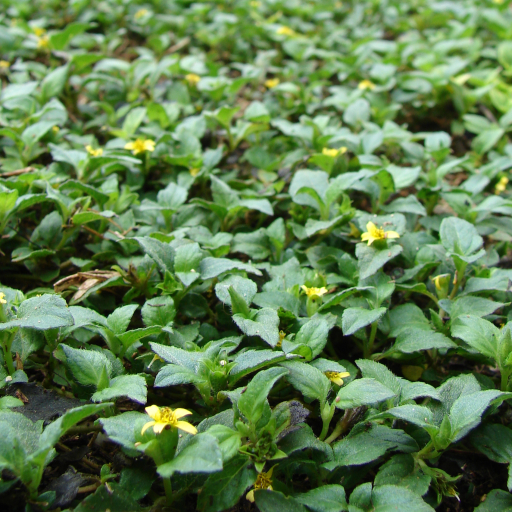
Plant Overview
Known affectionately as "Horseherb" or the "Straggler Daisy," this low-profile groundcover is the unsung hero of the shaded garden. While some perfectionist gardeners once treated it as a weed, many have now embraced it as the ultimate "lazy gardener's" turf alternative. It’s a resilient, native treasure that thrives where traditional grass gives up.
🔍 How to Identify
- 🌼 Teeny-Tiny Blooms: Miniature yellow flowers, barely a quarter-inch wide, that look like microscopic sunflowers tucked into the foliage.
- 🍃 Serrated Leaves: Small, oval-shaped green leaves with distinct "toothed" edges that grow in opposite pairs along the stem.
- 🌱 Creeping Habit: A prostrate, mat-forming growth style that stays very low to the ground, rarely exceeding 6 inches in height.
🏡 In Your Garden
- 🌳 The Shade Savior: Horseherb is famous for its ability to thrive in deep shade, making it the perfect solution for those bald spots under large oak or pecan trees where grass refuses to grow.
- 👣 Tough as Nails: It handles light foot traffic surprisingly well. It is often used as a "steppable" filler between flagstones or as a soft, green carpet for play areas.
- 🦋 Micro-Pollinator Hub: Though the flowers are small, they are a vital nectar source for small butterflies, such as the Dainty Sulphur, and various native tiny bees.
⚠️ Safety & Toxicity
- ✅ Safe for All: Horseherb is considered non-toxic to humans, cats, dogs, and horses (hence the name).
- 🌿 Skin Friendly: Unlike many lawn "weeds," it doesn't have thorns, prickles, or irritating saps, making it very gentle on bare feet and paws.
✨ Fun Fact
Horseherb is so resilient that it is often called "the plant that mows itself." Because it grows horizontally rather than vertically, you can go weeks or even months without needing to trim it, and it will still look like a lush, manicured lawn.

Detailed Care Instructions
| Humidity | Dry |
| Lighting | Part Sun |
| Difficulty | Medium |
| Hardiness Zones | 8A - 11 |
Here are some steps to grow Calyptocarpus vialis plants:
- Choose a suitable location: Calyptocarpus vialis plants thrive in partial shade to full shade. Find an area in your garden or landscape that receives limited sunlight throughout the day.
- Prepare the soil: Calyptocarpus vialis plants prefer well-draining soil. Amend the soil with organic matter like compost or leaf mold to improve drainage and fertility.
- Sow seeds: Calyptocarpus vialis plants are typically grown from seeds. Sow the seeds directly into the prepared soil during the spring or fall. Lightly press the seeds into the soil, but do not cover them as they require light to germinate.
- Water regularly: Keep the soil consistently moist, especially during the early stages of growth. Calyptocarpus vialis plants prefer slightly damp soil but can tolerate brief periods of dryness once established.
- Mulch: Apply a layer of organic mulch around the plants to help conserve moisture and suppress weed growth. This will also mimic their natural habitat and promote healthy growth.
- Prune if necessary: Calyptocarpus vialis plants have a spreading habit and can become invasive if not managed. Trim back any unwanted growth or to keep the plants within bounds. Pruning can also encourage denser growth.
- Maintenance: Fertilization is generally not required, as Calyptocarpus vialis plants adapt well to nutrient-poor soils. However, you can provide a balanced, slow-release fertilizer if desired. Remove any weeds that may compete with the plants for nutrients and water.
- Propagation: Calyptocarpus vialis plants can also be propagated through division or cuttings. Divisions should be done in spring or fall, while cuttings can be taken during the active growing season.
Remember that Calyptocarpus vialis plants are native to certain regions and may not be suitable for all climates. Ensure that they are well-suited to your area's conditions before attempting to grow them.

Place in a bright room that is sun drenched almost all day. Or directly in a south-facing window.

To properly water this plant, it is important to consider its soil and environmental conditions. The plant should be watered deeply but infrequently, allowing the soil to dry out slightly before watering again. It prefers well-draining soil and should be watered at the base of the plant rather than from above to avoid foliage getting wet, which can promote disease. The frequency of watering will depend on the level of humidity, temperature, and sunlight, so it is recommended to monitor these factors regularly to determine when to water. Overwatering should be avoided as it can lead to root rot and other issues.
To fertilize this plant, it is recommended to use a balanced, slow-release fertilizer with an equal ratio of nitrogen, phosphorus, and potassium. Apply the fertilizer in the spring, just before new growth appears, following the package instructions for the appropriate amount. Avoid fertilizing during the heat of summer or during drought conditions, as this may cause the plant stress. Instead, water deeply and regularly to maintain healthy growth.
The soil that is best suited for Calyptocarpus Vialis plant is a well-draining sandy loam soil mixture with organic matter mixed in. The pH of the soil should be neutral to slightly acidic (between 6.0 and 7.0). It is important to avoid using heavy clay soils or soils that are too compacted as they can impede drainage and prevent the roots from obtaining enough oxygen. Additionally, the plant prefers soil that is kept consistently moist but not waterlogged. Adequate drainage is important to prevent root rot. It is recommended to amend the soil with compost or organic matter regularly to improve soil quality and promote healthy growth.
To propagate this plant, you can take stem cuttings or root division. For stem cuttings, choose a healthy stem without any flowers or buds. Use sharp, clean scissors to cut off a 4-6 inch section of the stem, just below a node or leaf. Remove the lower leaves from the stem and dip the cut end in rooting hormone powder. Plant the stem in a well-draining soil mix and water it thoroughly. Keep the plant in a bright, warm location and mist it regularly to keep the soil moist. After a few weeks, roots should start to develop and you can transplant the new plant to a larger pot or into your garden.
To propagate Calyptocarpus Vialis plant by root division, dig up an established plant and separate the roots into smaller sections. Each section should have at least one stem and a few healthy roots. Plant the sections in a well-draining soil mix and water them thoroughly. Keep the new plants in a bright, warm location and mist them regularly to keep the soil moist. After a few weeks, the plants should start to establish themselves and you can transplant them to a larger pot or into your garden.
Common pests of the straggler daisy include Aphids, thrips, larvae, snails. Make a habit of checking your straggler daisy frequently for pests so that any infestations can be caught and managed early.








