Plant Overview
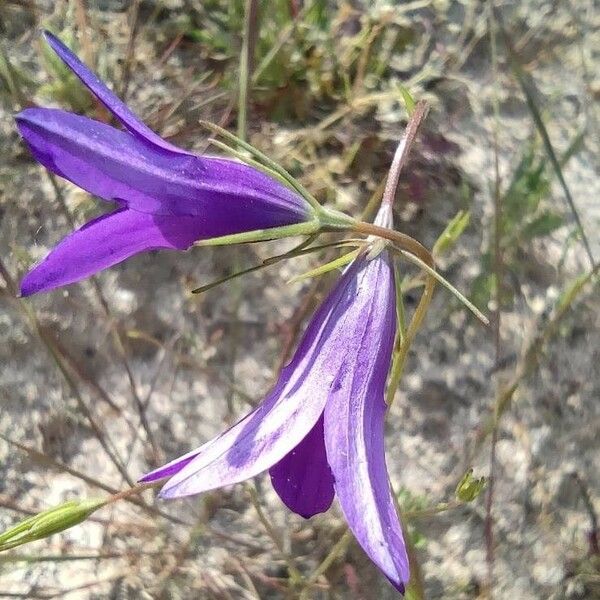
Often called the Portuguese Bellflower, this dainty wildflower paints the meadows and rocky cliffs of the Iberian Peninsula in shades of ethereal violet. It is a master of the "cottage-core" aesthetic, bringing a delicate, airy feel to any landscape. While it looks fragile, it is a rugged survivor that thrives in the thin, sun-baked soils of its Mediterranean home.
🔍 How to Identify
- 🔔 The Corolla: Look for deeply five-lobed flowers that form a classic "bell" shape. They are usually a vibrant violet-blue, often featuring a slightly lighter, almost white center.
- 🌿 Wiry Stems: The stems are remarkably thin and branching, giving the plant a "see-through" quality that allows it to blend beautifully with ornamental grasses.
- 🍃 Variable Foliage: The lower leaves are usually small and rounded with slightly toothed edges, while the upper leaves become narrower and more needle-like as they ascend the stem.
🏡 In Your Garden
- 🪨 Rocky Foundations: This plant is naturally adapted to scree and rocky slopes, meaning it absolutely hates "wet feet." If you plant it in heavy clay, it will likely struggle; it prefers gritty, fast-draining soil that mimics its cliffside origins.
- 🌬️ Self-Seeding Spirit: Because Campanula lusitanica is often a short-lived annual or biennial, it relies on dropping seeds to return each year. Avoid thick layers of mulch around the base, as the tiny seeds need contact with bare soil to germinate the following spring.
⚠️ Safety & Toxicity
- 🐾 Pet Friendly: Good news for animal lovers! Most members of the Campanula genus are considered non-toxic to cats, dogs, and horses.
- 👶 Gentle Nature: This plant is safe for curious children and does not possess stinging hairs or thorns, though its delicate stems are easily snapped by rough play.
✨ Fun Fact
📜 The Little Bell: The name Campanula is derived from the Latin word for "little bell." In folklore, bellflowers were sometimes called "Fairies' Thimbles," as it was believed that forest spirits used the blossoms as hats or drinking cups.

Detailed Care Instructions
Here are some steps to help you grow Campanula Lusitanica plant:
- Choose a suitable location: Campanula Lusitanica prefers full sun to partial shade. Select a spot in your garden that receives at least 4-6 hours of direct sunlight per day.
- Prepare the soil: The plant thrives in well-draining soil with a pH level between 6.0 and 7.5. Amend the soil with organic matter like compost to improve its quality and drainage.
- Planting: Dig a hole that is slightly larger than the root ball of the plant. Place the plant in the hole, ensuring the top of the root ball is level with the surrounding soil. Backfill the hole with the amended soil and gently firm it around the plant.
- Watering: Water the plant thoroughly after planting to settle the soil around the roots. Campanula Lusitanica prefers evenly moist soil, so regular watering is necessary, especially during dry spells. However, make sure to avoid overwatering, as it may lead to root rot.
- Mulching: Apply a layer of organic mulch, such as wood chips or shredded bark, around the base of the plant. This helps retain moisture, suppress weed growth, and regulate soil temperatures.
- Pruning: Trim back any dead or damaged foliage as needed to maintain a tidy appearance. Deadhead spent flowers to encourage more blooms.
- Fertilizing: Campanula Lusitanica generally does not require heavy fertilization. However, you can apply a balanced, slow-release fertilizer in early spring to promote healthy growth and blooming.
- Support: As the plant grows, it may require support to prevent its stems from flopping or breaking. Insert a plant stake or a small garden trellis near the base of the plant and tie the stems to the support using soft garden twine.
- Dividing: After a few years, Campanula Lusitanica may become crowded and benefit from division. Dig up the plant in early spring or fall, carefully separating the clumps into smaller sections with roots attached. Replant them at the same depth in well-prepared soil.
Remember to check for any specific care instructions for your particular Campanula Lusitanica variety, as some cultivars may have slightly different requirements.
To water this plant, you should thoroughly dampen the soil around its base. It is important to not oversaturate the soil, so checking the moisture level of the soil periodically is recommended. The plant prefers moist but well-draining soil, so make sure to allow excess water to drain away properly. Watering should be done on a consistent schedule, but the frequency may vary depending on the plant's environment and weather conditions. Avoid getting water on the foliage to prevent fungal growth.
For optimal growth and health of this plant, it is recommended to fertilize it during the growing season with a balanced, water-soluble fertilizer every 2-3 weeks. Use half the recommended dosage to avoid burning the roots. Fertilize early in the morning or late in the day when temperatures are cooler and the sun is less intense. For best results, water the plant well before fertilizing to ensure the nutrients are absorbed properly. Avoid fertilizing during dormancy periods.
Campanula Lusitanica prefers well-drained soil that is rich in organic matter. It can thrive in a variety of soil types, including sandy, loamy, and clay soils, as long as they are well-draining. The pH level of the soil should fall within the range of slightly acidic to neutral (between 6.0 and 7.5) for optimal growth. It is important to avoid overwatering Campanula Lusitanica and ensure that the soil does not become waterlogged, as this can cause root rot. A layer of mulch can be added to the soil surface to help retain moisture and regulate soil temperature.
Campanula Lusitanica is a type of plant that can be propagated through several methods, including division, cuttings, and seeds.
Division involves separating a part of the mature plant, including the roots, and replanting it in a separate location. This method is most effective in the spring or fall when the plant is not actively growing.
Cuttings involve taking a stem cutting from the parent plant and rooting it in a growing medium such as soil or water. This method is most effective in the early summer when the plant is actively growing.
Seeds can also be used to propagate Campanula Lusitanica. Seeds can be collected from the parent plant and sown in a suitable growing medium. The seeds should be sown in early spring or early fall.
Regardless of the method used, it is essential to provide adequate growing conditions, including ample sunlight, moisture, and nutrients, to ensure the successful growth and development of the propagated Campanula Lusitanica plant.








