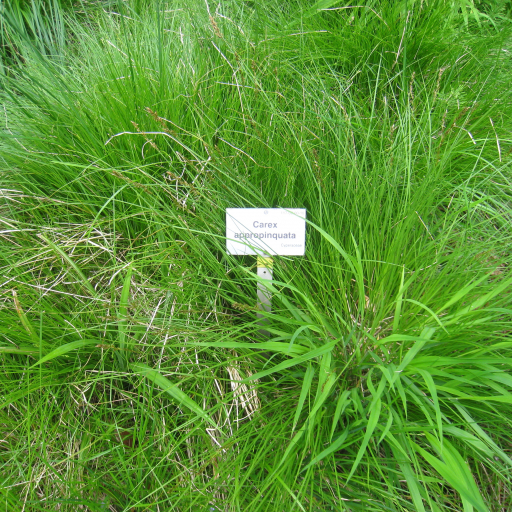
Plant Overview
Often called the Fibrous Tussock-sedge, this plant is a master of structure and stability in the marshy wetlands of Europe and Asia. Unlike sprawling grasses, it grows in tight, dense mounds known as "tussocks," which can eventually form raised islands in standing water. It plays a vital role in wetland ecology, acting as a mini-highrise for smaller plants and insects seeking a dry spot in the swamp.
🔍 How to Identify
- 🌿 Growth Habit: It forms very dense, compact clumps (tussocks) that can become quite tall and sturdy over many years.
- 📐 The Stem: Like most sedges, its stems are distinctly triangular and feel rough to the touch near the flowering head.
- 🧶 The "Fibrous" Base: One of its most identifying features is the dark brown or blackish leaf sheaths at the base, which fray into a thick, hair-like fibrous mat as they age.
- 🌾 The Inflorescence: It produces brownish, spike-like flower clusters that are densely packed together, appearing more "twiggy" than soft.
🏡 In Your Garden & Landscape
- 💧 Wetland Specialist: This is not a plant for a dry rockery. It thrives in "fens" or lime-rich marshes and is perfect for the edges of a garden pond or a dedicated bog garden.
- 🌱 Soil Preference: It specifically loves "base-rich" or alkaline conditions. If your soil is very acidic, this sedge may struggle to establish its characteristic tall mounds.
- 🐜 Habitat Creator: In a home landscape, it provides excellent overwintering sites for beneficial predatory beetles and spiders, helping with natural pest control.
⚠️ Safety & Toxicity
- ✅ Status: Generally considered non-toxic to humans, cats, and dogs.
- ✂️ Sharp Edges: Like many sedges, the leaf blades contain silica and can be quite sharp. Handling them without gloves can occasionally result in minor "grass cuts" on the skin.
- 🐄 Livestock: While not poisonous, it is relatively unpalatable to most livestock because of its tough, fibrous texture.
✨ Fun Fact
The specific name appropinquata comes from the Latin word for "approaching" or "drawing near." This is because early botanists felt it was visually "approaching" the appearance of its cousin, the Greater Tussock-sedge (Carex paniculata), though it remains a distinct species of its own!

Detailed Care Instructions

Place in a bright room that is sun drenched almost all day. Or directly in a south-facing window.

To water this plant, make sure to evenly moisten the soil at the base of the plant. Avoid watering the foliage, as this can lead to disease and pest problems. Use a watering can to gently pour water onto the soil, and water thoroughly until it begins to drain out of the bottom of the pot or container. Be sure not to overwater, as this can lead to root rot and other problems. Monitor the soil moisture level regularly, and adjust your watering schedule accordingly. Additionally, it is recommended to use a well-draining soil mix to avoid waterlogging of the plant roots.
For optimum growth and health, the recommended soil type for this particular plant is one that is well-draining yet retains moisture. It should be fertile and have a slightly acidic pH level, ranging from 5.5 to 6.5. The soil composition should ideally be a mix of organic matter, such as peat moss or compost, and a good-quality garden soil. Additionally, it is important to ensure that the soil is free from any contaminants or pollutants that may harm the plant. It is also advisable to top-dress the soil annually with a layer of organic matter to promote healthy growth and enhance overall soil quality.








