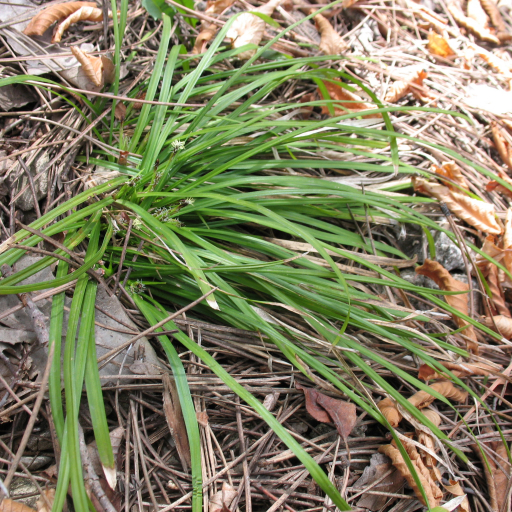
Plant Overview
Known as the Long-stalked Sedge, this unassuming green tuft is one of the true "harbingers of spring" in North American woodlands. While other plants are still dormant, Carex pedunculata is often already blooming, providing a splash of life against the thawed earth. Its name comes from the unusually long stalks (peduncles) that hold its flower spikes, making it a favorite for woodland gardeners looking for early-season texture.
🔍 How to Identify
- 🍃 The "Red Socks": One of the easiest ways to identify this sedge is by looking at its base; the leaf sheaths near the ground are a distinct, dark reddish-purple color.
- 🌿 Shiny Foliage: The leaves are narrow, evergreen to semi-evergreen, and have a slight glossy sheen that helps them stand out in the leaf litter.
- 🌾 Elevated Seeds: Unlike many sedges where seeds are tucked away, these seed heads (perigynia) are held on long, slender, drooping stalks that emerge from the center of the clump.
🏡 In Your Garden
- 🌑 Shade Specialist: This plant is a hero for dry shade. It thrives under the canopy of deciduous trees like Maples and Oaks, where many other grasses would struggle to survive.
- 🐢 Slow and Steady: It is a clumping sedge rather than a "runner," meaning it won't take over your garden. It stays in neat, tidy mounds, making it excellent for edging woodland paths.
- 🍂 Leaf Litter Lover: It prefers soil rich in organic matter. Instead of cleaning up every fallen leaf, let some decompose around the base of the plant to mimic its natural forest home.
⚠️ Safety & Toxicity
- ✅ Non-Toxic: Carex pedunculata is generally considered non-toxic to humans, dogs, and cats. It is a safe choice for households with curious pets.
- 🔪 Sharp Edges: Like many sedges, the leaves have microscopic serrations. While not dangerous, they can cause "grass cuts" if handled roughly, so gloves are recommended for heavy maintenance.
✨ Fun Fact
This plant uses a "hired crew" to move its seeds! The seeds have a small, oily attachment called an elaiosome that is irresistible to ants. The ants carry the seeds back to their nests, eat the oily treat, and "discard" the seed in their nutrient-rich waste tunnels—effectively planting the sedge in a perfect nursery.

Detailed Care Instructions
To grow Carex Pedunculata (also known as pendulous sedge), follow these steps:
- Choose the right location: Carex Pedunculata prefers partial shade to full shade, but it can tolerate some sun. It also thrives in moist, well-draining soil. Make sure to select a spot in your garden or yard that meets these criteria.
- Prepare the soil: Before planting, prepare the soil by loosening it with a garden fork or tiller. Remove any weeds or grass from the area and make sure the soil is well-draining. If the soil is heavy clay or sandy, consider amending it with organic matter, such as compost or aged manure, to improve its texture and fertility.
- Planting: Carex Pedunculata can be planted from seeds or divisions. To plant from seeds, sow them directly on the soil surface and lightly press them into the ground. If planting from divisions, dig a hole that is slightly wider and deeper than the root ball. Place the plant in the hole and backfill with soil, gently firming it around the roots.
- Watering: After planting, water the Carex Pedunculata thoroughly to ensure the soil is evenly moist. Keep the soil consistently moist, but not waterlogged, throughout the growing season. Add mulch around the plant to help retain moisture and suppress weed growth.
- Fertilizing: Carex Pedunculata generally does not require heavy fertilization. However, you can apply a balanced, slow-release fertilizer in early spring to give the plant a boost. Follow the manufacturer's instructions for application rates.
- Maintenance: Regularly check the soil moisture levels and water as needed. During hot and dry periods, you may need to water more frequently. Additionally, remove any weeds that may compete with the plant for nutrients and water. Divide the plant every few years to prevent it from becoming crowded or to propagate new plants.
- Pruning: Carex Pedunculata does not require much pruning other than removing any dead or damaged foliage. However, if the plant becomes overgrown or untidy, you can cut back the entire plant to a few inches above ground level in early spring to promote fresh growth.
By following these steps and providing the appropriate conditions, you can successfully grow Carex Pedunculata in your garden or landscape.

Place in a dark room with little light, like a dark bedroom or a spot far away from a window or directly in a north-facing window.

To water this plant, you should first check the soil moisture level by inserting a finger into the soil. If it feels dry to the touch, you should water the plant thoroughly. Make sure to direct the water towards the base of the plant and avoid getting water on the leaves. The plant prefers consistently moist soil, but be careful not to overwater it as this can lead to root rot. Consider using a watering can or spray bottle to deliver water slowly and evenly to the soil. It is important to avoid leaving standing water in the saucer beneath the pot, as this can also contribute to root rot. Finally, make sure to monitor the moisture level of the soil regularly and adjust your watering schedule as needed.
The best time to fertilize this plant is in the spring, when it begins to actively grow again. Use a balanced, slow-release fertilizer with a ratio of 10-10-10. Apply the fertilizer according to the package instructions, making sure to avoid getting any on the leaves or roots of the plant. Water the plant thoroughly after fertilizing to help distribute the nutrients. Avoid over-fertilizing, as this can cause the plant to grow too quickly and become less healthy overall.
Carex Pedunculata is a type of perennial plant that prefers moist and well-drained soil for optimal growth and development. The soil should have a rich, loamy texture with plenty of organic matter to support the plant's nutrient requirements. Additionally, the soil pH should be slightly acidic to neutral, ranging from 5.5 to 7.5.
It is recommended to use a quality potting mix that contains peat moss, perlite, and vermiculite to ensure good drainage and aeration. The soil mixture should be supplemented with organic fertilizer to provide adequate nutrients to the plant. On the other hand, if the plant is being grown in the ground, it is recommended to amend the soil with compost or aged manure to improve soil quality.
In general, it is important to avoid using heavy or clay soils that tend to retain water, as they can lead to root rot and other soil-borne diseases. Instead, choose a well-draining soil that allows excess water to drain away from the root system. Overall, selecting the right soil for Carex Pedunculata is essential to ensure the plant thrives and produces healthy foliage.
Carex pedunculata can be propagated by division in spring or early autumn. First, dig up the entire plant and gently separate the clumps into smaller sections, making sure each section has roots and green stems.
Then, plant each section in soil that is moist and well-draining, ensuring that the plant is not too deep. Water the newly planted sections thoroughly and keep the soil moist until the plant is well-established. Carex pedunculata can also be propagated by seed, which should be sown in the spring.








