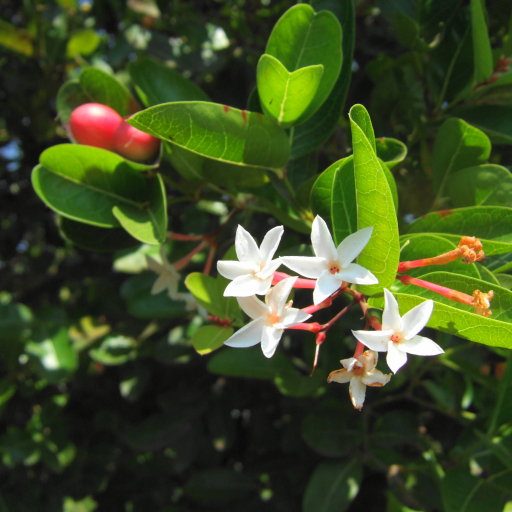
Plant Overview
Meet the Karanda, a hardy evergreen shrub often called the "Bengal Currant" or "Christ’s Thorn." Native to the Indian subcontinent, it is famous for its fierce, protective thorns and its stunning transformation from delicate white blossoms into dark, jewel-like berries. In many parts of the world, it is the ultimate "living fence," prized for being virtually impenetrable to intruders.
🔍 How to Identify
- 🌿 The Leaves: Small, oval, and exceptionally glossy. They grow in opposite pairs along the stem, maintaining a vibrant deep green color throughout the year.
- ⚔️ The Thorns: Long, sharp, and often forked. These are the plant's signature defense mechanism, growing directly from the branches to protect the developing fruit.
- 🌸 The Blooms: Clusters of star-shaped white flowers that look and smell remarkably like Jasmine, usually appearing in the spring and early summer.
- 🍒 The Berries: Round fruits that start green, turn a brilliant "lipstick" pink/red, and finally ripen into a deep, glossy purple-black.
🏡 In Your Garden
- 🛡️ Security Specialist: Because of its dense growth and sharp thorns, it makes an excellent privacy hedge. It thrives in well-drained soil and is surprisingly drought-tolerant once the root system is established.
- ✂️ Pruning Strategy: It responds very well to shaping, which is necessary to keep its sprawling habit under control. Always wear thick leather gardening gloves when handling this plant to avoid the formidable spines.
- ☀️ Sun & Heat: This plant is a sun-lover. To get a heavy harvest of berries, place it in the brightest spot available. It handles intense tropical heat with ease but dislikes "wet feet" or waterlogged roots.
⚠️ Safety & Toxicity
- 🥛 Milky Sap: Like many members of its family, the plant produces a white, milky latex (sap) when a leaf or stem is broken. This sap can cause mild skin irritation or dermatitis in sensitive individuals.
- 📍 Physical Hazard: The primary safety concern is the thorns. They are incredibly sharp and can easily puncture skin or clothing, so avoid planting it near narrow walkways or children's play areas.
- 🐾 Pet Safety: While the ripe fruit is generally safe, the unripe fruit and the sap are acidic and can cause stomach upset if chewed by curious pets.
✨ Fun Fact
The Karanda is known as the "Pickle Plant" in many cultures. Because the unripe green berries are intensely sour and acidic, they are used as a natural substitute for lemons or vinegar in spicy Indian chutneys and pickles!

Detailed Care Instructions
| Humidity | Normal |
| Lighting | Full Sun |
| Difficulty | Medium |
| Hibernation | Cold Period |
| Temperature | 18°C - 30°C |
| Hardiness Zones | Min 5 |
To grow a Carissa Carandas plant, also known as karonda or karaunda, you can follow these steps:
- Climate and Soil: Ensure you are in a suitable climate for growing the plant. Carissa Carandas thrives in tropical and subtropical zones. It prefers well-draining sandy loam soil but can adapt to a range of soil types.
- Propagation: You can propagate the plant from seeds or cuttings. Sow the seeds in a nursery bed or directly in pots filled with a well-draining potting mix. If using cuttings, take 6 to 8-inch-long semi-hardwood cuttings from a healthy parent plant and treat the base with rooting hormone before planting them in a potting mix.
- Planting: If starting from seed, sow them at a depth of about 1/2 inch in the nursery bed or potting mix. After germination, transplant the seedlings into individual pots or to the permanent planting location, leaving a space of around 6 to 8 feet between each plant.
- Sunlight: Ensure the Carissa Carandas plants receive full sun to partial shade. Adequate sunlight is essential for proper growth and fruiting.
- Watering: Water the plants regularly, maintaining slightly moist soil. Proper irrigation is important during the initial stages of growth. Once established, the plant can tolerate mild drought.
- Fertilizer: Apply a balanced fertilizer during the growing season to provide essential nutrients to the plant. Use a slow-release organic fertilizer or a well-balanced water-soluble fertilizer according to the manufacturer's instructions.
- Pruning: Prune the plant regularly to maintain its shape and remove any dead, damaged, or diseased branches. This will encourage healthy growth and fruiting.
- Pests and Diseases: Keep an eye out for common pests like aphids, mealybugs, whiteflies, or scale insects. Treat them promptly with insecticidal soap or neem oil. Watch for any signs of diseases such as leaf spots or powdery mildew, and take necessary steps to prevent or treat them.
- Harvesting: The Carissa Carandas plant usually begins fruiting within 2-3 years. Harvest the fruit when it reaches maturity, which is indicated by its red color and slightly soft texture. Use a sharp knife or pruners to remove the fruits carefully.
With proper care and suitable growing conditions, your Carissa Carandas plant should grow and produce abundant fruit.

Place in a window with dappled sun or a spot in the middle of a room. Or directly in a window facing west or east.

Carissa carandas is a type of plant that requires regular watering to thrive. To water it, fill up a watering can with room temperature water. Before watering, check the soil with your fingers to determine its moisture level. If the soil feels dry to the touch, pour water onto the soil around the base of the plant, making sure to avoid getting water on the leaves. Allow the water to soak into the soil. Repeat this process once a week, or more frequently if the soil feels particularly dry. Be careful not to overwater the plant, as this can lead to root rot.
To fertilize this plant, use a balanced fertilizer with equal ratios of nitrogen, phosphorus, and potassium. Apply the fertilizer during the growing season, which is usually from spring to autumn. Dilute the fertilizer with water and apply it to the soil around the base of the plant. Avoid fertilizing during the dormant season, which is usually during winter. Over-fertilizing may lead to excessive growth and weaken the plant, so follow the instructions carefully.
Carissa carandas is a plant that requires well-draining soil with good fertility. The ideal soil for Carissa carandas is slightly acidic, with a pH range of 5.5 to 6.5. It prefers nutrient-rich soil that is well-draining, and has a good mix of sand, silt, and clay. The soil should contain organic matter that will help to retain moisture and provide nutrients to the plant. A mixture of loamy soil, compost, and sand is an excellent option for Carissa carandas. It is also essential to ensure proper drainage by adding some coarse sand or gravel to the soil mixture. This will help to prevent waterlogging, which can lead to root rot and other diseases. The soil should be moist, but not waterlogged, and should be checked frequently to ensure that it is not too dry or too wet. A proper soil mix will help the Carissa carandas plant to grow healthy and strong, and produce abundant fruits.
First, ensure that you have a healthy and mature plant to propagate from. Select a stem that is long and healthy, and cut it at a 45-degree angle just below a leaf node. Remove the leaves from the lower half of the stem.
Prepare a pot with a well-draining soil mix. Dip the cut end of the stem in rooting hormone powder and insert it 1-2 inches deep into the soil mix. Water the soil well and cover the pot with a plastic bag to maintain humidity.
Place the pot in a warm and bright location, but out of direct sunlight. Mist the soil and stem regularly to keep it moist, but not waterlogged. After a few weeks, check for root growth by gently tugging on the stem. If there is resistance, roots have formed.
Remove the plastic bag and continue to care for the young plant by keeping the soil moist and providing regular, but not direct, sunlight. The young plant can be repotted into a larger pot or outside once it has grown and established itself.








