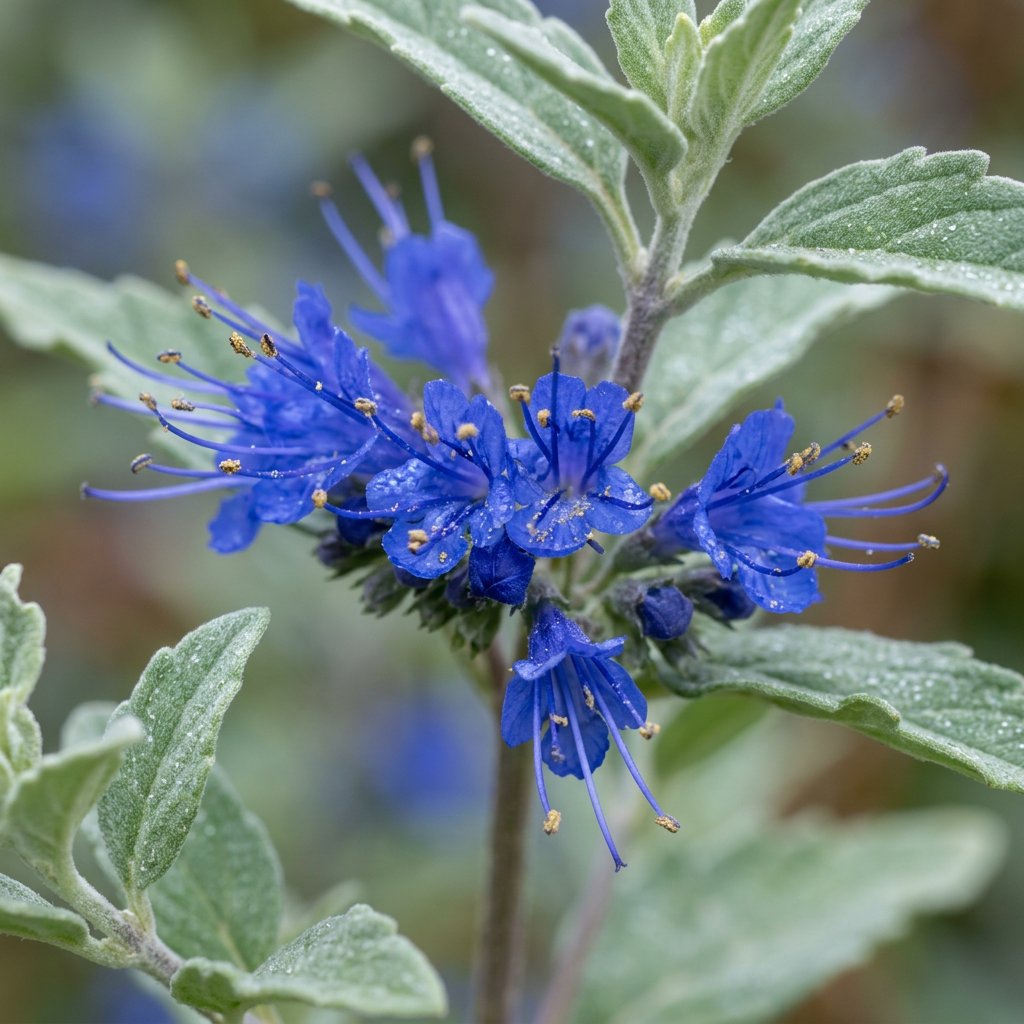
Plant Overview
Often called "Bluebeard" or "Blue Mist Shrub," this enchanting hybrid is a late-summer showstopper that brings a cooling cloud of azure to the garden just as other flowers begin to fade. It originated as a "chance seedling" in a garden in Clandon, England, in the 1930s. Its airy, ethereal appearance makes it a favorite for cottage gardens and those looking to support pollinators during the transition into autumn.
🔍 How to Identify
- ☁️ Cloud-like Flowers: Features frothy clusters of vibrant blue to violet flowers that bloom in the "axils" (where the leaf meets the stem), creating a tiered, misty look.
- 🍃 Aromatic Foliage: The lance-shaped, grayish-green leaves release a pleasant, spicy, or eucalyptus-like scent when bruised or brushed against.
- 🎨 Textured Undersides: If you flip a leaf over, you’ll notice a distinct silvery-white underside, which adds a shimmering effect when the wind blows.
- 🌿 Growth Habit: It grows as a low-mounded, deciduous shrub, typically reaching 2 to 3 feet in height and width.
🏡 In Your Garden
- ✂️ The Spring Haircut: Bluebeard blooms on "new wood" (the growth produced in the current season). For the best flower display, cut the plant back hard to about 6–12 inches from the ground in early spring just as new buds appear.
- ☀️ Sun & Drainage: This plant is a sun-worshipper and thrives in bright light. It is notoriously sensitive to "wet feet," meaning it will struggle or rot in heavy clay. It prefers rocky or sandy soils where water drains away quickly.
- 🦋 The Pollinator Pub: Because it blooms in late summer and fall, it serves as a vital refueling station for bees, butterflies, and hummingbirds preparing for the changing seasons.
⚠️ Safety & Toxicity
- ✅ Generally Safe: Caryopteris x clandonensis is widely considered non-toxic to humans, dogs, and cats. It is a very "user-friendly" addition to family landscapes.
- 🧤 Skin Sensitivity: While not poisonous, the aromatic oils in the leaves can occasionally cause mild skin irritation or a "contact rash" in individuals with very sensitive skin. Wearing gloves while pruning is a good practice.
✨ Fun Fact
The name "Bluebeard" comes from the long, fringed stamens that protrude from the tiny flowers, which many gardeners think look like the wispy whiskers of a blue-colored beard!

Detailed Care Instructions
Here are some steps to help you grow Caryopteris X Clandonensis plant:
- Choose the right location: Caryopteris plants prefer full sun to grow well. Select a location in your garden that receives at least 6-8 hours of sunlight each day.
- Soil preparation: Caryopteris plants favor well-draining soil. Amend the soil with organic matter, such as compost, to improve drainage and fertility. This will ensure a healthy growing environment for your plant.
- Planting: Dig a hole that is slightly larger than the root ball of the Caryopteris plant. Place the plant into the hole, making sure it is level with the ground or slightly higher. Gently backfill the hole with soil and pat it down to remove any air pockets.
- Watering: After planting, water the Caryopteris thoroughly to settle the soil. Provide regular watering during the first growing season to help establish the plant's root system. Once established, Caryopteris is fairly drought-tolerant and does not require excessive watering.
- Mulching: Apply a layer of organic mulch around the base of the plant to help conserve moisture, suppress weeds, and regulate soil temperature.
- Pruning: Caryopteris plants can be pruned in early spring before new growth begins or after flowering. Pruning helps maintain a compact, bushy shape and encourages more blooms. Remove dead or damaged branches, as well as any crossing branches.
- Fertilizing: Apply a balanced, slow-release fertilizer in early spring to promote healthy growth and flowering. Follow the instructions on the fertilizer packaging for application rates.
- Pests and diseases: Caryopteris plants are generally resistant to pests and diseases. However, they may occasionally be susceptible to aphids or powdery mildew. Monitor your plant regularly and treat any issues accordingly.
- Propagation: Caryopteris can be propagated by taking softwood cuttings in late spring or semi-hardwood cuttings in summer. Follow standard propagation techniques for success.
Remember to check your specific variety's requirements as there might be some slight variations. Happy gardening!

Place in a bright room that is sun drenched almost all day. Or directly in a south-facing window.

Caryopteris X Clandonensis is a plant that requires moderate watering. The best way to water this plant without over-watering it is to wait until the soil has become slightly dry before watering it again. The plant should be watered deeply, but not excessively, as this can lead to root rot and other problems. One way to ensure that the plant receives the right amount of moisture is to water it deeply once or twice a week, depending on the weather conditions and the soil type. It is also important to avoid getting water on the plant's leaves, as this can lead to fungal growth and other problems. Finally, it is a good idea to add a layer of mulch around the base of the plant to retain moisture and keep the soil cool. By following these simple tips, it is possible to keep a Caryopteris X Clandonensis plant happy and healthy for years to come.
To properly fertilize this plant, we recommend using a low-nitrogen, phosphorus-rich fertilizer. It is important to apply the fertilizer in the early spring before new growth appears and again in the early summer. Use a half-strength solution when applying the fertilizer to avoid burning the plant's roots. Be sure to water the plant thoroughly before and after fertilization. Avoid over-fertilizing as this can lead to excessive foliage growth and a decrease in flowering. Lastly, always read and follow the instructions on the fertilizer label.
Caryopteris X Clandonensis plant prefers well-draining soil that is rich in organic matter and has a neutral to slightly alkaline pH level. It thrives in soil that is moist but not waterlogged, with a sandy loam texture. The best soil for this plant should be able to retain some moisture, but also allow for proper drainage to prevent waterlogging. It is important to avoid heavy clay soils, which can often become compacted and limit root growth. Additionally, this plant prefers soil that has been amended with compost or other organic matter to improve its structure and fertility.
To propagate this plant, you will need to collect stem cuttings from a mature plant. Choose a healthy stem with several pairs of leaves and make a clean cut just below a leaf node. Remove any leaves from the lower half of the stem, but leave a few at the top. Dip the cut end of the stem into rooting hormone powder and plant it in a well-draining potting mix. Keep the soil moist and the cutting in bright, indirect light. It may take several weeks for roots to form. Once the cutting has established roots, it can be transplanted into a larger container or planted in the ground.








