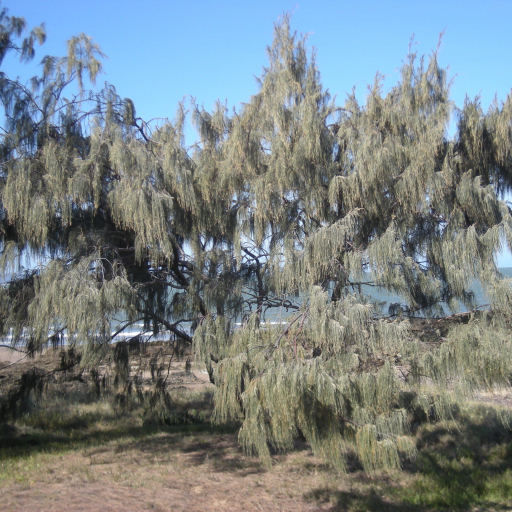
Plant Overview
Commonly known as the Whistling Pine or Horsetail She-oak, this tree is a master of disguise. While it looks exactly like a conifer, it is actually a flowering deciduous tree that has evolved to mimic pine needles to survive harsh coastal winds. It gets its name from the Latin equisetum (meaning "horsetail") due to the flowing, mane-like appearance of its branches.
🔍 How to Identify
- 🌿 "Needles": What look like long pine needles are actually thin, jointed branchlets. These green "twigs" perform photosynthesis for the tree.
- 🍂 True Leaves: If you look very closely at the joints of the branchlets, you’ll see a ring of tiny, microscopic teeth. These are the tree’s actual leaves!
- 🌰 Pseudo-Cones: It produces small, woody, round fruits that resemble pine cones. They are about half an inch long and contain tiny winged seeds (samaras).
🏡 In Your Garden
- 🏖️ Coastal Warrior: This is one of the best plants for seaside homes. It is incredibly salt-tolerant and acts as a "living fence" or windbreak, protecting your more delicate garden plants from salty sea spray.
- 🧪 Self-Fertilizing: The Whistling Pine has a special relationship with soil bacteria that allows it to "fix" nitrogen. This means it can thrive in poor, sandy soils where almost nothing else will grow.
- 🚫 Space Hog: Be careful about what you plant underneath it. The fallen branchlets create a thick carpet that can suppress the growth of other plants—a natural way the tree reduces competition for water.
⚠️ Safety & Toxicity
- ✅ General Safety: This tree is considered non-toxic to humans, dogs, and cats. It is a safe choice for family backyards.
- 🦶 Physical Hazard: The fallen woody "cones" are quite hard and prickly. If you have a specimen near a walkway, keep it swept to avoid stepping on them with bare feet.
- 🌾 Allergy Note: During its flowering season, the tree releases fine pollen that may cause mild hay fever in sensitive individuals.
✨ Fun Fact
The "whistling" in its name comes from the distinct, eerie sighing sound the wind makes as it passes through the fine branchlets. In many Pacific cultures, this sound was historically believed to be the voices of spirits or ancestors whispering through the trees.

Detailed Care Instructions
To grow Casuarina equisetifolia, also known as Australian Pine or Whistling Pine, you can follow the steps below:
- Climate: Ensure that you live in a suitable climate for Casuarina equisetifolia. It thrives in tropical and subtropical regions with temperatures between 68°F to 95°F (20°C to 35°C).
- Soil: Casuarina equisetifolia prefers well-draining soil. It can tolerate a wide range of soil types, including sandy, loamy, and even saline soils. However, it does not tolerate waterlogged or heavy clay soils.
- Sunlight: Choose a location that receives full sun to partial shade for planting your Casuarina equisetifolia. It generally requires at least 6 hours of direct sunlight per day.
- Planting: Dig a hole slightly larger than the root ball of the plant. Place the plant in the hole and backfill it with soil, firming it gently around the roots. Make sure the base of the trunk is level with the soil surface. Space individual trees at least 15-20 feet apart.
- Watering: Initially, keep the soil uniformly moist but not waterlogged. Once established, Casuarina equisetifolia is quite drought-tolerant and can survive on rainfall alone. Watering during extended dry periods can help them grow better.
- Fertilization: Apply a slow-release balanced fertilizer in spring to provide essential nutrients to the plant. Follow the instructions on the fertilizer packaging for the recommended dosage.
- Pruning: Casuarina equisetifolia does not require regular pruning. However, you can trim or shape it if desired. Remove any dead or damaged branches to maintain a healthy appearance.
- Protection: Mulch around the base of the plant to help retain moisture, suppress weed growth, and regulate soil temperature. Protect young plants from strong winds until they are well-established.
- Maintenance: Check the plant regularly for pests and diseases. Common problems include scale insects and root rot. Treat any issues promptly to prevent further damage.
Casuarina equisetifolia is a fast-growing tree that can reach heights up to 100 feet (30 meters) when mature. It is popular for its feathery foliage, tolerance to coastal conditions, and ability to provide windbreaks.

Place in a bright room that is sun drenched almost all day. Or directly in a south-facing window.

To water this plant, you should thoroughly soak the soil around it to a depth of at least six inches. Allow the soil to dry out slightly between watering, checking the moisture level by inserting a finger into the soil. Watering frequency will depend on factors such as the environment, temperature, humidity, and drainage conditions. It is essential to avoid overwatering, as this can lead to root rot and other problems. Additionally, make sure to water at the base of the plant rather than from overhead, as this can promote fungal growth and damage the foliage.
To fertilize the plant, use a slow-release granular fertilizer with a 3:1:2 NPK ratio. Apply the fertilizer evenly around the drip line of the tree and water thoroughly. Repeat every three months during the growing season. Avoid fertilizing during the dormant season.
The ideal soil for this particular plant should be well-draining and non-alkaline. It should contain a mix of organic and inorganic matter to provide the necessary nutrients for growth. The soil pH should range from slightly acidic to neutral. It should also be able to retain moisture without being too waterlogged as this can lead to rotting of the roots. Adding sand or perlite to the soil mixture can improve the drainage and prevent waterlogging. The plant also requires good aeration, so compact soils should be avoided. Furthermore, the type of soil can depend on the location and climate, as these plants are able to tolerate a range of soil conditions.
Casuarina equisetifolia is a plant that can be propagated through several methods like stem cuttings, air layering, and seeds. To propagate via stem cuttings, you will need to take a healthy branch cutting that is at least 10-15 cm long with 3-4 leaves. Remove the lower leaves and dip the stem bottom into the rooting hormone powder. Then, plant the stem cutting in a pot filled with moist soil mix and cover it with a clear plastic bag. Keep the pot in indirect sunlight, water it regularly, and remove the plastic cover once the cutting shows signs of new growth.
For air layering, choose a healthy branch and create a girdle by removing the bark in a 2-3 cm wide strip around the branch. Then, wrap that portion with a small amount of moist sphagnum moss and cover it with a clear plastic bag. Once the roots form, cut the branch below the ball of roots and plant it in a pot with well-draining soil.
Propagation through seeds is quite easy. Simply collect the seeds from mature cones, soak them for a day or two, and sow them in small individual pots filled with well-draining soil mix. Keep the soil moist and place the pots in a warm, bright spot. The seeds should germinate in about 7-10 days. Once the seedlings are large enough, they can be transplanted into bigger pots or directly into the ground.








