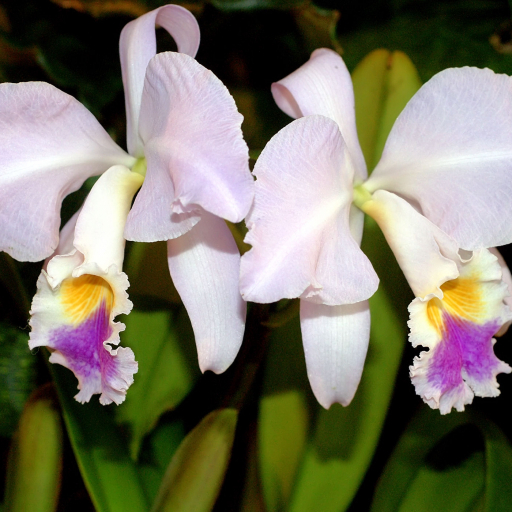
Plant Overview
Known as the "Mendel’s Cattleya," this majestic Colombian orchid is often hailed as one of the most elegant species in the Cattleya genus. During the Victorian era's "Orchidalia" craze, it was a prized possession among European collectors for its massive, ethereal blooms. Today, it remains a favorite for hobbyists who enjoy a plant that bridges the gap between wild mountain beauty and sophisticated indoor elegance.
🔍 How to Identify
- 🌸 The Bloom: These flowers are impressively large (up to 7 inches across) with petals that range from a delicate, snowy white to a faint, blushing lavender.
- 🎨 The Lip: The most striking feature is the labellum (lip), which typically boasts a rich crimson or deep purple splash at the front, contrasted by a bright yellow or gold "throat" inside.
- 🍃 The Foliage: This is a unifoliate orchid, meaning each sturdy, club-shaped pseudobulb supports only one thick, leathery, evergreen leaf.
🏡 In Your Garden
- ⛰️ Highland Heritage: Native to the Eastern Cordillera of the Colombian Andes, this orchid thrives in bright, indirect light. It prefers the "goldilocks" zone of temperature—warm days but significantly cooler nights to mimic its mountain home.
- 💧 The "Dry Rest" Secret: Unlike many tropical plants, Cattleya mendelii requires a distinct resting period in the winter. Reducing water during the colder months is the secret trigger that tells the plant it is time to produce its spectacular spring flowers.
- 🪴 Airy Roots: Because it grows on trees or rocks in the wild (epiphytic/lithophytic), it will suffocate in regular potting soil. It requires a chunky orchid bark mix that allows its thick, white roots to "breathe" after every watering.
⚠️ Safety & Toxicity
- ✅ Status: Non-Toxic.
- 🐾 Details: This orchid is generally considered safe and non-toxic for cats, dogs, and horses. While it won't harm your pets if they take a curious nibble, it is best kept out of reach to protect the delicate blooms and ensure no fertilizers or pesticides are ingested.
✨ Fun Fact
This species was named in the 1870s to honor Sir Samuel Mendel, a famous English orchid enthusiast. Interestingly, it is one of the few large-flowered Cattleyas that can produce up to four massive flowers on a single stem, making it a "heavyweight champion" of the orchid show circuit!

Detailed Care Instructions
| Humidity | High |
| Lighting | Part Sun |
| Difficulty | Easy |
| Hibernation | Cold Period |
| Temperature | 14°C - 30°C |
| Hardiness Zones | 11 - 12 |
To grow Cattleya mendelii, also known as the Mendel's Cattleya, follow these steps:
- Temperature: Cattleya mendelii grows best in intermediate to warm temperatures, between 60°F (15°C) and 80°F (27°C) during the day, and a drop of 10°F (6°C) at night to induce flowering.
- Light: Provide bright, indirect light for Cattleya mendelii. They can tolerate a few hours of direct sunlight in the morning or late afternoon, but be careful not to expose them to intense midday sun, as it may damage the leaves.
- Watering: Cattleya mendelii prefers to dry out slightly between waterings. Water thoroughly when the potting mix becomes dry, ensuring that water drains completely. Avoid overwatering, as it can lead to root rot.
- Humidity: Maintain a high humidity level, around 50-70%. You can achieve this by placing the plant on a humidity tray or using a humidifier. Mist the leaves regularly, especially during dry periods.
- Potting medium: Use a well-draining orchid mix, such as a combination of bark, perlite, and sphagnum moss. Repot the plant every 2-3 years or when the potting mix begins to break down.
- Fertilizer: Feed Cattleya mendelii with a balanced orchid fertilizer during the growing season (spring and summer). Dilute the fertilizer to half-strength and apply it every two weeks. Reduce or stop fertilizing during the winter months.
- Air circulation: Provide adequate air movement around the plant to prevent fungal and bacterial diseases. Avoid overcrowding them with other plants.
- Flowering: Cattleya mendelii typically blooms once a year, usually in late winter or spring. For optimal flower development, provide the plant with a cool, dry rest period for 4-6 weeks before blooming.
Remember that growing orchids can be challenging, and each species may have specific requirements. It is essential to research and understand the specific needs of Cattleya mendelii to ensure successful growth.

Place in a bright room that is sun drenched almost all day. Or directly in a south-facing window.
To properly water this plant, you will need to take note of its specific watering needs. Cattleya Mendelii prefers to be watered well, but to also dry out slightly between watering. This means you will want to water thoroughly until the water is draining through the bottom of the pot, but then allow the soil to dry out slightly before watering again. Be sure not to let the plant sit in standing water, as this can cause root rot. It is also important to note that Cattleya Mendelii prefers to be watered with distilled or rainwater, rather than tap water which can contain chemicals that may be harmful to the plant.
To fertilize this orchid plant, mix a balanced water-soluble fertilizer with water at half strength. Apply this solution to the plant's roots when it is actively growing, which is typically in the spring and summer months. Fertilize every two weeks during this time. During the fall and winter months, reduce the frequency to once a month. Avoid fertilizing a dry or dehydrated plant as it can lead to root damage.
Cattleya Mendelii plant requires a specific type of soil that is well-draining, yet able to retain moisture. The soil should be a mix of organic materials, such as sphagnum moss or coconut coir, and other porous materials like perlite or bark. The soil pH should be slightly acidic, between 5.5 and 6.5. Additionally, the soil should be fertilized with a balanced fertilizer at regular intervals to ensure proper growth and health of the plant. It is important to avoid overwatering or using soil that retains too much moisture, as this can lead to root rot and other issues.
To propagate this plant, first find a healthy mature plant that has several pseudobulbs and strong roots. Carefully cut off one of the pseudobulbs using a sterilized tool. Make sure the cut is clean and does not damage the remaining plant.
Prepare a pot with well-draining medium, such as coarse bark or a mix of peat moss and perlite. Insert the cut pseudobulb into the medium, leaving the top of the bulb exposed. Water the plant sparingly, allowing the medium to dry out slightly before watering again.
Place the new plant in a bright location with indirect sunlight and warm temperatures. It may take several months for the new plant to develop roots and start growing. Once it has established itself, it can be transplanted into a larger pot or mounted onto a piece of bark or other support.
Propagation can also be done using the division method, where the plant is carefully separated into smaller sections, each with a pseudobulb and roots. This method should only be done on mature plants that have several pseudobulbs.








