Plant Overview
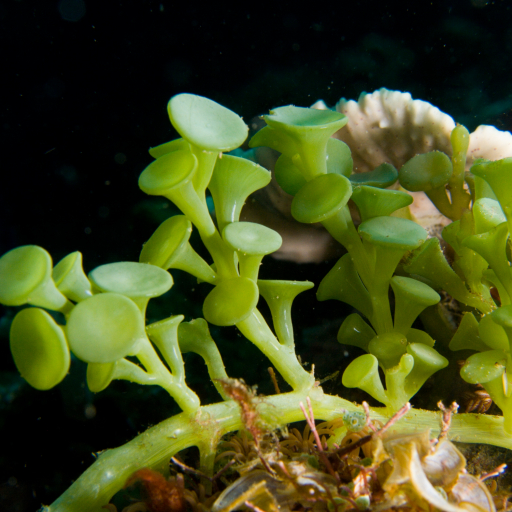
Commonly known as "Sea Grapes" or "Green Caviar," Caulerpa racemosa is a captivating marine macroalga that looks more like a cluster of emerald gems than a plant. Found in tropical and subtropical waters globally, it is both a culinary delicacy in many Pacific cultures and a popular choice for reef aquarium hobbyists. However, its beauty hides a relentless growth habit that can quickly overtake its surroundings if left unchecked.
🔍 How to Identify
- 🍇 Grape-like Clusters: The most striking feature is the "ramuli"—small, round, or club-shaped structures that grow in tight bunches, mimicking tiny green grapes.
- 🌿 Creeping Stolons: These clusters are connected by long, horizontal runners called stolons. These act like vines, anchoring the plant to rocks or sand with root-like "rhizoids."
- 🟢 Vibrant Green: It maintains a translucent, bright lime-green color. In high-light environments, it glows with a neon intensity, while deeper-water specimens may appear a darker forest green.
🌊 In Your Aquarium or Coastline
- 🧪 Nutrient Sponge: In a home reef tank, this alga is a powerhouse for "nutrient export." It aggressively sucks up nitrates and phosphates, helping to keep the water crystal clear for corals.
- ✂️ The Pruning Rule: Because it grows so fast, it requires constant "harvesting." If the colony becomes too dense, it may undergo "sporulation"—a dramatic event where the entire plant turns white and releases its contents into the water, which can crash a small aquarium's oxygen levels.
- 🏝️ Invasive Potential: Outside of its native range, it is a formidable competitor. It can carpet the sea floor, smothering native seagrasses and changing the entire underwater landscape.
⚠️ Safety & Toxicity
- 🍽️ Edible Assessment: It is widely eaten by humans in salads (especially in the Philippines and Japan). However, it should never be eaten from a home aquarium, as it can absorb heavy metals and chemicals used in fish treatments.
- 🧪 Chemical Defense: The plant produces a secondary metabolite called caulerpin. While this gives it a unique peppery taste for humans, it is mildly toxic to many herbivorous fish, acting as a natural deterrent against being eaten.
- 🐾 Pet Safety: It is generally safe to handle, though the high salt content in aquarium trimmings means you should keep it away from curious land pets like cats or dogs.
✨ Fun Fact
Despite its complex appearance with "stems" and "leaves," Caulerpa racemosa is actually a single-celled organism! It is coenocytic, meaning the entire plant is one giant cell containing many nuclei, making it one of the largest single cells in the world.

Detailed Care Instructions
- Choose a container that is suitable for the size of the plant.
- Fill the container with freshwater to a depth that is sufficient to cover the roots of the plant.
- Place the plant in the container, ensuring that it is completely submerged in water.
- Check the water level regularly to ensure it remains at the appropriate depth.
- If the water becomes cloudy or discolored, it is recommended to change the water and rinse the plant carefully.
- Provide ample light source, preferably a bright indirect light, for the plant to photosynthesize properly.
- Avoid overwatering the plant as it can lead to root rot and other diseases.
- If the plant starts to show signs of wilting or yellowing, it may indicate that it needs more water.
- Use a plant fertilizer specifically designed for aquatic plants to provide necessary nutrients for growth.
- Lastly, follow appropriate care instructions for the specific type of plant to ensure it thrives and remains healthy.
The best soil to use with this plant is a type of loose, well-draining substrate that allows for good oxygen flow to the roots. This can include a mixture of sand, gravel, and a small amount of organic matter such as peat moss or coconut coir. It is important to avoid soil that is compact or has a high clay content, as this can suffocate the plant's roots and prevent proper growth. Additionally, it is recommended to fertilize with a balanced, low-nitrogen fertilizer to provide necessary nutrients without promoting excessive leaf growth.







