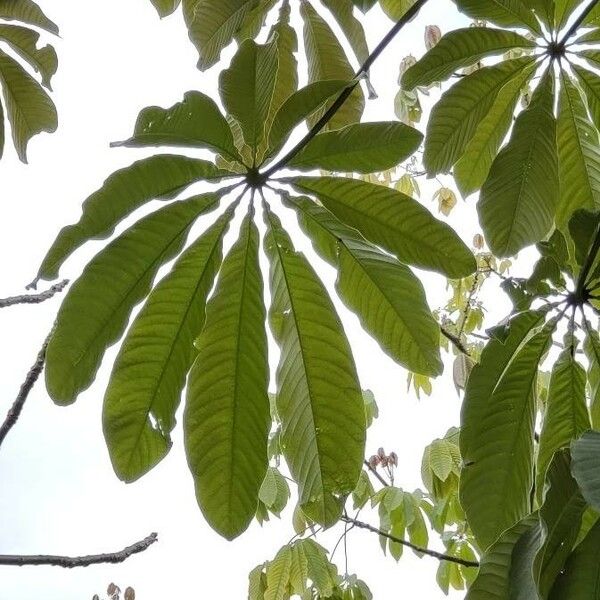
Plant Overview
Often called the Red Cecropia or Embaúba, this Brazilian beauty is a true pioneer of the Atlantic Forest. It is famous for its architectural silhouette and the way its silver-backed leaves shimmer like mirrors against the deep green of the jungle canopy. In its native habitat, it acts as a "biological clock," being one of the first trees to reclaim cleared land and provide a home for local wildlife.
🔍 How to Identify
- 🍃 The Leaves: Massive, umbrella-like leaves that are deeply lobed (palmately) into 7 to 11 segments. While the tops are a rich green, the undersides are covered in a dense, chalky-white or silver fuzz.
- 🪵 The Trunk: A slender, light-colored trunk that is prominently ringed with scars from old leaves, giving it a segmented appearance similar to giant bamboo.
- 🕯️ The Flowers: Produces unique, finger-like clusters (spikes) that hang down like a bunch of pale candles or "sausages" among the foliage.
🏡 In Your Garden
- ☀️ Light & Space: This is a sun-worshipper that grows incredibly fast. In a garden setting, it needs plenty of vertical space and full sun to develop its iconic silver sheen; in the shade, the leaves may stay greener and less dramatic.
- 🐜 The Ant Connection: In the wild, this tree is a myrmecophyte, meaning it has a hollow stem designed to house protective Azteca ants. While garden-grown specimens in different climates might not host these specific ants, the tree still produces "Mullerian bodies"—tiny, protein-rich food pellets—at the base of its leaf stalks to "pay" its insect guards.
⚠️ Safety & Toxicity
- ✅ Status: Generally considered non-toxic to humans and pets.
- 🐜 The "Sting" Risk: While the plant itself isn't poisonous, wild specimens are almost always guarded by very aggressive ants that live inside the trunk. If you encounter one in the wild, be careful before leaning against the bark, as the ants will swarm to defend their "fortress."
- 🧤 Skin Sensitivity: The fine, hook-like hairs on the leaves can occasionally cause mild skin irritation for people with very sensitive skin.
✨ Fun Fact
The Cecropia glaziovii is the favorite "snack bar" for the Three-toed Sloth! Sloths prefer these trees not just for the tasty leaves, but because the open canopy allows them to soak up the sun, which helps them digest their food more efficiently.

Detailed Care Instructions
To grow Cecropia glaziovii plants, you can follow these steps:
- Obtain seeds or cuttings: You can buy seeds or obtain cuttings from mature plants. If using cuttings, make sure they are healthy and at least 6-8 inches long.
- Prepare a growing medium: Cecropia glaziovii prefers well-draining soil. Prepare a mix of equal parts potting soil, perlite, and sand to provide a suitable growing medium.
- Germinate the seeds: If using seeds, scarify them with sandpaper or a file to enhance germination. Soak the scarified seeds in warm water overnight. Plant the seeds in small pots or seed trays filled with the prepared growing medium. Sow the seeds about 1/4 inch deep and lightly cover them with soil.
- Provide suitable conditions: Cecropia glaziovii requires bright, indirect sunlight. Place the seed trays or pots in a warm location, ideally between 70-80°F (21-27°C). Keep the soil moist but not waterlogged.
- Transplant the seedlings: Once the seedlings are about 6 inches tall, transplant them into individual pots. Choose pots that are at least 10-12 inches deep. Fill the pots with the same growing medium as for germination. Handle the seedlings gently to avoid damaging their delicate roots.
- Watering and feeding: Water the plants regularly, keeping the soil evenly moist. However, make sure not to overwater as it can lead to root rot. Fertilize the plants every 4-6 weeks with a balanced, slow-release fertilizer.
- Provide support: Cecropia glaziovii is a fast-growing tree that can grow up to 50 feet in height. As the plant grows, provide a sturdy support structure, such as a stake, to help it stand upright and develop a strong trunk.
- Pruning: Regularly prune any dead or diseased branches to promote healthy growth and shape the plant.
- Protect from extreme weather conditions: Cecropia glaziovii is sensitive to cold temperatures and strong winds. If you live in a region with cold winters or strong winds, consider protecting the plant with a frost cloth or by moving it indoors during extreme weather conditions.
By following these steps, you can successfully grow Cecropia glaziovii plants.
To properly water a Cecropia Glaziovii plant, it is important to consider the specific needs of the plant. Here are some details on how to water it effectively:
- Observe the soil: Before watering, check the soil moisture level by feeling the top inch of the soil. It should feel slightly dry to the touch. If it feels excessively dry, it is time to water.
- Watering frequency: Cecropia Glaziovii prefers regular watering rather than intermittent wetting and drying. Water the plant when the top inch of soil becomes dry but avoid overwatering, as it may lead to root rot.
- Watering method: Pour water directly on the base of the plant, near the root zone. Avoid wetting the foliage excessively as it may lead to fungal diseases or damage the leaves.
- Amount of water: Provide enough water to thoroughly saturate the soil around the root system. Aim for a slow and deep watering that allows the water to penetrate the soil deeply instead of just wetting the surface.
- Drainage: Ensure the plant pot has proper drainage holes to allow excess water to escape. It helps prevent waterlogging, which can be detrimental to the plant's health.
- Temperature and humidity: Consider the environmental conditions when deciding how much to water. In hot and dry climates, the plant may require more frequent watering, whereas in cooler and humid conditions, it may require less water.
- Water quality: Use room temperature or lukewarm water to avoid shocking the plant's roots. Also, consider using filtered water or rainwater if the tap water in your area is high in mineral content or contains chlorine.
- Time of day: Water the plant in the morning or early afternoon to allow excess moisture on the foliage to evaporate before nightfall. This helps prevent fungal growth and diseases associated with damp conditions.
- Monitor the plant: Regularly check the plant for any signs of water stress, such as wilting, yellowing leaves, or drooping. Adjust your watering schedule accordingly to meet its specific needs.
Remember, it is crucial to tailor the watering routine to the unique requirements of the Cecropia Glaziovii plant, taking into account factors like climate, pot size, and overall health.
To effectively fertilize the plant Cecropia glaziovii, follow these instructions:
- Choose a balanced fertilizer: Select a well-balanced fertilizer with an equal ratio of nitrogen (N), phosphorus (P), and potassium (K). Look for a slow-release variety to provide nutrients over time.
- Dilute the fertilizer: Dilute the fertilizer as per the manufacturer's instructions. Generally, a concentration of 1 part fertilizer to 2 parts water is suitable.
- Prepare the plant: Make sure the plant is well-watered before applying fertilizer. This helps prevent root burn.
- Apply fertilizer sparingly: Pour the diluted fertilizer mixture around the base of the plant. Avoid direct contact with the stem or foliage to prevent injury.
- Observe the plant's response: Monitor the plant's growth and overall health after fertilizing. If the leaves turn brown or curl, reduce the fertilizer concentration or amount used.
- Fertilize during the growing season: Apply fertilizer every two to four weeks during the growing season, typically spring and summer. Reduce or stop fertilization during the dormant season, usually in fall and winter.
- Water after fertilizing: After applying fertilizer, thoroughly water the plant to help dissolve and disperse the nutrients into the soil.
Remember, the specific nutritional requirements of Cecropia glaziovii may vary depending on the soil conditions and environmental factors. Adjust the fertilization schedule or concentration based on individual plant needs and consult a local gardening professional if necessary.
When selecting soil for the Cecropia glaziovii plant, it is important to consider its specific needs to ensure optimal growth. This plant prefers a well-draining soil that retains some moisture without becoming waterlogged. It is best to use a soil mix that combines organic matter, such as compost or peat moss, with a sandy or loamy texture.
The addition of organic matter helps improve the soil's fertility and nutrient content while facilitating water retention. This is particularly important for the Cecropia glaziovii plant, as it benefits from consistent moisture levels. However, excessive waterlogging can lead to root rot. Hence, a well-draining soil mix is crucial to prevent waterlogged conditions.
Sandy or loamy soil provides adequate drainage and aeration while allowing water to reach the plant's root system. The finer texture of these soil types prevents compaction and encourages healthy root development. This is beneficial for the Cecropia glaziovii plant, as it relies on a well-developed root system to support its large, fast-growing stature.
In summary, a suitable soil mix for the Cecropia glaziovii plant is one that combines organic matter, like compost or peat moss, with sandy or loamy soil. This provides the plant with the necessary moisture retention capacity while ensuring the soil remains well-draining to avoid waterlogging.
Cecropia glaziovii is a plant that can be propagated through various methods. Here are some detailed steps on how to propagate it:
- Choose a mature and healthy cecropia glaziovii plant from which you want to take the cuttings. Look for a plant with strong stems and vibrant foliage.
- Prepare a clean, sharp pruning shears or a pair of scissors. You will use this tool to take the cuttings, so make sure it is sanitized to prevent the spread of diseases.
- Select a stem of the cecropia glaziovii that is about 4-6 inches long and has multiple nodes. Nodes are the areas on the stem where new leaves and branches emerge.
- Make a clean, diagonal cut just below a node on the selected stem. This will create a cutting with a fresh, open wound, which will improve rooting.
- Remove any leaves that are close to the base of the cutting, as these may rot when placed in the propagation medium. Leave a few leaves at the top of the cutting to support photosynthesis.
- Prepare a well-draining potting mix by combining equal parts of perlite, peat moss, and vermiculite. This mix provides good aeration and moisture retention.
- Moisten the potting mix slightly, ensuring it is damp but not soaking wet. Excessive moisture can lead to rotting of the cutting.
- Dip the base of the cecropia glaziovii cutting into a rooting hormone powder or gel. This treatment enhances the development of roots and improves success rates.
- Make a small hole in the potting mix and gently insert the base of the cutting into it. Firmly press the mixture around the cutting to ensure good soil-to-stem contact.
- Place the potted cutting in a warm and bright location, but avoid direct sunlight. Indirect or filtered light is ideal for promoting root development.
- Maintain the moisture level of the potting mix by misting it regularly or covering the pot with a plastic bag to create a humid environment. Be careful not to overwater, as it may cause rotting.
- Check for root development after a few weeks. Gently tug the cutting, and if you feel resistance, it means roots have started to form. If not, continue to provide the appropriate conditions.
- Once the cecropia glaziovii cutting has developed a healthy root system, it is ready to be transplanted into a larger pot with well-draining soil. Gradually acclimate it to the outdoor environment if you plan to grow it outside.
By following these steps, you can successfully propagate Cecropia glaziovii and have new plants to enjoy in your garden or indoor space.








