Plant Overview
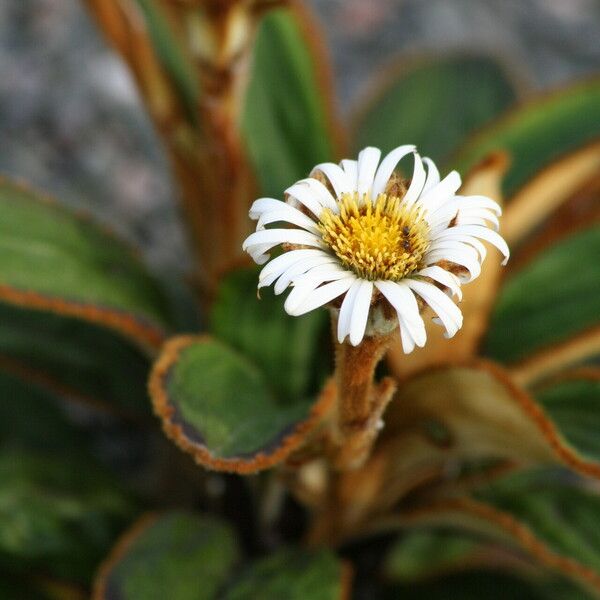
Known as Travers’s Mountain Daisy, this New Zealand native is often hailed as the "Queen of the Alpines." Thriving in the rugged, high-altitude herbfields of the South Island, it is famous for its striking "bicolor" foliage that looks almost hand-painted. It is a slow-growing aristocrat that brings a touch of wild, mountainous elegance to any cool-climate rock garden.
🔍 How to Identify
- 🍃 Leathery Foliage: The leaves are thick, broad, and strap-like, featuring a deep forest-green upper surface with a polished, waxy sheen.
- 🟣 The Purple Margin: Its most distinctive trait is the "tomentum"—a dense, velvety coating of rusty-purple or chocolate-brown hairs that wrap around the leaf edges and cover the undersides.
- 🌼 Regal Blooms: In mid-summer, it sends up sturdy, fuzzy stalks topped with large, white daisy-like flowers featuring a bright golden-yellow central disc.
🏡 In Your Garden
- 🏔️ The Alpine Rule: Because it originates from rocky mountain slopes, it demands "cool heads and wet feet." It requires constant moisture at the roots but must have impeccable drainage; it will rot quickly in heavy, stagnant clay.
- 🌬️ Climate Sensitive: This plant is not a fan of the heat. It struggles in humid, tropical environments and prefers areas with high light intensity but cool air temperatures, mimicking the breezy mountain air of its homeland.
⚠️ Safety & Toxicity
- ✅ Non-Toxic Status: Celmisia traversii is generally considered safe and non-toxic to humans, cats, and dogs.
- 🧤 Leaf Texture: While not chemically toxic, the leathery, fibrous nature of the leaves can be difficult to digest if swallowed by curious pets, potentially causing minor stomach upset.
✨ Fun Fact
The thick, felt-like fuzz (tomentum) on the leaves isn't just for decoration—it acts as a sophisticated survival suit. It traps a layer of air to insulate the plant against freezing alpine nights and reflects harsh UV rays during the day!

Detailed Care Instructions

Some plants require more regular watering than others, which should be done every few days. It's critical to maintain the soil moist all of the time. The water requirements of the same plant placed in pots with varying sizes will differ. Because the water in the smaller pot evaporates faster than the water in the larger pot, it will require more watering. Regardless of pot size, the surface should constantly be maintained moist.








