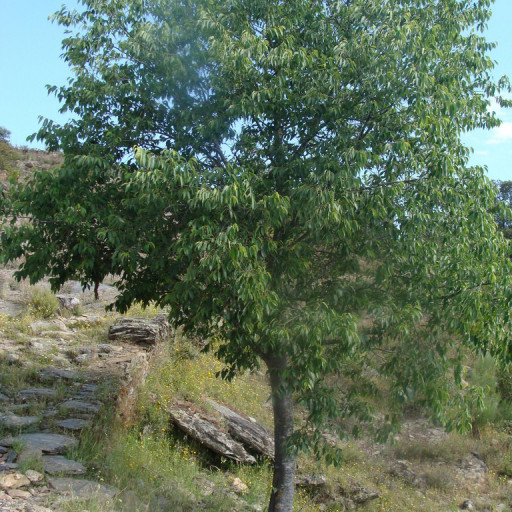
Plant Overview
Known as the European Hackberry or the legendary "Lote Tree," Celtis australis is a Mediterranean icon that has shaded weary travelers for millennia. It is celebrated for its incredible longevity and its ability to thrive in tough, rocky soils where other trees might struggle. In ancient folklore, it was whispered to be the plant that caused Odysseus's crew to forget their homes and stay in a state of peaceful bliss.
🔍 How to Identify
- 🐘 Bark Texture: Younger trees have smooth, silver-gray bark reminiscent of an elephant's skin or a Beech tree. As it matures, it remains relatively smooth but can develop small, corky "warts."
- 👅 Sandpaper Leaves: The leaves are lance-shaped with serrated edges and a very distinctively lopsided (asymmetrical) base. If you run your finger over the top, they feel rough, almost like fine sandpaper.
- 🍒 Dark Drupes: It produces small, pea-sized berries that transition from green to a deep purple or brownish-black when they ripen in late autumn.
🏡 In Your Garden
- 🏙️ Urban Warrior: This tree is a champion of city life. It is highly resistant to air pollution and can tolerate the reflected heat of pavements, making it an ideal choice for urban shade.
- 🐦 Wildlife Sanctuary: If you want to invite nature into your yard, this is the tree for you. The berries are a favorite high-energy snack for birds, while the dense canopy provides excellent nesting sites.
- 🪴 Patience is Key: While it is drought-tolerant and hardy once established, it grows slowly in its youth. Avoid frequent transplanting, as it develops a deep taproot that prefers to stay undisturbed.
⚠️ Safety & Toxicity
- ✅ General Safety: Celtis australis is considered non-toxic to humans, dogs, and cats. It is a very "friendly" giant for family gardens.
- 🍴 Edible Fruit: The berries (hackberries) are technically edible and have a mild, sweet flavor, though they are mostly seed with a very thin layer of flesh.
- 🍂 Leaf Litter: While not toxic, the leaves are high in tannins; they take a bit longer to decompose in compost piles compared to thinner leaves.
✨ Fun Fact
[📜] The Lotus-Eaters: Many historians believe that the "Lotus" mentioned in Homer’s Odyssey—the fruit that made sailors forget their homeland—was actually the fruit of the Celtis australis. While it won't actually give you amnesia, its sweet taste was clearly legendary enough to start a myth!

Detailed Care Instructions
| Soil Ph | 6.6-8.4 |
| Humidity | Normal |
| Lighting | Full Sun |
| Soil Type | Moist, Loamy Soils |
| Bloom Time | Mid-Spring |
| Difficulty | Medium |
| Plant Type | Deciduous Shrub |
| Mature Size | 40-70 Feet In Height |
| Native Area | Native To The Mediterranean Region (Southern Europe, Southwestern Asia And Northern Africa) |
| Sun Exposure | Full Sun |
| Hardiness Zones | 7-9 |
To grow Celtis australis, commonly known as European hackberry or nettle tree, you can follow these steps:
- Choose a suitable location: Celtis australis prefers a sunny spot but can also tolerate partial shade. Ensure the soil is well-draining and fertile.
- Propagation: You can propagate Celtis australis from seeds or cuttings. Seeds can be collected from ripe fruits in the fall, cleaned, and stratified (kept in a cold environment) for a few months before sowing. Cuttings can be taken in early summer, around 6-8 inches long, and rooted in a well-draining soil mix.
- Soil preparation: Prepare the planting hole by loosening the soil and adding organic matter like compost or well-rotted manure. This will help improve the soil fertility and drainage.
- Planting: Plant the Celtis australis in the prepared hole, ensuring the root ball is level with or slightly above the ground. Water the plant thoroughly after planting.
- Watering: Keep the soil moist but not waterlogged. Water deeply once or twice a week, depending on the weather and soil conditions, especially during the first year of growth.
- Mulching: Apply a layer of organic mulch around the base of the plant to help retain moisture, suppress weed growth, and regulate soil temperature.
- Pruning: Celtis australis has a naturally attractive form, but pruning can be done to remove damaged or crossing branches. Prune in late winter or early spring before new growth appears.
- Fertilizing: Celtis australis generally does not require frequent fertilization. However, you can apply a balanced slow-release fertilizer in the spring to provide essential nutrients.
- Protection: Protect young Celtis australis plants from extreme temperatures and freezing conditions during the first few years after planting.
- Maintenance: Regularly monitor the plant for pests and diseases, and take appropriate measures if necessary. Keep an eye out for signs of stress like wilting or yellowing leaves and address any issues promptly.
With proper care and attention, Celtis australis can grow into a beautiful, resilient tree.

Place in a bright room that is sun drenched almost all day. Or directly in a south-facing window.

To water this plant, ensure that the soil is dry to the touch before watering. Use a watering can and gently pour water at the base of the plant, being careful not to pour directly onto the leaves. Water thoroughly until the soil is moist, but not waterlogged. Allow any excess water to drain from the pot or surrounding soil before moving the plant back to its original location. Water this plant regularly, but avoid over-watering, as this can lead to root rot and damage to the plant.
- Begin fertilizing in early spring, after the danger of frost has passed.
- Use a balanced fertilizer specifically formulated for trees.
- Follow the manufacturer's instructions for application rates and frequency.
- Apply fertilizer evenly around the base of the tree, extending out to the drip line.
- Avoid fertilizing during periods of drought or extreme heat, as this may cause damage to the tree.
- Water the tree thoroughly after fertilizing to ensure that the nutrients are absorbed by the roots.
- Reapply fertilizer every 2-3 months during the growing season to promote healthy growth.
For optimal growth and health of the [plant], it is recommended to use a well-draining soil mix that retains some moisture but is not waterlogged. The ideal soil pH should be slightly acidic to neutral, ranging from 6.0 to 7.0. The soil should be rich in organic matter and nutrients, such as nitrogen, phosphorus, and potassium. Adding compost or aged manure to the soil can improve its fertility and structure. It is important to avoid using heavy clay soils, which can hinder root growth and water movement. Additionally, the soil should be aerated and loosened periodically to promote healthy root growth.
Celtis Australis can be propagated through different methods such as sowing seeds, stem cuttings, and layering.
Sowing seeds: Collect the mature fruits/seeds from the Celtis Australis plant. Scarify the seeds by nicking the hard outer coat with a knife or rubbing them with sandpaper to break the dormancy of the seed. Sow the seeds 1-2 inches deep in a pot or a seedbed filled with well-draining soil. Place the pot/seedbed in a warm and bright location, keeping the soil moist. It may take a few weeks to months for the seeds to germinate.
Stem cuttings: Select a healthy stem from the Celtis Australis plant that is about 6-8 inches long and free from any diseases or pests. Cut the stem just below a node, and remove any leaves or flowers from the lower half. Dip the cut end in rooting hormone powder and plant it in a pot or container filled with well-draining soil. Keep the soil moist and place the pot in a shaded location. After a month or two, the stem should start developing roots and new growth.
Layering: This method involves bending a branch or stem of the Celtis Australis plant and burying it partially in the ground. Keep the branch in place with a stake or a rock. Cover the buried section of the branch with soil, leaving the tip exposed. Water the soil thoroughly and keep it moist. After a few months, new roots should develop from the buried section, and the new plant can be cut off from the parent plant and transplanted to a new location.
Common pests of the european nettle tree include Scale insect, larvae. Make a habit of checking your european nettle tree frequently for pests so that any infestations can be caught and managed early.








