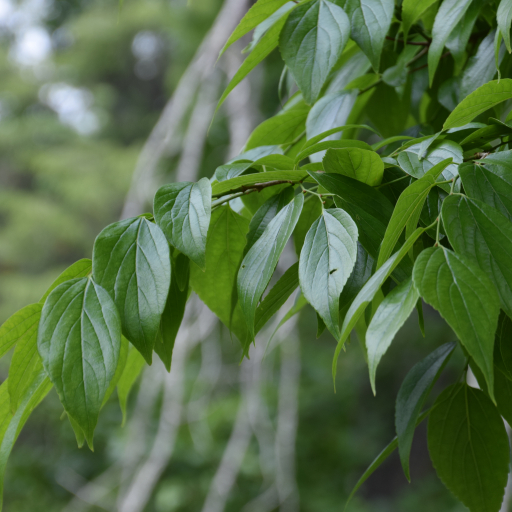
Plant Overview
Known widely as the Nilgiri Nettle Tree or the Four-stamen Hackberry, this elegant tree is a staple of the Himalayan foothills and the sweeping landscapes of Southeast Asia. It acts as a majestic green canopy, often found flanking ancient temples or shaded hillsides. While it belongs to the same family as hemp and nettles, it lacks the "sting," offering instead a cooling shade and a haven for local wildlife.
🔍 How to Identify
- 🍃 The Leaf Shape: Look for ovate, pointed leaves with "toothed" or serrated edges. A key giveaway is the asymmetrical base—where one side of the leaf joins the stem slightly higher than the other.
- 🩶 The Bark: The trunk is typically smooth and light grey. As the tree matures, the bark may develop corky, wart-like protrusions that give it a rugged, textured character.
- 🍒 The Berries: In late summer, it produces small, globe-shaped fruits known as drupes. These transition from green to a pale yellow, eventually ripening into a deep orange or brownish-black.
🏡 In Your Garden
- 🦋 A Butterfly Buffet: This tree is a critical "host plant" for several butterfly species, including the Common Snout and various Nymphalids. Planting one is like setting up a five-star nursery for local pollinators.
- 🌳 The Space Requirement: Because it possesses a vigorous root system and a wide-reaching canopy, it is best suited for large gardens or parks. It is often used as a "pioneer species" to help restore soil health in disturbed areas.
- 💧 Drainage is Key: While it is quite hardy once established, it thrives in well-draining, loamy soil. It dislikes "wet feet," so avoid planting it in areas where water tends to pool after a storm.
⚠️ Safety & Toxicity
- ✅ Status: Generally Non-Toxic.
- 🐾 Details: The Celtis tetrandra is considered safe for humans, dogs, and cats. The berries are a favorite for birds, though they are generally too fibrous and pit-heavy for human consumption. As with many trees, the spring pollen can be a minor trigger for those with seasonal allergies.
✨ Fun Fact
In many traditional cultures across India and Southern China, the tough, flexible wood of the Hackberry was the go-to material for crafting tool handles and walking sticks. Even its leaves were historically used as high-protein fodder for livestock during the dry seasons!

Detailed Care Instructions

Place in a bright room that is sun drenched almost all day. Or directly in a south-facing window.

When the top few inches of soil dry out, water your plants. If the top few inches of soil are still moist, do not water your plant. Wait a few days, then poke your finger into the soil to see if anything has changed. Overwatering poses a disease risk, such as the development of fungal diseases in the roots. These plants have adaptations in there leaves that allow them to survive in low water supply.








