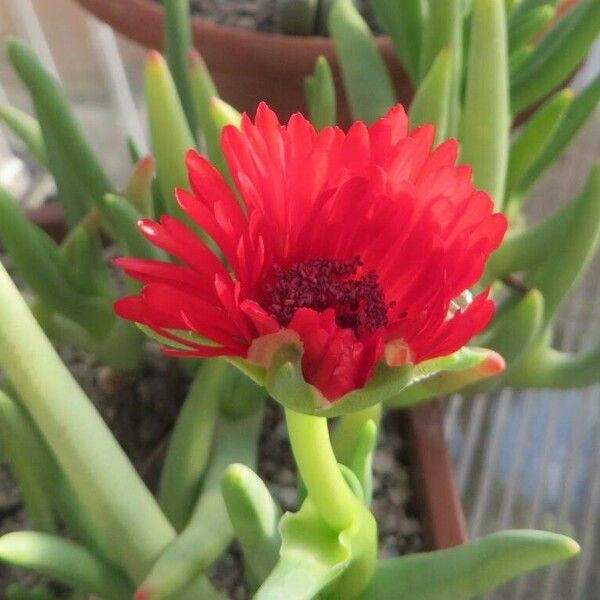
Plant Overview
Commonly known as the "Red Spike" or "Alston's Head-Leaf," this South African native is a show-stopping succulent that turns arid landscapes into a sea of neon. While most succulents are prized for their leaves, Cephalophyllum alstonii is a floral superstar, producing oversized, metallic-red blossoms that seem almost too bright to be real. It is a hardy, creeping groundcover that perfectly captures the resilient beauty of the Karoo desert.
🔍 How to Identify
- 🍃 The Foliage: Look for fleshy, finger-like leaves that are grey-green and grow in upright pairs. They have a distinct "triquetrous" (three-sided) shape, feeling firm and waxy to the touch.
- 🌸 The Bloom: The flowers are the main giveaway—they are large, daisy-like, and a deep, shimmering magenta or ruby red with a bright yellow center. They typically appear in late winter to early spring.
- 📏 Growth Habit: This plant stays low to the ground, rarely exceeding 5 inches in height, but it spreads horizontally via trailing stems to form a dense, succulent mat.
🏡 In Your Garden
- ☀️ Sun-Chasing Blooms: These flowers are phototropic, meaning they require direct, bright sunlight to open. If your garden is too shady, the "Red Spike" will keep its petals tightly tucked away, hiding its best feature.
- 💧 Winter Drinker: Unlike many common garden plants, this species is a "winter-grower." It appreciates a bit more moisture during the cooler months when it is preparing to bloom, but it must have extremely gritty, fast-draining soil to prevent its roots from "suffocating" in standing water.
- 🪨 Rockery Specialist: Because of its creeping nature and drought tolerance, it is the perfect candidate for rock gardens or "hellstrips" (those hot, dry areas between the sidewalk and the street) where other plants might wither.
⚠️ Safety & Toxicity
- 🟢 Non-Toxic: Cephalophyllum alstonii is generally considered non-toxic to humans and common household pets like cats and dogs.
- 🛡️ Gentle Nature: Despite the nickname "Red Spike," the leaves are smooth and fleshy, not sharp. There are no thorns or irritating saps to worry about when handling the plant or placing it near walkways.
✨ Fun Fact
The genus name Cephalophyllum comes from the Greek words for "head" and "leaf." This refers to the way the leaves often cluster at the ends of the stems, looking like little green heads emerging from the soil!

Detailed Care Instructions

Place in a bright room that is sun drenched almost all day. Or directly in a south-facing window.

When the top few inches of soil dry out, water your plants. If the top few inches of soil are still moist, do not water your plant. Wait a few days, then poke your finger into the soil to see if anything has changed. Overwatering poses a disease risk, such as the development of fungal diseases in the roots. These plants have adaptations in there leaves that allow them to survive in low water supply.
These plants can thrive without taking help from any fertilizer. However, if the medium of growth is something other than soil for instance sand then you may need to add little fertilizer. The best way to know if your plants need fertilizer or not is to check for yellowing of leaves. If the leaves start to turn yellow it’s fertilizing time.
You may use All Purpose Plant Food or Cactus Fertilizer for your Red Spike Ice Plant
Common pests of the red spike ice plant include Mealybugs, larvae, snails. Make a habit of checking your red spike ice plant frequently for pests so that any infestations can be caught and managed early.








