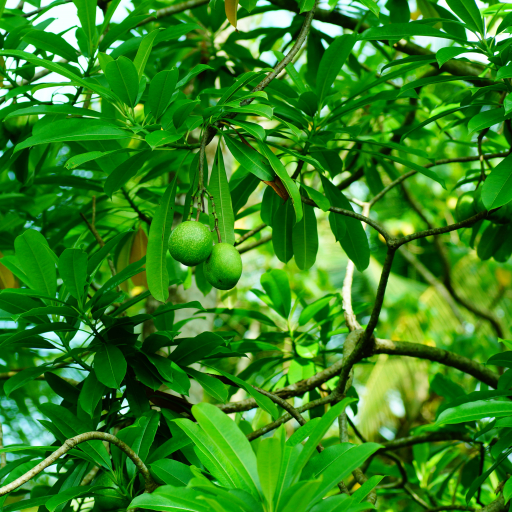
Plant Overview
Often called the "Suicide Tree" or the "Pong-pong" tree, Cerbera odollam is a hauntingly beautiful member of the Oleander family. Native to the coastal swamps of India and Southeast Asia, it is frequently mistaken for the common Frangipani due to its delicate, star-shaped flowers. Despite its serene appearance, it holds a dark reputation in folklore and history as one of the most lethal plants on Earth.
🔍 How to Identify
- 🍃 Glossy Foliage: The leaves are long, lance-shaped, and a deep, waxy green. They tend to grow in crowded spirals at the ends of the branches, giving the tree a lush, tropical canopy.
- 🌸 "Fried Egg" Flowers: The blossoms are white with five petals and a distinct yellow-to-orange "eye" in the center. They release a sweet, intoxicating fragrance that can be misleadingly pleasant.
- 🥥 Fibrous Fruit: It produces a smooth, green ovoid fruit that looks remarkably like a small mango. As it matures, it turns bright red and eventually reveals a thick, woody, fibrous husk that allows it to float on water.
🏡 In Your Garden
- 🌊 Coastal Specialist: Because it naturally evolves in mangrove and swamp environments, this tree is incredibly salt-tolerant. It thrives in humid, coastal air where other garden plants might wither from the salt spray.
- 🌳 Growth Habit: This is not a plant for a small patio. It grows into a medium-sized tree with a powerful root system designed to anchor it in wet, muddy soils. If planted in a residential garden, it requires significant space to prevent its roots from interfering with structures.
⚠️ Safety & Toxicity
- 🚫 EXTREMELY TOXIC: The entire plant—especially the seeds within the fruit—is deadly if ingested. It contains cerberin, a potent cardiac glycoside that can stop a human heart within hours.
- 🐕 Pet & Child Danger: This tree should never be planted in areas where children or pets play. Even the smoke from burning the wood can be toxic, and the milky sap can cause severe skin irritation or blistering upon contact.
✨ Fun Fact
The tree is named after Cerberus, the multi-headed "Hellhound" of Greek mythology who guarded the gates of the Underworld. This name was chosen by botanists to serve as a permanent warning of the plant's lethal nature.

Detailed Care Instructions
| Humidity | Normal |
| Lighting | Full Sun |
| Difficulty | Medium |
To grow Cerbera Odollam, also known as the "suicide tree" or "pong-pong," follow these steps:
- Obtain seeds: Purchase Cerbera Odollam seeds from a reputable seller or obtain them from a mature plant. Seeds are usually enclosed within a large fruit, similar to a mango.
- Prepare the seeds: Soak the seeds in water for 24 hours to help remove the surrounding pulp and improve germination rates.
- Germination: Fill a small pot with well-draining soil mix. Plant the seeds about 2 cm deep and place the pot in a warm and humid place, preferably with indirect sunlight. Maintain the soil moisture by misting it regularly.
- Provide optimal growing conditions: Cerbera Odollam thrives in tropical or subtropical climates. Ensure it receives plenty of sunlight, ideally 6-8 hours a day. Maintain a warm temperature, around 20-30 °C (68-86 °F).
- Watering: Keep the soil consistently moist, but avoid overwatering, as it can lead to root rot. Water the plant when the top inch of soil feels dry to the touch.
- Fertilization: Feed the plant with a balanced, slow-release fertilizer once a month during the growing season.
- Transplantation: Once the seedlings have developed multiple sets of true leaves and have grown 10-15 cm tall, transplant them into larger pots using well-draining soil. Ensure the new pot has drainage holes.
- Pruning: Prune the plant to encourage bushier growth and maintain the desired shape. Remove any dead or diseased branches regularly.
- Pests and diseases: Monitor the plant for common pests like aphids, mealybugs, or scale insects. Treat any infestations promptly with appropriate organic or chemical insecticides. Rotate the plant periodically to ensure even growth and prevent pests from settling.
- Be cautious: Cerbera Odollam is a highly toxic plant, so handle it with caution. Keep it out of reach from children and pets, and wash your hands thoroughly after any contact with the plant's sap or parts.
Note: Growing Cerbera Odollam is discouraged in many areas due to its high toxicity and potential danger. It is recommended to consult with local authorities and take necessary precautions before attempting to grow this plant.

Place in a bright room that is sun drenched almost all day. Or directly in a south-facing window.

The plant should be watered thoroughly but infrequently, allowing the soil to dry out slightly between watering. During the active growing season, the plant requires more water than during the dormant season. When watering, it is important to ensure that water does not accumulate in the plant's saucer or pot. Overwatering can lead to root rot and other plant diseases. The plant prefers slightly acidic soil and can benefit from periodic fertilization during the growing season. In addition, the plant should be kept in a location with bright, indirect sunlight and protected from harsh winds or extreme temperatures.
To fertilize this plant, use a slow-release fertilizer with an N-P-K ratio of 3-1-2. Apply the fertilizer during the growing season, which is typically the spring and summer months. Water the plant before applying the fertilizer to avoid burning the roots. Spread the fertilizer evenly around the base of the plant and gently work it into the soil. Water the plant after fertilizing to help distribute nutrients and avoid fertilizer burn. Avoid fertilizing in the fall and winter months, as the plant enters a period of dormancy and does not require additional nutrients.
For the Cerbera Odollam plant, it is recommended to use a well-draining soil that is rich in nutrients. The soil should have a pH level between 6.0 and 7.5, which is slightly acidic to neutral. It is also important to ensure that the soil does not contain any toxins or chemicals that may harm the plant. Organic matter, such as compost or manure, can be added to the soil to improve its fertility and water retention capabilities. Additionally, the plant prefers a slightly moist soil, so regular watering is necessary to keep the soil hydrated.
Cerbera odollam plant can be propagated by using either seeds or stem cuttings. For propagation through seeds, collect ripe and healthy fruits, remove the fruit pulp, and allow the seeds to dry for a day or two. Sow the seeds in a pot filled with well-draining soil, and keep the soil moist. The seeds will germinate in about 3-4 weeks, and the young plants can be cared for like mature ones.
For propagation through stem cuttings, select healthy stems of about 4-6 inches length with 2-3 leaves at the top. Cut the stem at a 45-degree angle below a leaf node, dip the cutting in rooting hormone powder, and plant it in well-draining soil. Keep the soil moist and place the pot in indirect sunlight for 2-3 weeks until the roots develop. The new plants can be transplanted to individual pots and treated like mature ones.
Both these methods of propagation are easy and can be done successfully with proper care and attention. The plant requires regular watering, fertilization, and pruning to maintain its health and appearance. It is also important to protect the plant from extreme temperatures, pests, and diseases to ensure its growth and survival.








