Plant Overview
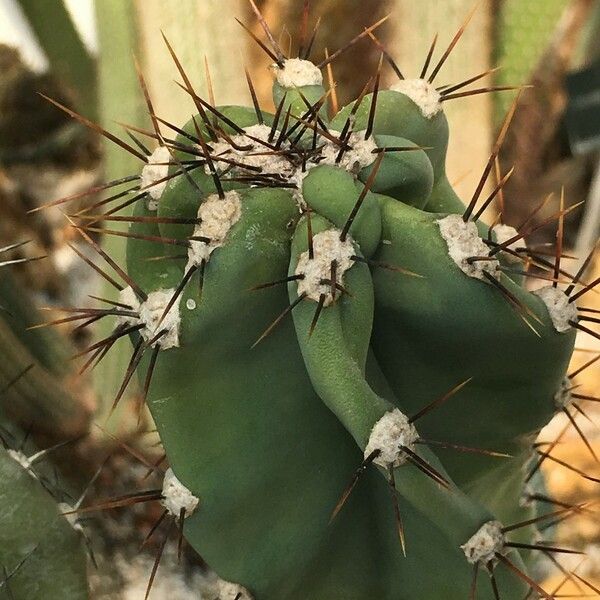
Often called the "Blue Columnar Cactus," this South American native looks like it belongs in a high-contrast desert dreamscape. Its striking turquoise skin isn't just for show—it’s a natural adaptation that helps it survive the intense UV rays of its Brazilian homeland. Growing tall and proud, it is a favorite for architectural landscaping and minimalist indoor collections.
🔍 How to Identify
- 🟦 Glaucous Skin: The most striking feature is its dusty, powdery blue or turquoise-gray hue, caused by a waxy coating that can be rubbed off (though it shouldn't be!).
- 🌵 Deep Ribs: It typically features 5 to 8 prominent, vertical ribs that allow the plant’s body to expand like an accordion when it drinks up rainwater.
- 🪡 Areoles & Spines: Along the edges of the ribs, you’ll find small, fuzzy "cushions" (areoles) sprouting clusters of sharp, brownish-gray spines that darken as the plant ages.
🏡 In Your Garden
- ☀️ Natural Sunscreen: That beautiful blue powder is actually epicuticular wax. It acts as a built-in sunscreen; the more bright, indirect light it receives, the more intense its blue coloration becomes to protect its tissues.
- 🪹 Root Health: This cactus is a "dry-dweller" through and through. It hates "wet feet" and requires extremely gritty, fast-draining soil. If kept in standard potting soil, the roots can succumb to rot within a single season of overwatering.
⚠️ Safety & Toxicity
- 🌵 Physical Hazard: While the plant is not chemically poisonous, its spines are very sharp and can cause painful puncture wounds. It should be placed away from high-traffic areas or narrow hallways.
- 🐾 Pet & Child Safety: It is generally considered non-toxic to cats, dogs, and humans if accidentally ingested. However, the physical danger of the spines makes it a "look but don't touch" resident for homes with curious toddlers or pets.
✨ Fun Fact
The Cereus caesius is a member of the "night-blooming" cacti. It produces massive, fragrant white flowers that can reach 6-8 inches in diameter, but they only open after the sun goes down and typically wither by the next morning!

Detailed Care Instructions
| Humidity | High |
| Difficulty | Medium |
| Hibernation | Cold Period |
| Temperature | 18°C - 30°C |
| Hardiness Zones | 9B - 11B |
These humidity-loving plants thrive in extreme humidity, but they also require lots of sunlight. Keep the plant and the soil surface moist at all times. Low or dry humidity distorts the leaf shape as well as browns the leaf tip. During the winters, it is recommended to shift these plants to a bathroom or use a humidifier to regulate the humidity levels needed by these plants.








