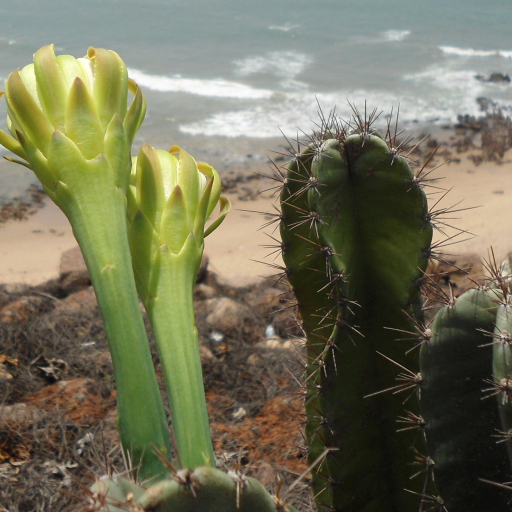
Plant Overview
Often referred to as the "Queen of the Night" or the "Hedge Cactus," the Cereus is a majestic columnar cactus that commands attention with its towering, skyward growth. These desert giants are famous for their dramatic, oversized blossoms that wait for the cover of darkness to bloom, filling the night air with a heavy, sweet fragrance. Whether standing as a lone sentinel in a dry garden or acting as a sculptural centerpiece in a bright room, they bring a prehistoric, architectural beauty to any space.
🔍 How to Identify
- 🌵 Ribbed Columns: The plant grows in tall, vertical stems that feature deep, longitudinal ribs, giving it a pleated or accordion-like appearance.
- ⚔️ Spiny Ridges: Along the edges of these ribs sit small cushions (areoles) which sprout sharp, needle-like spines that can range from grey to dark brown.
- 🌙 Nocturnal Blooms: Look for massive, funnel-shaped white flowers that typically open only at night and wither by the following morning.
🏡 In Your Garden
- ☀️ Sun Seekers: The Cereus is a true sun-worshipper; if grown indoors without enough light, it will "stretch" (etiolate), becoming thin and weak at the top as it searches for the sun.
- 💧 The "Wet Feet" Rule: These cacti are incredibly drought-tolerant but very sensitive to overwatering. They require gritty, porous soil because their roots will rot quickly if left sitting in damp earth for more than a day or two.
⚠️ Safety & Toxicity
- 🟢 Non-Toxic: The Cereus is generally considered non-toxic to humans, cats, and dogs, making it a safer choice for households with curious pets.
- ⚔️ Mechanical Injury: While not poisonous, the spines are very sharp and can cause painful punctures or skin irritation. It is best placed in a low-traffic corner where children or pets won't accidentally brush against it.
✨ Fun Fact
The name "Cereus" originates from the Latin word for "wax" or "torch." This refers to the plant’s straight, candle-like shape—and in some regions, the dried woody skeletons of dead Cereus plants were historically used as literal torches!

Detailed Care Instructions
| Humidity | Normal |
| Lighting | Full Sun |
| Toxicity | Poisonous |
| Difficulty | Medium |
| Hibernation | Cold Period |
| Temperature | 21°C - 35°C |
| Hardiness Zones | 9A - 10B |
To grow a Cereus plant, you can follow these steps:
- Choose the right location: Cereus plants thrive best in bright, indirect sunlight. Select a location such as a sunny window or a spot with filtered light.
- Prepare the soil: Use well-draining soil mixed with sand or perlite to ensure proper drainage. Cereus plants prefer slightly acidic soil with a pH level between 6 and 7.
- Watering: Water your Cereus plant thoroughly, allowing the soil to dry slightly between waterings. Overwatering can lead to root rot, so it's important not to let the soil stay overly wet.
- Temperature and humidity: Cereus plants prefer warm temperatures between 65-85°F (18-29°C). Keep them away from drafts and ensure a humidity level of around 50-60%.
- Fertilization: Feed your Cereus plant with a balanced liquid fertilizer during the growing season (spring and summer) every two to four weeks. Reduce or stop fertilization during the dormant period in winter.
- Provide support: As your Cereus plant grows, it may develop sprawling or climbing tendencies. Provide support, such as stakes or trellises, to help it grow upright.
- Pruning and shaping: Prune your Cereus plant occasionally to maintain its shape and remove any dead or dying parts. Be cautious as the plant has thorns and needs careful handling.
- Considerations: Cereus plants can also benefit from being kept outside during warm summer months but protect them from excessive direct sunlight. In winter, keep them in a cooler location to simulate their natural dormant period.
By following these steps, you should be able to successfully grow a Cereus plant. Remember to provide it with proper care, and it should grow into a healthy and beautiful plant.

Place in a bright room that is sun drenched almost all day. Or directly in a south-facing window.

To water this particular species of plant, it is important to let the soil dry out completely before watering again. This type of plant prefers to be slightly under-watered rather than over-watered. When watering, pour water gently into the soil until it begins to drain out the bottom of the pot. Do not water the leaves or stem directly as this can cause damage. It is best to water in the morning so the plant has time to dry before cooler temperatures at night. During the winter months, water less frequently as the plant will go into a dormant period.
Fertilize the plant every two weeks during the growing season using a balanced fertilizer with equal parts of nitrogen, phosphorus, and potassium. Dilute the fertilizer to half strength before applying to avoid burning the roots. Water the plant thoroughly before applying the fertilizer. Avoid fertilizing during winter months as the plant is dormant and does not require nutrients.
When planting your Cereus plant, it is important to choose a well-draining soil that is not too rich in nutrients. A mixture of sand, perlite, and peat moss can be used to create a lightweight, porous soil that will allow air and water to easily penetrate. Additionally, Cereus plants thrive in slightly acidic soil with a pH between 6 and 7. To ensure proper drainage, plant your Cereus in a container with drainage holes at the bottom.
Cereus plants can be propagated by taking stem cuttings. Take a sharp, clean pair of pruning shears and cut a stem from the parent plant. Choose a stem that is at least 6 inches long and has several nodes along the length of the stem.
Remove any leaves from the bottom 2-3 inches of the stem, leaving only bare stem. Dip the cut end of the stem in rooting hormone, available from most garden centers, to speed up the rooting process.
Fill a pot with a well-draining potting mix and make a hole in the center with a pencil or similar object. Insert the cut end of the stem into the hole and firm the soil around it.
Water the cutting well and place it in a bright, but indirect light location. Keep the soil moist, but not too wet, and avoid letting it dry out completely.
Roots should begin to form in about 4-6 weeks. To check for root growth, gently tug on the stem. If it resists, roots have formed. Once the cutting has rooted, it can be transplanted to a larger pot or planted in the garden.







