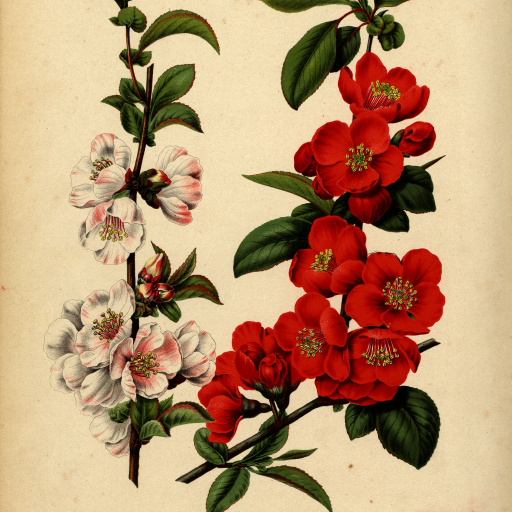
Plant Overview
Known as the Flowering Quince, this hardy shrub is one of the most stubborn heralds of spring. Often blooming while snow is still on the ground, its bright, waxy blossoms appear on bare, thorny branches long before the leaves emerge. Originally hailing from East Asia, it has been a garden favorite for centuries, prized for its "tough-as-nails" attitude and its ability to bring vibrant color to a gray late-winter landscape.
🔍 How to Identify
- 🌸 The Flowers: Cup-shaped with five waxy petals, typically appearing in brilliant shades of scarlet, salmon-pink, or snowy white. They often grow in clusters directly against the woody stems.
- 🌿 The Leaves: Small, glossy, dark green ovals with finely serrated edges. They usually wait until the first flush of flowers begins to fade before making their full appearance.
- ⚔️ The Stems: A dense, tangled thicket of dark gray-brown wood. If you look closely, the branches are armed with sharp, stout spines that make it an excellent natural security hedge.
🏡 In Your Garden
- 🧱 Site Selection: This plant is nearly indestructible once established, handling drought and urban pollution with ease. However, it develops a deep, stubborn taproot. This means it hates being moved, so ensure you pick a permanent spot where it has room to sprawl.
- ✂️ Pruning Nuance: Flowering Quince sets its flower buds on "old wood" (growth from previous years). To avoid a flowerless spring, only prune the shrub immediately after the flowers have dropped; pruning in winter will accidentally cut off all of next year's "fireworks."
⚠️ Safety & Toxicity
- 🛡️ Physical Warning: The primary "danger" of this plant is its thorns. They are stiff and sharp, so heavy-duty gardening gloves are a must when weeding around the base or pruning.
- 🐾 Pet & Human Safety: The green-yellow fruits (pomels) that appear in autumn are technically edible but extremely hard and astringent when raw. While the fruit is safe for jams, the seeds contain tiny amounts of cyanogenic glycosides—similar to apple pips. They are generally considered low-risk, but it is best to keep curious pets from snacking on the core or seeds.
✨ Fun Fact
In the world of Bonsai, Chaenomeles speciosa is a superstar. Because the plant naturally grows in a gnarled, twisted fashion and produces miniature "apples," it is used to create tiny, ancient-looking trees that look like they belong in a dark fairytale.

Detailed Care Instructions
With its thorny habit and relatively short bloom season, flowering quince is not a great specimen plant, but it works well planted en masse along borders or as an informal barrier hedge. In large mixed borders, it can provide an early-spring accent. The fruit from quince shrubs (especially the related C. japonica) can be used in jams and jellies.
How long does a flowering quince shrub live?
A flowering quince shrub that remains healthy can live for several decades. Plants 40 years old are not uncommon.
Is the fruit of a flowering quince shrub edible?
The small apple-like fruits are rather sour and bitter if eaten directly off the plant, but quince fruits are often used in jellies and preserves.
How does wildlife interact with this shrub?
Flowering quinces are known to be plants that attract hummingbirds and butterflies. Because of its thorny nature, it is fairly resistant to damaging browsing from deer.
What is the difference between flowering quince and Japanese quince?
Japanese quince (Chaenomeles japonica) is a smaller shrub (usually growing to no more than 3 feet). It is considered less ornamental than C. speciosa, and thus is rarely sold in the trade. Many of the so-called Japanese quince plants are not pure species, but rather hybrids between C. speciosa and C. japonica.
| Color | White, Orange, Red, Or Pink |
| Soil Ph | 3.7 To 7.0; Acidic To Neutral |
| Lighting | Full Sun |
| Soil Type | Loam |
| Bloom Time | Late Winter, Early Spring |
| Plant Type | Deciduous Shrub |
| Native Area | China, Korea |
| Sun Exposure | Full Sun |
| Hardiness Zones | 4 To 9, Usda |
To grow Chaenomeles Speciosa (commonly known as Japanese flowering quince), follow these steps:
- Choose a suitable location: Japanese flowering quince prefers full sun, but it can tolerate partial shade. It also prefers well-draining soil.
- Prepare the soil: Before planting, loosen the soil with a garden fork or tiller and remove any weeds or rocks. Incorporate organic matter like compost or well-rotted manure to improve soil fertility and drainage.
- Planting: Dig a hole that is slightly wider and deeper than the plant's root ball. Place the plant in the hole, making sure that the top of the root ball is level or slightly above the soil surface. Backfill the hole with soil, firming it gently around the roots. Water thoroughly after planting.
- Watering: Keep the soil consistently moist, especially during the plant's first year. Once established, Japanese flowering quince can tolerate some drought, but it still benefits from regular watering during dry periods.
- Mulching: Apply a layer of organic mulch, such as wood chips or straw, around the base of the plant after planting. Mulch helps retain moisture, suppresses weed growth, and regulates soil temperature.
- Pruning: Prune Japanese flowering quince in late winter or early spring while it is still dormant. Remove any dead, damaged, or crossing branches. Regular pruning will help maintain its shape and stimulate better flowering.
- Fertilizing: Japanese flowering quince is generally low maintenance and does not require much fertilization. However, you can apply a balanced, slow-release fertilizer in early spring to promote healthy growth and blooming.
- Pests and diseases: Japanese flowering quince is relatively resistant to pests and diseases, but keep an eye out for common issues like aphids, scale insects, or powdery mildew. Monitor the plant regularly and treat any problems promptly.
Overall, Chaenomeles Speciosa is a hardy plant that can adapt to a wide range of conditions. With proper care and maintenance, it can thrive and produce beautiful flowers year after year.

Place in a window with dappled sun or a spot in the middle of a room. Or directly in a window facing west or east.

The best way to water this plant is to ensure that the soil is moist but not overly saturated. To achieve this, water the plant deeply once a week, allowing the water to soak into the soil. Avoid watering the leaves or flowers, as this can cause damage or disease. If the soil is particularly dry, you may need to water more frequently, but be careful not to over-water as this can lead to root rot. During periods of heavy rainfall, you may need to adjust your watering schedule accordingly.
To fertilize this plant, you should apply a balanced fertilizer in early spring, just before new growth appears. Use a slow-release granular fertilizer that is high in phosphorus. Make sure to water the plant thoroughly after fertilizing. Avoid fertilizing in the fall, as this may encourage late-season growth that will not harden off before winter.
Chaenomeles Speciosa is a deciduous shrub that requires well-draining soil with a neutral pH level. The soil should be rich in organic matter and nutrients, as the plant requires a lot of nutrients to thrive. It is recommended to incorporate organic matter, such as garden compost or well-rotted manure, into the soil before planting.
The soil should also be slightly acidic to neutral, with a pH range between 6.0 to 7.0. Avoid planting in heavy clay soils, as they tend to retain too much water and can cause root rot. Sandy or loamy soils that drain well are ideal for this plant.
When planting Chaenomeles Speciosa, ensure that the soil is moist but not waterlogged. After planting, water the plant regularly to keep the soil evenly moist. Applying a layer of mulch around the base of the plant can help to retain moisture in the soil and also provide beneficial nutrients as it breaks down.
Overall, the key to growing Chaenomeles Speciosa successfully is to provide well-draining soil that is rich in nutrients and organic matter.
One way to propagate this plant is through hardwood cuttings. First, select a healthy branch from the plant that has recently undergone a dormant period. Cut a 6- to 8-inch section of the branch, making sure it is free of disease and pests.
Next, remove any leaves on the lower half of the cutting and dip the cut end in a rooting hormone. Plant the cutting in a container filled with a well-draining, sterile soil mix.
Be sure to keep the soil moist but not waterlogged and provide high humidity around the cutting by covering it with a plastic bag or placing it in a propagator. Place the container in a bright, but indirect light location.
Check on the cutting regularly and remove any diseased or dead plant material. After a few weeks, you should see new growth emerging from the cutting, indicating that it has successfully rooted.
Once the roots have established, the new plant can be transplanted into a larger container or the garden.








