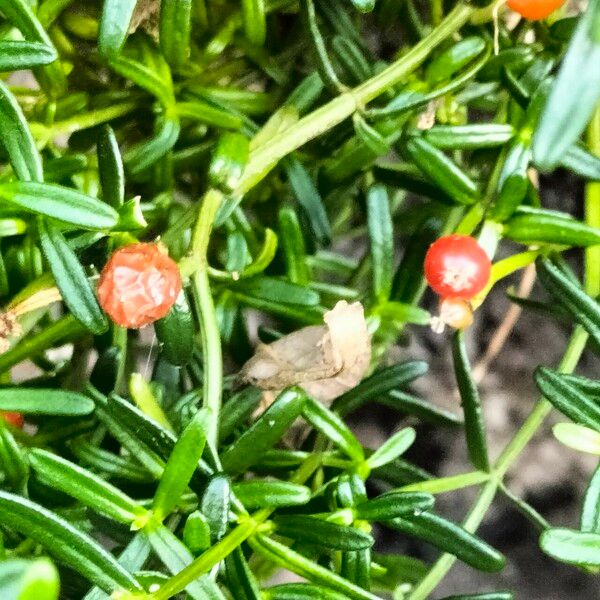
Plant Overview
Often called the Christmas Berry or Bitterbos, this cheerful South African native looks like it jumped straight off a holiday greeting card. Known for its perfectly rounded shape and brilliant red fruits that appear just in time for the festive season, it is a staple of coastal dunes and fynbos landscapes. While it looks sweet, its common name "Bitterbos" (Bitter Bush) hints at the surprising punch it packs for anyone curious enough to take a bite.
🔍 How to Identify
- 🌸 Starry Blooms: Before the berries arrive, the plant is covered in five-petaled, bright pink flowers with distinct yellow anthers that stand out against the green.
- 🍒 The "Candy" Berries: The most iconic feature is the mass of marble-sized, glossy red berries that persist on the plant for months.
- 🌿 Wiry Foliage: It grows as a dense, rounded shrub with small, narrow, and slightly succulent dark green leaves that give it a "mounded" appearance from a distance.
🏡 In Your Garden
- 🏖️ Coastal Warrior: This plant is incredibly salt-tolerant and wind-resistant, making it a "must-have" for seaside gardeners who struggle with harsh spray.
- ☀️ Sun Seeker: It thrives in poor, sandy soils and full sun. Because it has a relatively short lifespan (about 3 to 4 years), gardeners often let it "self-seed" so that new seedlings can naturally replace the older plants.
- 💧 Waterwise Nature: Once established, it requires very little attention. It prefers to dry out between waterings, mimicking the well-drained slopes of its native South African home.
⚠️ Safety & Toxicity
- 👅 Status: Not considered deadly, but definitely unsafe for consumption.
- 🐾 The Bitter Truth: The entire plant contains bitter compounds (iridoids) that can cause stomach upset if eaten. While the berries look like edible treats to children, their extremely bitter taste usually prevents anyone from swallowing enough to cause serious harm. Keep away from curious pets.
✨ Fun Fact
The genus name Chironia is derived from Chiron, the wise Centaur of Greek mythology. Legend says Chiron used plants from this family to heal his wounds, though today we mostly value the Baccifera species for its beauty rather than its bandages!

Detailed Care Instructions
Chironia baccifera, commonly known as the Christmas Berry, is a beautiful and versatile plant that can be easily grown in a garden or container. Here are some tips on how to grow Chironia baccifera:
- Choose a suitable location: Chironia baccifera prefers full sun to partial shade and well-draining soil. Make sure to plant it in a location that receives at least 6 hours of sunlight per day.
- Soil preparation: Before planting, improve the soil by adding organic matter such as compost or well-rotted manure. This will help to improve drainage and fertility, which are important for healthy plant growth.
- Planting: Plant Chironia baccifera in spring or early summer. Dig a hole slightly larger than the root ball and place the plant in the hole at the same depth as it was in the container. Backfill with soil and water thoroughly.
- Watering: Water Chironia baccifera regularly, especially during dry periods. Make sure the soil is consistently moist but not waterlogged. Mulching around the base of the plant can help to retain moisture.
- Fertilizing: Feed Chironia baccifera with a balanced fertilizer in spring and summer to encourage healthy growth and flowering.
- Pruning: Prune Chironia baccifera lightly after flowering to promote bushy growth and to remove any dead or damaged branches.
- Pest and disease control: Keep an eye out for pests such as aphids or scale insects, which can be easily treated with insecticidal soap. Avoid overwatering to prevent root rot and other fungal diseases.
By following these tips, you can successfully grow Chironia baccifera and enjoy its beautiful flowers and berries in your garden.

Place in a bright room that is sun drenched almost all day. Or directly in a south-facing window.

Chironia Baccifera plants should be watered thoroughly but infrequently. It is important to allow the soil to dry out slightly between waterings to prevent root rot. When watering, make sure to soak the soil evenly until water drains out of the bottom of the pot. It is best to water in the morning to allow the plant to dry out during the day and reduce the risk of fungal diseases. Additionally, be sure to use room temperature water to avoid shocking the plant's roots. Proper watering practices will help to keep the Chironia Baccifera healthy and thriving.
To fertilize Chironia Baccifera, apply a balanced fertilizer with equal parts of nitrogen, phosphorus, and potassium once every two weeks during the growing season. Dilute the fertilizer according to the manufacturer's instructions and water the plant thoroughly after fertilizing. Avoid over-fertilizing as this can cause damage to the plant.
Chironia Baccifera plants thrive in well-draining soil that is rich in organic matter. A mix of sandy loam soil with perlite or coarse sand is ideal for these plants as it helps prevent waterlogged conditions that can cause root rot. The soil should also have a slightly acidic to neutral pH level (6.0-7.0) to support the plant's growth and health. Adding a layer of mulch on top of the soil can help retain moisture and regulate soil temperature, which is beneficial for Chironia Baccifera plants. Regularly checking the soil moisture level and watering only when the top inch of soil is dry will help prevent overwatering and maintain the proper growing conditions for the plant.
Chironia baccifera can be propagated through several methods including seed propagation, division of mature plants, and stem cuttings. Here is a general overview of how to propagate this plant:
- Seed propagation: Collect mature seeds from the plant and sow them in a well-draining potting mix. Keep the soil moist but not waterlogged and place the pot in a warm, bright location. Germination can take several weeks to months, so be patient.
- Division: If you have a mature Chironia baccifera plant, you can propagate it by dividing the plant into smaller sections. Carefully dig up the plant and separate the sections, making sure each division has some roots attached. Replant the divisions in individual pots with fresh soil and water them well.
- Stem cuttings: Take cuttings from healthy, young stems of the plant. Remove any leaves from the lower portion of the cutting and dip the cut end in rooting hormone to promote root growth. Plant the cutting in a pot with well-draining soil and place it in a warm, bright location. Keep the soil consistently moist until roots develop.
Overall, Chironia baccifera is a relatively easy plant to propagate, but it may take some time and patience to see successful results. Keep in mind that not all propagation methods may be successful, so it is a good idea to try multiple methods to increase your chances of success.







