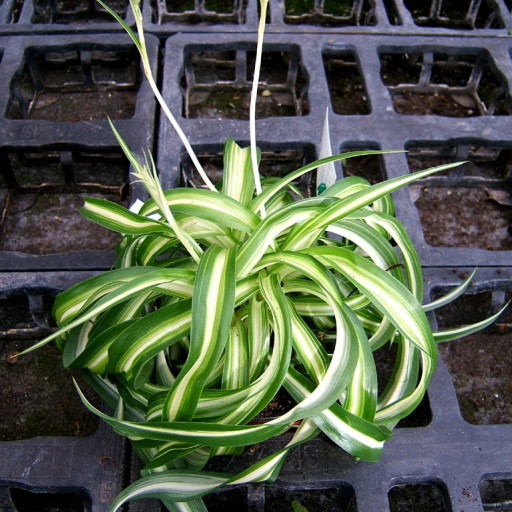
Plant Overview
Known globally as the "Spider Plant," Chlorophytum comosum is perhaps the most iconic and resilient houseplant in the world. Originally hailing from the coastal regions of South Africa, it earned its nickname from the tiny "spiderettes" that dangle from the mother plant like friendly arachnids on a silken web. It is a symbol of endurance and is often the very first plant a budding gardener learns to propagate.
🔍 How to Identify
- 🍃 Arching Foliage: Long, narrow, sword-shaped leaves that grow in a central rosette and arch gracefully outward. While some are solid green, most household varieties feature a creamy white stripe down the center or along the edges.
- 🕸️ Stolons (Runners): Mature plants send out long, wiry, yellowish stems. These stems produce small, star-shaped white flowers that eventually transform into miniature clones of the parent plant.
- 🥕 Fleshy Roots: Beneath the soil, the plant develops thick, white, tuberous roots. These are specialized storage organs that hold water and nutrients, allowing the plant to survive during "droughts" caused by a forgetful owner.
🏡 In Your Garden & Home
- 🌤️ Light Nuance: While it is incredibly adaptable, the Spider Plant prefers "dappled" light. Direct afternoon sun can scorch the delicate leaves, causing brown "burn" spots, whereas too little light may cause the vibrant white variegation to fade back to green.
- 💧 The "Pale" Tell: This plant is excellent at communicating its needs. When it is thirsty, the vibrant green leaves will turn a dull, dusty grey-green and go limp. Once watered, the leaves usually "snap" back to their bright color within a few hours.
- 🪴 Potting Behavior: Because of its aggressive, tuberous root system, the Spider Plant can become "root-bound" quickly. It has been known to actually crack plastic or thin ceramic pots as its roots expand in search of more space.
⚠️ Safety & Toxicity
- 🐾 Pet Safe: Unlike many common houseplants, the Spider Plant is considered non-toxic to cats and dogs by the ASPCA.
- 🐈 A Note for Cat Owners: Many cats are strangely attracted to the leaves, which contain mild compounds similar to opium that can have a slightly hallucinogenic effect on felines. While not poisonous, excessive munching can lead to a mild upset stomach or "kitty hangovers."
✨ Fun Fact
In 1989, NASA conducted the "Clean Air Study" and found that the Spider Plant is a powerhouse at scrubbing indoor air. It was proven to remove up to 95% of toxic household agents, such as formaldehyde and xylene, from the surrounding atmosphere!

Detailed Care Instructions
| Soil Ph | Neutral |
| Humidity | Normal |
| Lighting | Part Sun |
| Toxicity | Non-Toxic |
| Soil Type | Fast-Draining, Well-Aerated Potting Mix |
| Difficulty | Easy |
| Plant Type | Herbaceous, Perennial |
| Hibernation | Cold Period |
| Mature Size | Up To Three Feet (Stems) |
| Native Area | South Africa |
| Temperature | 10°C - 27°C |
| Sun Exposure | From Semi-Shady To Partial Direct Sun |
| Hardiness Zones | 9-11 |
To grow a Chlorophytum Comosum plant, also known as a Spider Plant, follow these steps:
- Choose a suitable location: Spider plants thrive in bright, indirect light. Place them near a window where they can get filtered sunlight. Avoid direct sunlight as it can burn the leaves.
- Plant in well-draining soil: Spider plants prefer well-draining soil to prevent waterlogging. Use a potting mix that is light and airy. You can also add some perlite or sand to improve drainage.
- Select a container: Choose a pot with drainage holes to prevent excess water accumulation. Spider plants can grow in a variety of pot sizes, but make sure the container is not too small to restrict root growth.
- Propagation: Spider plants are easily propagated by dividing the plant or using the plantlets, commonly known as spiderettes, that grow from the parent plant. To propagate using spiderettes, wait until they have developed their own root system and then carefully separate them from the parent plant and plant them in a new container.
- Watering: Spider plants prefer slightly moist soil. Water the plant thoroughly whenever the top inch of soil feels dry. Avoid overwatering, as it can lead to root rot. In winter, reduce the frequency of watering.
- Humidity: Spider plants appreciate higher humidity levels, so mist the leaves occasionally or place the pot on a tray filled with pebbles and water to increase humidity around the plant.
- Fertilization: Spider plants are not heavy feeders, but you can apply a balanced houseplant fertilizer diluted to half strength once a month during the growing season (spring and summer). Avoid fertilizing in winter.
- Pruning: Trim off any yellow or dead leaves to maintain the plant's overall appearance and health. Regularly remove any long, leggy growth or plantlets that have outgrown their pot.
- Repotting: Spider plants prefer slightly crowded roots, but if the plant becomes rootbound or outgrows its container, repot it into a slightly larger pot with fresh soil.
- Pests and diseases: Spider plants are generally resistant to pests and diseases. However, they can occasionally be affected by mealybugs or spider mites. If you notice any signs of infestation, treat the plant with an appropriate pesticide or use a gentle organic solution like neem oil.
By following these guidelines, you should be able to successfully grow a Chlorophytum Comosum plant and enjoy its cascading, arching foliage.

Place in a window with dappled sun or a spot in the middle of a room. Or directly in a window facing west or east.

1. Evaluate your watering goals: It is important to evaluate how much water is needed by the plant and how often it should be watered. Chlorophytum Comosum plant prefers slightly moist soil but not soggy soil.
2. Check the soil: Check the soil's moisture level by dipping your finger about an inch into the soil. If it feels dry, then it's time to water the plant.
3. Watering methods: Chlorophytum Comosum plant can be watered in several ways, including the traditional top watering method and bottom watering method. Top watering involves pouring water directly on the soil surface, while bottom watering involves soaking the pot in a tray of water for a few minutes, allowing the soil to absorb water from the bottom up.
4. Avoid waterlogging: Chlorophytum Comosum plant should not be over-watered, as waterlogging can lead to root rot and other issues. If you notice water pooling on the soil surface or sitting in the plant's tray, it is essential to remove the excess water.
5. Watering frequency: The frequency of watering the Chlorophytum Comosum plant depends on various factors like light, temperature, and humidity levels. Generally, the plant needs to be watered once a week, but in winter, it may require less frequent watering.
6. Use filtered water: Chlorophytum Comosum plant doesn't need any specific type of water, but many studies have shown that it thrives well with filtered water. Tap water may contain minerals and chemicals that can be harmful to the plant.
7. Avoid wetting foliage: Chlorophytum Comosum plant should only be watered at the soil level to avoid wetting its foliage. Wetting foliage can lead to fungal growth, which can harm the plant.
8. Don't water at night: It is advisable not to water the Chlorophytum Comosum plant at night as it can lead to fungal growth, harm your plant, and suffocate the soil. Instead, water early in the morning or late in the afternoon.
9. Observe the plant: Always observe your Chlorophytum Comosum plant after watering to ensure it doesn't remain wet for too long, leading to root rot. Also, check if the soil is adequately moist but not waterlogged.
10. Proper drainage: Ensure your pot has proper drainage holes in the base to ensure excess water drains out and doesn't remain in the soil and harm your Chlorophytum Comosum plant.
To fertilize this plant, you should use a water-soluble fertilizer. Mix the fertilizer with water according to the package instructions, then apply it to the soil around the plant. Be careful not to over-fertilize, as this can harm the plant. It is recommended to fertilize once a month during the growing season (spring and summer), and stop fertilizing during the winter months when the plant is dormant.
In order to successfully grow the plant in question, it is important to choose a well-draining soil that is nutrient-rich and has a slightly acidic pH level between 6.0 and 6.5. It is recommended to use a mix of peat moss, perlite, and vermiculite for the soil composition. Other potential additions to the soil mix could include compost, sand, or coconut coir. It is important to ensure that the soil is moist but not waterlogged, as over-watering can lead to root rot. Additionally, the plant should be fertilized regularly with a balanced fertilizer during the growing season to maintain its health and vitality.
Chlorophytum Comosum is a popular indoor plant that can be propagated easily. One way to propagate this plant is through division. First, prepare a new pot with fresh potting soil and make sure it has good drainage. Then, carefully remove the parent plant from its pot and gently shake away the excess soil. Look for natural separations where the plant has already begun to produce baby plants with their own root systems. Separate these baby plants from the parent plant by gently pulling them apart, trying to keep as many roots intact as possible. Plant each baby plant in the new pot and add some water to moisten the soil. The new plants should be kept in a warm, bright location and watered when the soil becomes dry. It's important to note that Chlorophytum Comosum can also be propagated by leaf cuttings, but this process is more difficult and less reliable.
Common pests of the spider plant include Spider mites, fungus gnats, aphids. Make a habit of checking your spider plant frequently for pests so that any infestations can be caught and managed early.








