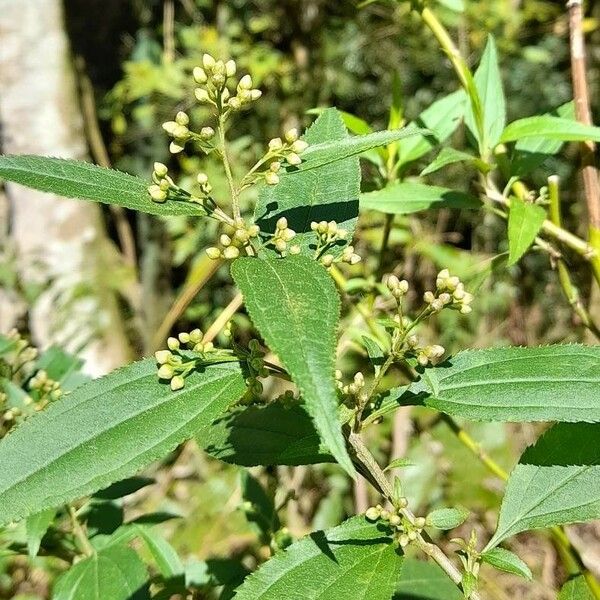
Plant Overview
Often called the Smooth Siam Weed or Smooth Jack-in-the-Bush, Chromolaena laevigata is the more "polished" cousin of the notorious invasive Siam Weed. Native to the lush landscapes of Central and South America, this woody shrub is known for its glossy, emerald-green foliage that looks like it has been buffed to a shine. While it is admired for its resilience and fluffy floral displays, it carries a reputation for being a vigorous grower that can quickly claim territory in a tropical garden.
🔍 How to Identify
- ✨ Glossy Leaves: Unlike its fuzzy relatives, the leaves of this species are remarkably smooth and shiny. They are lance-shaped, grow in opposite pairs, and often feature three distinct veins running from the base.
- 🍇 Purple Stems: The young, supple stems often exhibit a striking reddish or purplish hue before they mature into greyish, woody branches.
- ☁️ Mist-like Flowers: It produces terminal clusters of small, tubular flowers. These "fuzzy" blooms are typically white to pale lavender and appear in dense, flat-topped arrangements that look like soft clouds resting on the foliage.
🏡 In Your Garden
- ☀️ The Sun Seeker: This plant thrives in full sun and is a master of "scrambling." In a garden setting, it will use nearby structures or taller plants as a trellis to lift its leaves toward the light, so it may require regular pruning to keep it from becoming a "space-hog."
- 🌱 Tough as Nails: It is incredibly adaptable to different soil types, provided they are well-draining. Because it naturally inhabits forest edges and disturbed areas, it is very drought-tolerant once established and can survive in "neglected" corners of the yard where other plants might fail.
⚠️ Safety & Toxicity
- 🚫 Toxic if Ingested: Like many members of the Aster family, this plant contains pyrrolizidine alkaloids. These compounds are known to cause liver damage if consumed in significant quantities.
- 🐾 Pet & Livestock Warning: It is particularly dangerous for grazing animals like horses or cattle. While pets are less likely to munch on its woody stems, it is best to keep it out of reach of curious dogs or cats. Some gardeners also report mild skin irritation from the sap when pruning.
✨ Fun Fact
The seeds of Chromolaena laevigata are tiny engineers of flight! Each seed is attached to a "pappus"—a feathery parachute—that allows it to travel miles on a light breeze, helping the plant colonize new tropical frontiers with ease.

Detailed Care Instructions
- Choose a suitable location: Chromolaena Laevigata plants thrive in full sunlight and well-draining soil. Select a spot in your garden that receives 6-8 hours of direct sunlight each day.
- Prepare the soil: This plant prefers rich, loamy soil with good drainage. Amend the soil with compost or organic matter to improve fertility and drainage.
- Plant the seedlings: You can either grow Chromolaena Laevigata plants from seeds or purchase seedlings from a nursery. Plant the seedlings at a depth of about 1 inch and space them at least 12 inches apart.
- Water regularly: Keep the soil consistently moist but not waterlogged. Water the plants deeply once a week, or more often during hot and dry weather.
- Fertilize occasionally: Apply a balanced, water-soluble fertilizer every 4-6 weeks during the growing season (spring and summer) to promote healthy growth and blooming.
- Prune as needed: Trim back any dead or damaged branches to encourage new growth and maintain a compact shape. Pruning can also help promote better air circulation and prevent diseases.
- Protect from pests and diseases: Watch out for common garden pests such as aphids, spider mites, and whiteflies. Use organic insecticides or insecticidal soap to control pest infestations. Additionally, avoid overwatering to prevent root rot and fungal diseases.
- Mulch around the plants: Apply a layer of organic mulch, such as wood chips or straw, around the base of the plants to help retain moisture, suppress weeds, and improve soil fertility.
By following these tips, you can successfully grow and care for Chromolaena Laevigata plants in your garden.
To water the plant in question, it is important to check the soil moisture before watering. Stick your finger about one inch deep into the soil and if it feels dry, it's time to water. Water the plant slowly and deeply until water drains out of the bottom of the pot. Do not let the plant sit in standing water as it can lead to root rot. It is important to maintain a consistent watering schedule, typically around once a week. However, the watering frequency may vary depending on the season and climate. Finally, it is important to avoid getting water on the foliage as this can lead to fungal diseases.
To fertilize Chromolaena laevigata, apply a balanced slow-release fertilizer in the spring or early summer. Use a fertilizer with equal amounts of nitrogen, phosphorus, and potassium. Apply the fertilizer according to the label instructions, being careful not to over-fertilize. Water the plant after applying the fertilizer to ensure proper absorption. Repeat the fertilization process once or twice during the growing season as needed. Avoid fertilizing during the dormant winter months.
Chromolaena Laevigata plant prefers well-draining soil that is rich in organic matter and nutrients. A mix of loamy soil and composted organic matter like peat moss or coir is ideal. It is important to avoid heavy, poorly draining soils, as the excess moisture can cause root rot and other plant diseases. Additionally, the soil should have a slightly acidic to neutral pH level (between 6 and 7), as this is the optimal range for the plant's growth and nutrient utilization. Adding a slow-release fertilizer to the soil during planting is recommended to provide the plant with additional nutrients as it grows.
Chromolaena laevigata plant can be propagated through several methods, including stem cuttings and division. To propagate through stem cuttings, select a healthy and mature stem from the plant. Cut the stem at a 45-degree angle with a sharp and sterile pair of scissors or pruning shears. Remove any leaves from the bottom of the cutting to expose the nodes.
Place the stem cutting in a small pot filled with well-draining soil. Keep the soil moist but not waterlogged and place the cutting in a warm and brightly lit area, but out of direct sunlight. The cutting should begin to develop roots within a few weeks. Once roots have formed, the cutting can be transferred to a larger pot or planted directly in the garden.
To propagate through division, carefully dig up the plant and divide the root ball into smaller sections, making sure that each section has a good amount of roots and foliage. Replant the divided sections in pots or directly in the garden, ensuring that they are well-watered and receive adequate sunlight.
Propagation of Chromolaena laevigata plant can be a rewarding and relatively simple process that allows you to create new plants from an existing source. By following these steps and providing the proper care, you can successfully propagate this plant and expand your garden or indoor plant collection.








