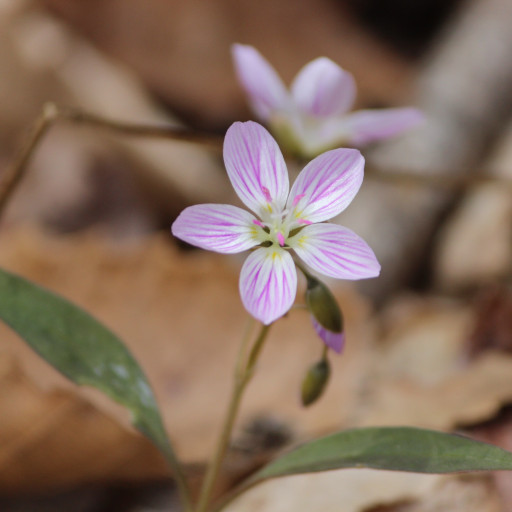
Plant Overview
The Carolina Spring Beauty is a delicate "spring ephemeral" that awakens the forest floor long before most other plants dare to show their faces. Often found carpeting the deciduous woods of Eastern North America, it acts as a silent messenger that winter is finally losing its grip. Its dainty, candy-striped petals and brief life cycle make it a cherished sight for hikers and woodland gardeners alike.
🔍 How to Identify
- 🌸 The Petals: It features five rounded petals that range from pure white to soft pink, prominently marked with distinct, fine magenta veins that serve as "nectar guides" for insects.
- 🍃 The Foliage: Unlike its close relative (the Virginia Spring Beauty), the Carolina species has broader, oval-shaped leaves that are somewhat fleshy and grow in pairs halfway up the stem.
- 🌱 Growth Habit: This is a low-growing plant that rarely exceeds 6 inches in height. It sprouts from a small, round underground tuber that looks like a miniature potato.
🏡 In Your Garden
- 🌳 Ephemeral Nature: This plant is a specialist in timing. It completes its entire life cycle—flowering and seeding—before the trees overhead fully leaf out. By mid-summer, the plant will go completely dormant and disappear underground, so it's important to mark the spot so you don't accidentally dig it up.
- 🐝 Early Pollinators: Because it blooms so early, it is a critical food source for native "mining bees" and hoverflies that emerge during the first warm days of the year when other flowers are still dormant.
⚠️ Safety & Toxicity
- ✅ Safe Status: Claytonia caroliniana is generally considered non-toxic to humans, dogs, and cats.
- 🌿 Foraging Caution: While the plant is safe, it is often found in sensitive forest ecosystems. Foraging is discouraged in many areas to protect the slow-growing native populations from being depleted.
✨ Fun Fact
🥔 Fairy Spuds: The small, starchy tubers of this plant are completely edible and are nicknamed "Fairy Spuds." When boiled in salt water, they are said to taste exactly like tiny, nutty roasted potatoes or chestnuts!

Detailed Care Instructions
| Humidity | Normal |
| Difficulty | Medium |
| Hibernation | Cold Period |
| Temperature | 26°C - 29°C |
| Hardiness Zones | 5 - 9 |
To grow Claytonia Caroliniana, also known as Carolina spring beauty, follow these steps:
- Species Overview: Claytonia Caroliniana is a perennial plant native to eastern North America. It thrives in moist, fertile soils and is typically found in woodlands or along stream banks.
- Planting Time: The best time to plant Claytonia Caroliniana is in early spring or fall. Choose a location with partial shade to full sun and well-draining soil.
- Soil Preparation: Prepare the soil by removing any weeds, rocks, or debris. Loosen the soil to create a favorable environment for the roots to establish and grow.
- Sowing Seeds: Claytonia Caroliniana is usually grown from seeds. Scatter the seeds evenly over the soil surface and lightly press them into the soil. Do not bury them too deep, as they require exposure to light for germination.
- Watering: Keep the soil consistently moist but not waterlogged. Water the seeds regularly, especially during dry periods or if the weather is hot. Avoid overwatering, as it can lead to root rot.
- Mulching: Apply a layer of organic mulch around the plants to retain moisture and suppress weed growth. Mulching will also insulate the soil and protect the shallow roots from extreme temperature fluctuations.
- Fertilization: Claytonia Caroliniana generally does not require heavy fertilization. However, you can apply a slow-release, balanced fertilizer in spring to provide essential nutrients. Follow the package instructions for application rates.
- Maintenance: Remove any weeds that compete with Claytonia Caroliniana for resources. Mulching will help minimize weed growth. Prune back any dead or damaged foliage to maintain the plant's appearance and health.
- Propagation: Claytonia Caroliniana can be propagated by dividing mature clumps or collecting seeds from the mature plants. Divide the plants in early spring or fall, making sure each division has sufficient roots.
- Pests and Diseases: Claytonia Caroliniana is relatively resistant to pests and diseases. However, keep an eye out for any signs of aphids, slugs, or fungal infections. Treat any infestations promptly using organic pest control methods.
Remember to check your specific region's climate and adapt the growing instructions accordingly. Additionally, observe your plant closely and adjust care practices for individual conditions and requirements.

Place in a bright room that is sun drenched almost all day. Or directly in a south-facing window.

To water this plant, thoroughly moisten the soil, ensuring that water reaches the roots. The plant prefers consistent moisture, but be careful not to overwater and cause waterlogging. Allow the top layer of soil to dry out before watering again, as this plant is susceptible to root rot. Ensure adequate drainage in the pot or planting area, and avoid getting water on the leaves as this can cause disease. Use a watering can or hose with a gentle spray nozzle to apply water slowly and evenly.
To fertilize this plant, apply a balanced fertilizer with equal amounts of nitrogen, phosphorus, and potassium. Fertilize once a month during active growth periods, starting in early spring. Avoid over-fertilization as it can cause leaf burn or stunted growth. Water the plant after fertilizing to help the roots absorb the nutrients.
The recommended soil for growing the plant known as Claytonia Caroliniana should be a well-draining soil with a slightly acidic to neutral pH level. The soil should be rich in organic matter and provide adequate moisture to the plant. It is important to avoid compacted soils or those that are prone to waterlogging. Sandy loam or loamy soils are ideal for the plant's growth and development. Additionally, the soil should be free of any pests, diseases, or chemical residues that could harm the plant. It is also advisable to mix in some all-purpose fertilizer into the soil before planting to provide essential nutrients for the plant's growth.
The propagation process for this plant involves taking stem cuttings from a healthy parent plant. The cuttings should be approximately 2-4 inches long and taken from the tips of the stems. Make sure to choose stems that are not flowering or producing seeds.
Once the cuttings have been taken, remove all but the top set of leaves and dip the cut end in rooting hormone powder. Plant the cuttings in a well-draining potting mix and keep them moist and in indirect sunlight.
After a few weeks, the cuttings should begin to develop new roots and can be gradually acclimated to direct sunlight. When the new plants have established strong roots, they can be transplanted into larger containers or into the ground.








