Plant Overview
Often hailed as the "Queen of Climbers," Clematis jackmanii is perhaps the most iconic hybrid in the gardening world. Since its creation in 1858, this Victorian-era favorite has been the gold standard for vertical color, known for its ability to blanket a trellis in a sea of velvet-purple. It is a vigorous scrambler that brings a sense of old-world romance to any garden wall or arbor.
🔍 How to Identify
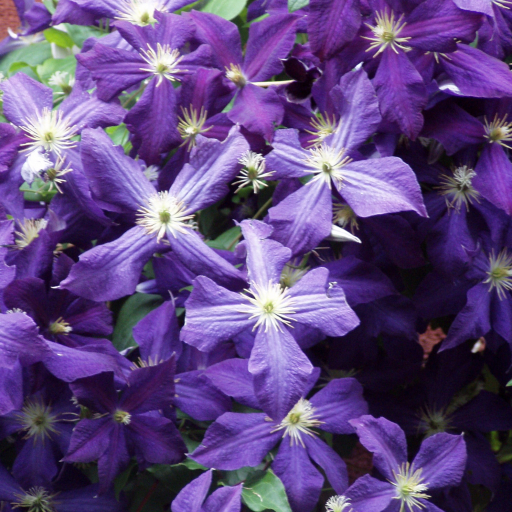
- 💜 The Bloom: Large, four-to-six-petaled flowers that are a deep, saturated violet-purple. The "petals" (technically sepals) have a rich, velvety texture.
- 🌟 The Center: A prominent cluster of creamy-yellow or greenish-white stamens creates a striking "eye" that contrasts beautifully with the dark petals.
- 🌿 The Foliage: Mid-green, heart-shaped or lance-like leaves that grow on twining stems. Unlike many vines, it climbs by wrapping its leaf stalks (petioles) around thin supports like wire or twine.
🏡 In Your Garden
- 🦶 Cool Feet, Warm Head: This is the golden rule for Clematis. They crave full sun for their flowers but need their root zone kept cool and shaded. You can achieve this by planting a low-growing shrub or a thick layer of mulch at the base.
- ✂️ Pruning Logic: Jackmanii is a "Group 3" (Hard Prune) variety. Because it blooms on new growth produced each year, you should cut the entire plant back to about 12 inches above the ground in late winter or early spring to encourage a massive flush of flowers.
- 🧱 Support Needs: Because it climbs with delicate leaf stalks, it cannot grip flat walls. It requires a trellis, netting, or a nearby shrub to scramble through to reach its full 10-12 foot height.
⚠️ Safety & Toxicity
- 🐾 Status: Mildly toxic to pets (dogs, cats, and horses).
- 👄 Details: The plant contains ranunculin, which can cause drooling, vomiting, or diarrhea if ingested. The sap may also cause minor skin irritation or "Clematis itch" in sensitive gardeners, so wearing gloves during pruning is a good idea.
✨ Fun Fact
Though we call them "flowers," the purple parts of a Clematis are actually modified leaves called sepals! Because they lack true petals, the sepals have evolved to be incredibly tough and long-lasting, allowing the bloom to stay vibrant for weeks compared to more delicate garden flowers.

Detailed Care Instructions
To grow a Clematis Jackmanii plant, follow these steps:
- Choose a suitable planting location: Clematis plants prefer full sun to partial shade. Ensure the planting spot has well-draining soil and provides support for the vine to climb on, such as a trellis, fence, or arbor.
- Prepare the soil: Clematis plants thrive in fertile, moist, and slightly acidic soil. Prior to planting, enrich the soil with compost or well-rotted manure. This will improve soil fertility and drainage.
- Planting: Dig a hole that is about twice the size of the root ball. Place the plant in the hole, ensuring that the crown is level with the soil surface. Backfill the hole with soil and gently firm it around the roots.
- Watering: Water the newly planted Clematis thoroughly, ensuring that the soil is evenly moist. Avoid overwatering, as it can lead to root rot. During the growing season, keep the soil consistently moist.
- Mulching: Apply a layer of organic mulch, such as wood chips or bark, around the base of the plant. Mulching helps retain moisture, suppresses weed growth, and keeps the roots cool.
- Pruning: Pruning is essential for Clematis Jackmanii plants to promote healthy growth and abundant flowering. Prune in late winter or early spring before new growth begins. Remove any dead or weak stems and trim back the remaining healthy stems to about 12-18 inches above the ground.
- Fertilizing: Feed the Clematis plant with a balanced, slow-release fertilizer in early spring and midsummer. Follow the instructions on the fertilizer packaging for proper application.
- Support: As the plant grows, make sure to provide support for the vines to climb on. Regularly check and secure the stems to the support system to prevent damage.
- Maintenance: Regularly check for pests and diseases. In case of infestation or disease, treat accordingly with appropriate pesticides or fungicides. Additionally, remove any dead or decaying foliage to promote air circulation and reduce the risk of fungal infections.
- Winter care: In colder climates, Clematis Jackmanii may need protection from harsh winter conditions. In late fall, after the plant has gone dormant, cover the base with a layer of mulch to insulate the roots. You can also use a protective covering, such as burlap, to shield the plant from extreme cold and wind.
By following these guidelines, you can successfully grow and care for a beautiful Clematis Jackmanii plant.
Clematis Jackmanii is a climbing plant that requires regular watering to grow and bloom properly. To water this plant, you should first check the soil to see if it is dry. If the soil is dry to the touch, it is time to water the plant.
To water the Clematis Jackmanii plant, you should use a watering can or hose with a gentle flow of water. Make sure to water the soil and avoid getting water on the leaves or flowers as this can cause damage and fungal diseases.
Water the plant until the soil is moist but be careful not to overwater as this can lead to root rot. It is recommended to water the Clematis Jackmanii plant deeply once a week, especially during hot and dry weather.
In addition to regular watering, Clematis Jackmanii also benefits from mulching the soil around it with organic material to retain moisture and suppress weed growth.
For best results, apply a balanced fertilizer in the spring before new growth appears, and then again in the summer after the first wave of blooms. Use a slow-release granular fertilizer and follow the recommended application rate on the package, being careful not to over-fertilize. Water the plant thoroughly after fertilizing to help distribute the nutrients throughout the root zone. Avoid fertilizing in the fall as this can encourage new growth that may not have time to harden off before winter.
The ideal soil for the particular plant in question is a well-draining, fertile soil that is rich in organic matter. It should have a slightly acidic to neutral pH level (around 6.0-7.0) and be kept consistently moist, but not waterlogged. It is recommended to incorporate compost or well-rotted manure into the soil before planting, as well as providing a layer of mulch around the base of the plant to help retain moisture and regulate soil temperature. Additionally, the plant may benefit from occasional fertilization with a balanced, slow-release fertilizer throughout the growing season.
To propagate this plant, begin by taking a cutting from the parent plant. Make a clean cut just below a leaf node, using a sharp, sterile pair of pruning shears. The cutting should be around 4-6 inches long with at least two or three sets of leaves.
Next, remove the lower leaves from the cutting, leaving just a few at the top. Dip the cut end of the stem in rooting hormone powder, and then plant it in a container filled with a well-draining potting mix. Water the cutting well and place it in a bright, filtered light area.
Keep the soil moist and mist the cutting regularly to keep the humidity high. After a few weeks, you should start to see new growth emerging from the top of the cutting, indicating that roots have formed.
Once the cutting has established roots, transplant it into a larger pot or directly into the ground, being careful not to disturb the roots. Water well and continue to care for the plant as you would a mature Clematis Jackmanii plant.








