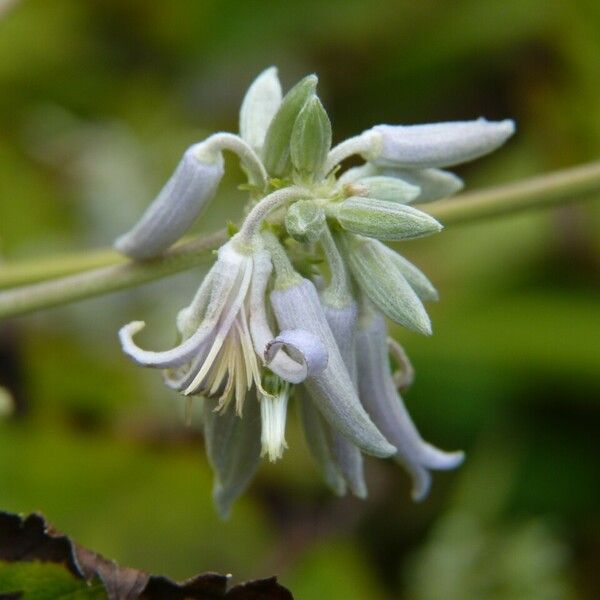
Plant Overview
Known as the "Kusabotan" in its native Japan, Clematis stans is the rebellious cousin of the famous climbing vines. Unlike most Clematis that scale trellises and walls, this sub-shrubby perennial prefers to stay grounded, forming a lush, upright mound of foliage. It is cherished by woodland gardeners for its "unconventional" Clematis look and its delicate, hyacinth-like fragrance that wafts through the late-summer air.
🔍 How to Identify
- 🔔 The Flowers: Small, tubular, nodding bells in shades of pale violet-blue or white. The petal tips recurve (curl backward) dramatically, looking like tiny, elegant squids or lily-of-the-valley blooms.
- 🌿 The Foliage: Large, coarse, trifoliate leaves (sets of three) with deeply toothed edges. The foliage is much more substantial than climbing Clematis and can easily be mistaken for a shrub at first glance.
- 🏗️ Growth Habit: This is a non-vining species. It grows in a fountain-like, semi-woody clump reaching about 2–3 feet in height. It lacks the twining petioles (leaf stalks) that its cousins use to climb.
🏡 In Your Garden
- 🍂 Pruning Nuance: Since it blooms on "new wood" (the current season's growth), it belongs to Pruning Group 3. You should cut it back hard to about 6–12 inches above the ground in early spring to encourage a fresh, bushy explosion of leaves.
- 💧 Cool Roots, Sun Face: Like all Clematis, it follows the rule of "feet in the shade, head in the sun." It thrives best when the base of the plant is mulched or shaded by smaller perennials, while the foliage enjoys dappled sunlight.
- 🌬️ Support Systems: While it doesn't climb, its stems can become "floppy" when heavy with blooms. Planting it near sturdier neighbors or using a low circular peony hoop can help maintain its upright, elegant shape.
⚠️ Safety & Toxicity
- 🤢 Status: Toxic to pets and humans if ingested.
- 🤚 Details: The plant contains protoanemonin, a bitter compound that causes mouth pain and digestive upset. Additionally, the sap can cause localized skin irritation or "Clematis dermatitis" for some gardeners, so wearing gloves while pruning is highly recommended.
✨ Fun Fact
The botanical name stans literally translates from Latin to "standing," a direct nod to the fact that this unique species stands on its own two feet rather than scrambling up a fence like the rest of its family!

Detailed Care Instructions
To successfully grow Clematis Stans, follow these steps:
- Choose a suitable location: Find a spot in your garden that receives full sun to partial shade. Clematis Stans thrives in well-draining soil, so ensure the area has good drainage.
- Prepare the soil: Before planting, dig a hole that is twice as wide and deep as the root ball. Mix compost or well-rotted manure into the soil to improve its quality.
- Planting: Gently place the Clematis Stans plant into the hole, making sure the crown (the point where the roots meet the stem) is level with the soil surface. Fill the hole with soil and gently firm it down.
- Watering: Water the plant thoroughly after planting to settle the soil. Clematis Stans prefers moist soil, so water it regularly, especially during dry spells. However, avoid oversaturating the soil, as it can lead to root rot.
- Mulching: Apply a layer of organic mulch, such as wood chips or bark, around the base of the plant to help retain moisture and suppress weeds. Leave a small gap between the mulch and the stem to prevent rotting.
- Support structure: Provide a trellis, fence, or other support structure for the Clematis Stans plant to climb as it grows. This vine requires vertical support to grow and showcase its beautiful flowers.
- Pruning: Prune Clematis Stans in late winter or early spring. Cut back any dead or weak stems and remove any overcrowded branches. This will encourage new growth and enhance the overall appearance of the plant.
- Fertilizing: Feed the plant with a balanced, slow-release fertilizer in spring and early summer. Follow the package instructions for proper application.
- Protect from harsh conditions: During extreme heat, provide some shade to protect the plant. In regions with cold winters, apply a layer of mulch around the base to insulate the roots from freezing temperatures.
- Monitoring: Regularly monitor the plant for any signs of pests or diseases. Treat any issues promptly to prevent further damage.
By following these steps, you can successfully grow and enjoy a healthy Clematis Stans plant in your garden.

Place in a window with dappled sun or a spot in the middle of a room. Or directly in a window facing west or east.

Clematis Stans is a flowering plant that belongs to the buttercup family. It has beautiful, showy flowers and requires adequate watering for proper growth and flowering. Below are some detailed steps on how to water the Clematis Stans plant:
1. Assess the soil moisture: Before watering the Clematis Stans plant, it is important to check the moisture level of the soil. Insert your finger or a soil moisture meter into the soil, about an inch deep, to determine if it is dry or moist.
2. Frequency of watering: Clematis Stans plants generally require regular watering to maintain adequate moisture in the soil. During the growing season or when the weather is hot and dry, it is usually recommended to water the plant 1-2 times a week.
3. Water amount: When watering the Clematis Stans plant, provide enough water to thoroughly saturate the root zone. It is important to water deeply to encourage the roots to grow deeper into the soil. Typically, watering until the top 6-8 inches of soil is moist is sufficient for this plant.
4. Watering method: To prevent water runoff and ensure the water reaches the plant's roots, it is advisable to use a slow and steady watering method. This can include using a watering can, a drip irrigation system, or a soaker hose. Avoid using a high-pressure spray or sprinkler system, as it may not effectively reach the plant's roots.
5. Mulching: After watering, consider applying a layer of organic mulch around the base of the Clematis Stans plant. Mulch helps retain soil moisture and regulates temperature, reducing water evaporation.
6. Seasonal adjustments: During the cooler months or in periods of reduced growth, such as winter, the Clematis Stans plant requires less water. Adjust your watering schedule accordingly, allowing the soil to partially dry out between waterings.
7. Avoid overwatering: While adequate watering is essential, it is important to avoid overwatering the Clematis Stans plant. Overwatering can lead to root rot or other fungal diseases. Always check the soil moisture before watering and ensure that excess water can drain away from the plant's root zone.
By following these detailed steps, you can provide the proper amount of water to your Clematis Stans plant, allowing it to thrive and produce beautiful flowers.
To fertilize the Clematis Stans plant, you can follow these instructions:
- Use a balanced, water-soluble fertilizer designed for flowering plants. Look for a fertilizer with an equal NPK ratio or relatively high phosphorus content.
- Dilute the fertilizer according to the package instructions. Typically, you will mix it with water to achieve the desired concentration.
- Water the plant thoroughly before applying the fertilizer. This ensures that the roots are well-hydrated and prepared to take in the nutrients.
- Apply the diluted fertilizer to the base of the plant, avoiding direct contact with the foliage. You can use either a watering can or a garden sprayer, depending on your preference.
- Follow a regular fertilizing schedule throughout the growing season. Generally, feeding the Clematis Stans plant every two to four weeks during the spring and summer months is recommended.
- Monitor the plant's response to the fertilizer. If the foliage becomes excessively dark or growth appears stunted, reduce the amount or frequency of fertilizing.
- Water the plant lightly after each fertilization to help the nutrients penetrate the soil and reach the roots.
- Avoid overfertilization, as it can lead to excessive vegetative growth and reduce the plant's ability to produce flowers.
- During the fall and winter months, reduce or stop fertilizing, as the plant enters a dormant phase.
- Always read and follow the instructions provided with the fertilizer for specific dosage and application guidelines.
Clematis Stans, also known as the plant in question, prefers a specific type of soil that helps promote optimal growth and health. The most suitable soil for Clematis Stans is well-draining and fertile. It should provide adequate moisture to the plant without becoming waterlogged.
A mixture of sandy loam soil and organic matter, such as compost or well-rotted manure, is recommended for Clematis Stans. This combination ensures that the soil is rich in nutrients and retains moisture while allowing excess water to drain away.
The pH level of the soil should be slightly acidic to neutral, ranging between 6.0 and 7.0. This range provides an ideal environment for the plant's roots to absorb nutrients efficiently.
It is crucial to avoid using heavy clay soils or those prone to retaining moisture for Clematis Stans, as such soils can lead to waterlogging and root rot. Additionally, sandy soils that drain too quickly may result in inadequate moisture retention.
To further enhance the soil conditions for Clematis Stans, organic mulch can be applied around the base of the plant. This helps to retain moisture, regulate soil temperature, and inhibit the growth of weeds.
Regular soil testing can be helpful in determining if the soil needs any amendments or adjustments to meet the specific needs of Clematis Stans. It is important to monitor the soil moisture levels and provide supplemental irrigation, especially during dry spells or periods of high heat.
By providing the appropriate soil type and conditions, it is more likely that Clematis Stans will thrive and produce abundant blooms, adding beauty to any garden or landscape.
Clematis Stans is a perennial plant that can be easily propagated through various methods to create new plants. Here is a step-by-step guide on how to propagate Clematis Stans:
- Select a healthy parent plant: Choose a well-established, mature Clematis Stans plant to take cuttings from. Ensure that the plant is disease-free and vibrant.
- Gather the necessary tools: Collect a sharp pair of sterilized gardening shears or a knife, a clean container with drainage holes, a rooting hormone (optional), high-quality potting soil, and water.
- Choose the right time: The best time to propagate Clematis Stans is during the spring or early summer when the plant is actively growing.
- Take stem cuttings: Locate a non-flowering stem that is around 4-6 inches in length. Make a clean, diagonal cut just below a node (a point where leaves emerge). Remove any lower leaves, leaving only a few on the upper part of the stem.
- Prepare the cutting: If desired, dip the cut end of the stem into a rooting hormone powder or gel. This hormone can help stimulate root growth, although it is not necessary for successful propagation.
- Plant the cutting: Fill a clean container with moist, well-draining potting soil. Create a hole in the soil with a pencil or your finger and gently insert the cutting into the hole, ensuring the leafy part of the stem is above the soil surface. Firmly press the soil around the cutting to secure it.
- Provide proper care: Place the container in a location that receives bright, indirect sunlight. Ensure that the soil remains consistently moist, but not waterlogged. Mist the cutting regularly to maintain humidity levels.
- Ensure ideal temperature and moisture: Clematis Stans cuttings prefer a warm and humid environment for successful rooting. Keep the temperature between 70-75°F (21-24°C) and use a transparent plastic bag or a propagator dome to create a mini greenhouse effect and retain moisture around the cutting.
- Monitor and wait for rooting: Over the next few weeks, check the cutting regularly for signs of new growth or root development. Avoid disturbing the cutting during this time to allow it to establish itself.
- Transplant the rooted cutting: Once the cutting has developed a healthy root system, usually after 6-8 weeks, it is ready to be transferred to a larger pot or planted directly in the garden. Ensure the new growing location provides adequate sunlight, well-draining soil, and enough space for the plant to grow and climb.
Remember to provide regular care and maintenance to your propagated Clematis Stans plant, including regular watering, pruning, and providing necessary support for climbing. With proper care, your propagated Clematis Stans will thrive and add beauty to your garden.








