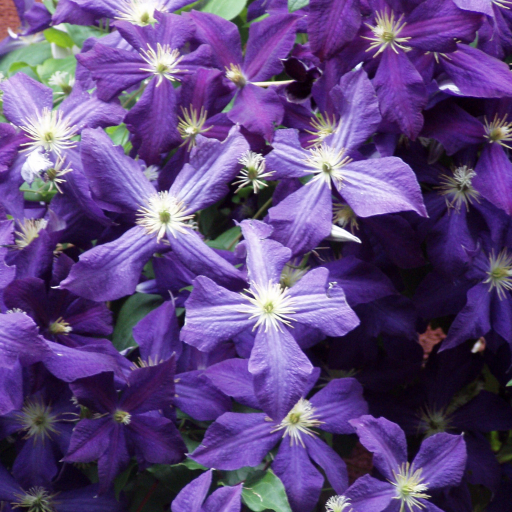
Plant Overview
Often hailed as the "Queen of Climbers," the Clematis x Jackmanii is perhaps the most famous hybrid in the gardening world. Created in 1858 by George Jackman in England, this Victorian-era treasure remains a staple today for its massive, velvety purple blooms that can transform a plain fence into a royal tapestry. It is a vigorous climber that uses its leaf stalks to coil around supports like delicate fingers.
🔍 How to Identify
- 💜 The Bloom: Large, four-to-six-petaled flowers reaching up to 5–7 inches across. They feature a rich, royal purple color with a velvety texture and a striking cluster of creamy-yellow stamens in the center.
- 🍃 The Foliage: Medium-green leaves that are usually trifoliate (divided into three leaflets), providing a dense backdrop that makes the purple flowers "pop."
- 🧗 The Habit: A deciduous woody vine that climbs by twisting its petioles (leaf stalks) around any thin structure, such as wire, trellis, or even other shrubs.
🏡 In Your Garden
- 🦶 Cool Feet, Warm Head: This plant has a famous quirk—it loves its "head" in the full sun to produce those brilliant flowers, but its "feet" (roots) must stay cool. Gardeners achieve this by planting low-growing perennials around the base or using a thick layer of mulch to shade the soil.
- ✂️ Pruning Group 3: Unlike some Clematis that bloom on old wood, Jackmanii is a "late-flowering" type. This means it blooms on the current season's growth. To keep it from becoming a tangled mess, you should cut it back hard (to about 12 inches from the ground) in late winter or early spring.
- 🏗️ Support Systems: Because it climbs via thin leaf petioles, it cannot grip thick wooden posts or brick walls directly. It needs a fine mesh, wire, or thin trellis to successfully make its way upward.
⚠️ Safety & Toxicity
- 🚫 Toxic to Pets: Like most members of the Ranunculaceae family, it contains protoanemonin. If ingested by dogs, cats, or horses, it can cause drooling, vomiting, and diarrhea.
- 🧤 Skin Irritation: The sap can be an irritant to human skin. It is wise to wear gloves when pruning your Clematis to avoid a mild itchy rash or "Clematis dermatitis."
✨ Fun Fact
The Clematis x Jackmanii was the first large-flowered hybrid ever produced and won the prestigious First Class Certificate from the Royal Horticultural Society way back in 1863—a title it still lives up to over 160 years later!

Detailed Care Instructions
To grow a Clematis X Jackmanii plant, follow these steps:
- Choose the right location: Clematis plants prefer a sunny spot with at least 6 hours of direct sunlight each day. Ensure the soil is well-draining and rich in organic matter.
- Prepare the soil: Before planting, amend the soil with compost or well-rotted manure to improve its fertility and drainage. Avoid planting in heavy clay or waterlogged areas.
- Planting: Dig a hole that is twice as wide and deep as the root ball of the plant. Gently loosen the roots and place the plant in the hole, ensuring that the crown is at or slightly above the soil level. Backfill the hole with soil, firming it gently around the roots.
- Support structure: Clematis plants are climbing vines and require some support. Install a trellis, fence, or other vertical structure near the plant to provide support for its growth.
- Watering: Regular watering is essential, especially during the first year of growth. Water deeply, ensuring the water reaches the roots. Avoid overwatering, as Clematis plants prefer moist but not waterlogged soil.
- Mulching: Apply a layer of organic mulch around the base of the plant to retain soil moisture and regulate temperature. Avoid covering the crown, as it can lead to rot.
- Pruning: Clematis X Jackmanii blooms on new wood, so it's best to prune it in late winter or early spring before new growth emerges. Remove any dead or damaged wood and cut back the remaining stems to around 12-18 inches from the ground. This encourages vigorous growth and abundant blooms.
- Fertilizing: Feed the plant in early spring with a balanced slow-release fertilizer, following the package instructions. Avoid high-nitrogen fertilizers, as they can promote leaf growth at the expense of flowers.
- Pest and disease management: Monitor the plant regularly for aphids, slugs, and other common pests. Treat them promptly using organic or chemical pest control methods. Watch for signs of diseases like powdery mildew or leaf spot, and address them as soon as detected.
- Winter protection: In colder climates, provide winter protection by mulching above the crown with a layer of straw or leaves. This helps insulate the roots and prevent freezing.
With proper care and attention, your Clematis X Jackmanii plant should grow vigorously and reward you with beautiful blooms.
Clematis X Jackmanii plant is a vine that is known for its beautiful flowers. When it comes to watering this plant, it is recommended to follow a few tips to ensure that the plant stays healthy and hydrated.
Firstly, the soil of the Clematis X Jackmanii plant should be kept moist at all times, but not waterlogged. One way to do this is to water the plant deeply once a week, allowing the water to soak into the soil. Depending on the environment and season, it may be necessary to water the plant more or less frequently.
It is important to note that the Clematis X Jackmanii plant is sensitive to water stress, which means it should not be allowed to get too dry or too wet. This can be an issue during extreme weather conditions or if the plant is placed in a pot with poor drainage.
It is also recommended to water the plant in the morning or early afternoon to avoid water droplets sitting on the leaves overnight, which can lead to fungal diseases.
Overall, it is important to monitor the soil moisture level and adjust watering accordingly to keep the Clematis X Jackmanii plant healthy and thriving.
To provide nutrients for the aforementioned plant, it is advisable to apply a balanced fertilizer containing equal parts of nitrogen, phosphorus, and potassium, with a ratio of 10-10-10 or 12-12-12. This should be done every spring and early summer, depending on the plant's growth and health. Additionally, it is recommended to add a layer of organic mulch to the soil around the base of the plant, which will gradually break down and provide a nutrient-rich environment that will help nourish the plant. Finally, watering should be done conservatively, as the plant prefers well-drained soil that is neither too moist nor too dry.
The optimal soil for Clematis X Jackmanii is a well-drained, slightly alkaline soil with a pH range between 6.5 and 7.5. The soil should be rich in organic matter and should have a good supply of nutrients, especially potassium and phosphorus. It is recommended to use a blend of compost, peat moss, and perlite to create a light, fluffy soil mix that promotes good drainage and aeration. The plant also prefers a deep soil that allows for ample root growth, so a deep planting hole is recommended. Avoid using soil that is compacted or heavy, as it may lead to poor drainage and root rot.
To propagate this plant, you will need to take stem cuttings from a healthy mother plant. First, choose a stem that is mature and not too woody. Cut off a piece that is about four inches long and has at least two nodes. Remove the lower leaves from the stem, leaving only one or two at the top.
Next, dip the cut end of the stem in rooting hormone powder to encourage root growth. Plant the stem cutting in a pot filled with a well-draining potting mix and water it thoroughly. Cover the pot with a plastic bag to create a humid environment and place it in a bright, indirect light location.
Check on the cutting periodically and water it as needed to keep the soil moist but not waterlogged. After a few weeks, you should see new growth emerging from the top of the cutting, which is a good sign that roots have formed.
Once the cutting has established roots and has grown at least two sets of leaves, it can be transplanted into a larger pot or into the ground in a suitable location. With proper care and attention, your new plant should continue to grow and bloom for many years to come.








