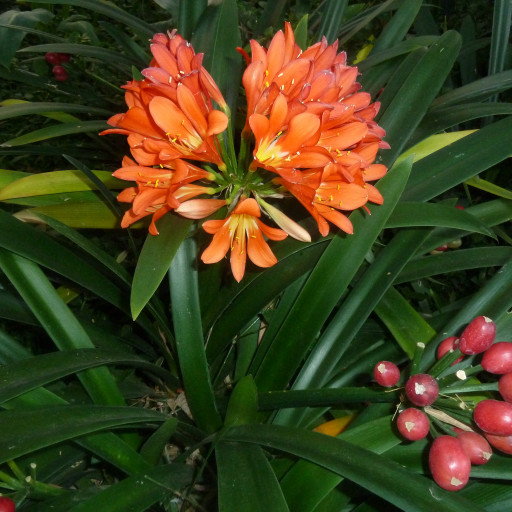
Plant Overview
Known affectionately as the Bush Lily or Natal Lily, the Clivia miniata is a true "shade royalty" from the woodland floors of South Africa. Unlike many flowering plants that crave the spotlight, this elegant perennial prefers the dappled shadows of a porch or a dim corner of your home. It is widely beloved for its ability to produce bursts of fiery orange blooms exactly when most other plants are resting.
🔍 How to Identify
- 🌿 Strap-Like Foliage: The leaves are thick, leathery, and dark green, growing in a distinctive symmetrical fan shape from the base.
- 🎺 Trumpet Blooms: It produces a central flower stalk topped with a cluster (umbel) of 10 to 20 trumpet-shaped flowers, typically bright orange with a contrasting yellow throat.
- 🍒 Ornamental Berries: After the flowers fade, the plant may produce large, fleshy green berries that slowly turn a deep ornamental red over several months.
🏡 In Your Garden
- 🏺 The "Cramped" Secret: Clivias actually bloom better when their roots are slightly crowded. If you move them to a massive pot too soon, they may focus all their energy on leaf growth rather than those iconic orange flowers.
- ❄️ The Winter Nap: To trigger a spectacular spring show, this plant requires a "tough love" period. From late autumn through mid-winter, keep it in a cool spot and almost entirely stop watering; this dry rest mimics its natural South African habitat.
- ☀️ Sunburn Sensitivity: Unlike its succulent cousins, the Clivia has very sensitive skin. Direct afternoon sun will quickly bleach the dark green leaves, leaving permanent, unsightly yellow or brown scorch marks.
⚠️ Safety & Toxicity
- 🚫 Status: Toxic to pets and humans.
- 🐾 Details: The plant contains lycorine, an alkaloid that can cause drooling, vomiting, or diarrhea if ingested. While it would take a large amount to be life-threatening, it is best kept on high shelves away from curious cats, dogs, and toddlers.
✨ Fun Fact
The genus Clivia was named in the 19th century to honor Lady Charlotte Florentia Clive, the Duchess of Northumberland and one-time governess to Queen Victoria, who was the first person to grow and flower the species in the United Kingdom.

Detailed Care Instructions
Fire lilies are in the same plant family as the popular winter holiday gift plant amaryllis (Hippeastrum). Both have the same strappy foliage, and both are from South Africa. The amaryllis has larger flowers and blooms earlier in the year. The amaryllis has several hundred cultivars, so you can find a greater diversity in size, shape, and color within the amaryllis group than you can in the fire lilies.
How long does a fire lily live?
These hardy plants can survive for 10 years or so with proper care. Keep in mind that they might not bloom during the first season or two.
How can I keep animals away from my fire lily?
When growing the fire lily as a houseplant, keep it out of reach of curious dogs. When it's growing outside, consider covering the bed with wire mesh just underneath the soil, with appropriate-sized holes cut for the plant to grow through to prevent animals from digging up or munching on the bulbs.
| Color | Orange, Yellow, Cream, Pink |
| Soil Ph | Slightly Acidic; 6.5-7.0 |
| Humidity | Normal |
| Lighting | Full Sun |
| Toxicity | Poisonous |
| Soil Type | Average And Well-Drained |
| Bloom Time | Winter |
| Difficulty | Easy |
| Plant Type | Perennial |
| Mature Size | Two Feet |
| Native Area | South Africa |
| Temperature | 16°C - 24°C |
| Sun Exposure | Partial Sun |
| Hardiness Zones | Usda Zones 10-11 |
To grow Clivia Miniata plants, follow these steps:
- Select a healthy and well-established plant or purchase seeds or seedlings.
- Choose a suitable location with bright, indirect light. Clivia Miniata prefers bright, filtered sunlight, so it can thrive in a north or east-facing window or a spot under a shade tree.
- Prepare the soil by using a well-draining potting mix. Clivia Miniata prefers slightly acidic soil with a pH of around 6.0-6.5.
- Plant the Clivia Miniata in a pot or in a well-prepared garden bed. Make sure the plant is positioned at its original depth, and avoid burying the neck of the plant.
- Water the plant thoroughly after planting and then water it when the top inch of soil feels dry. Avoid overwatering as it can lead to root rot.
- Fertilize the Clivia Miniata plant every 2-3 months during the growing season (spring and summer) with a balanced, slow-release fertilizer. Follow the instructions on the fertilizer package for the correct dosage.
- Maintain a consistent temperature around 70-75°F (21-24°C) during the day and 55-65°F (13-18°C) at night. Clivia Miniata prefers cooler temperatures during its dormant period in the winter.
- Provide high humidity for the plant by misting the leaves regularly or placing a tray of water near the plant.
- In spring, remove any dead or wilted leaves and blooms to keep the plant healthy and promote new growth.
- Clivia Miniata plants may take several years to bloom, so be patient. Once the plant reaches maturity, it will produce clusters of beautiful, trumpet-shaped flowers in shades of orange, red, or yellow.
- Propagate the plant when it becomes overcrowded by dividing the clumps and repotting them in fresh soil.
- Watch out for pests like mealybugs and spider mites. Treat any infestations promptly with appropriate insecticides or by manually removing the pests.
- Enjoy the beauty of your Clivia Miniata plant and continue to care for it as described above for long-lasting growth and blooms.

Place in a window with dappled sun or a spot in the middle of a room. Or directly in a window facing west or east.

Clivia Miniata is a type of plant that requires proper watering techniques to thrive. The best way to water this plant is to avoid watering it too much or too frequently, as this can cause the roots to rot.
To water Clivia Miniata, start by checking the soil's moisture level. Stick your finger into the soil up to your first knuckle to see if the soil feels dry. If the soil is dry, it's time to water the plant.
When watering, use a watering can with a spout to avoid splashing water on the plant's leaves. Slowly pour water around the plant's base until you see water seeping out of the drainage holes at the bottom of the pot. Be sure not to overwater the plant, as this can cause the soil to become waterlogged and lead to root rot.
To ensure the plant's soil retains moisture, add a layer of mulch to the top of the soil. This will help prevent the soil from drying out too quickly. In general, it's best to water Clivia Miniata about once a week, but you should adjust the frequency depending on the plant's specific needs and the temperature and humidity of the environment.
To properly fertilize this plant, use a balanced fertilizer with a 10-10-10 ratio or a similar mix. Apply this fertilizer once per month during the growing season, which is typically from late winter through mid-summer. Avoid fertilizing during the colder months, as the plant's growth may slow or stop during this time. Additionally, always follow the manufacturer's instructions for the specific fertilizer product you choose to use.
The ideal soil for Clivia Miniata plants should be well-draining, with good moisture retention and a slightly acidic pH level. The soil should be rich in organic matter and nutrients to support healthy growth and flowering. It is recommended to use a potting mix that contains a mixture of peat moss, perlite, and vermiculite. Avoid using heavy, clay soils that may cause waterlogging and root rot. Additionally, providing regular fertilizer treatments during the growing season can help ensure optimal plant health.
Propagation of this plant can be done through a few methods including division, seed propagation, and basal offsets. Division involves separating the plant into smaller sections and replanting them. Seed propagation requires collecting and sowing the plants' seeds in a suitable soil medium. Basal offsets refer to the growth of new shoots from the base of the parent plant, which can then be detached and planted independently. Careful attention to proper soil conditions, adequate watering, and sufficient light exposure is necessary for successful propagation. It is also important to handle the plant and its roots with care to avoid damage during propagation.
Common pests of the bush lily include Scale insect, mealybugs, aphids, thrips, larvae. Make a habit of checking your bush lily frequently for pests so that any infestations can be caught and managed early.








