Plant Overview
Often called the Barbados Sea Grape or Uvilla, Coccoloba barbadensis is a rugged tropical evergreen that thrives where other plants falter. A native of the Caribbean and Central America, it is frequently used to stabilize coastal dunes thanks to its incredible resistance to salt spray. With its architectural, leathery leaves and "knobby" fruit clusters, it brings an effortless, sun-drenched aesthetic to any tropical landscape.
🔍 How to Identify
- 🍃 The Foliage: Look for broad, leathery, oval-shaped leaves with a smooth texture and a vibrant green hue. They are often larger and more elongated than those of the common Sea Grape (C. uvifera).
- 🌼 The Flowers: It produces long, drooping spikes (racemes) covered in tiny, fragrant, greenish-white blossoms that attract a variety of pollinators.
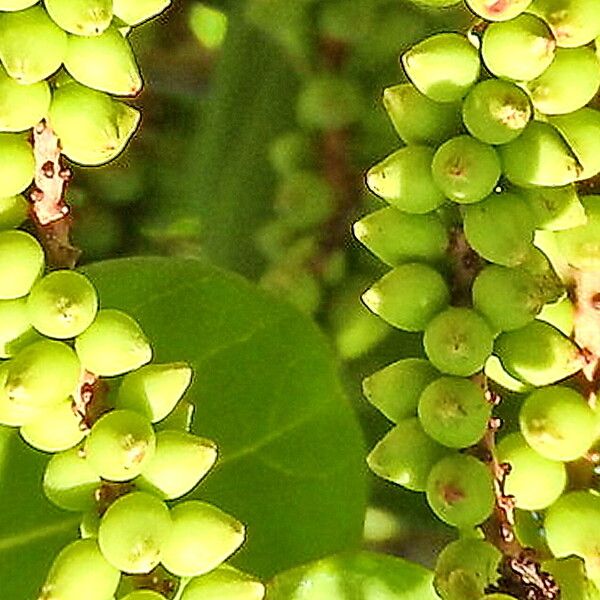
- 🍇 The Fruit: The plant bears small, round fruits that grow in dense clusters. They transition from a bright green to a deep, dark purple or black as they ripen.
🏡 In Your Garden
- 🌊 Salt Warrior: This plant is an excellent choice for beachfront properties. It has evolved to "breathe" through salty air and can handle the abrasive winds of the coast without losing its luster.
- ✂️ Architectural Growth: While it can be trained into a dense, privacy-providing hedge, it naturally grows into a handsome, multi-trunked small tree. It has a deep taproot, so choose its "forever home" carefully—it does not like being moved once established.
⚠️ Safety & Toxicity
- 🟢 Status: Generally non-toxic to humans, but exercise caution around pets.
- 🐾 Details: While the ripe fruits are technically edible for humans (though often quite tart), ingesting large amounts of the leaves or unripe fruit may cause mild digestive upset in dogs or cats. The sap is generally mild but can be slightly sticky or irritating to those with very sensitive skin.
✨ Fun Fact
The genus name Coccoloba is derived from the Greek words kokkos (berry) and lobos (pod), but in its native regions, the wood was historically prized for making durable furniture and even charcoal because of its density and strength!

Detailed Care Instructions







