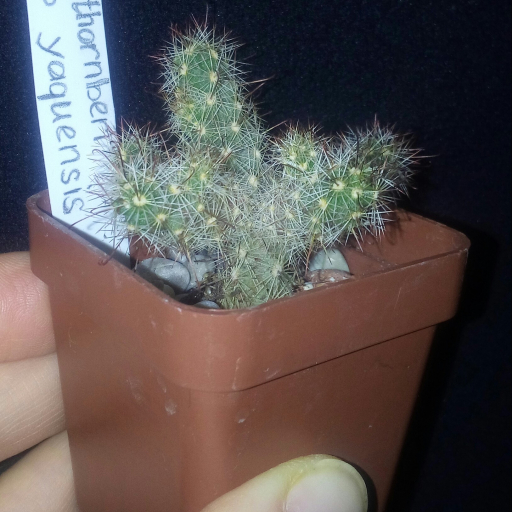
Plant Overview
Often called the Thornber’s Fishhook Cactus, this desert native is a master of disguise and survival. Native to the Sonoran Desert, it spends much of its life huddled in the shade of larger "nurse plants" like Creosote bushes. It is a clumping species, forming low-profile mats of slender, finger-like stems that look like a collection of tiny, spiky pickles until they erupt in stunning springtime color.
🔍 How to Identify
- 🌵 Stem Shape: Slender, cylindrical stems that grow in dense clusters. They are often a pale green but can turn a deep reddish-purple when "stressed" by sun or cold.
- 🪝 The Fishhooks: Each spine cluster features one or more dark, central spines that curve into a sharp, prominent hook—true to its common name.
- 🌸 The Bloom: Large, funnel-shaped flowers appear near the tips of the stems. They are typically white or pale pink with a distinct, darker lavender mid-stripe on each petal.
🏡 In Your Garden
- 🛡️ The Nurse Plant Strategy: Unlike many cacti that crave blistering, direct sun, Cochemiea thornberi prefers "filtered" light. In a home setting, it thrives in a spot that mimics the dappled shade of a desert shrub.
- 📉 Seasonal Shinking: This plant is a "contractor." During periods of extreme drought or winter dormancy, it will actually lose water volume and pull itself closer to the soil line to stay protected. Avoid the urge to overwater when it looks "shriveled" in winter.
⚠️ Safety & Toxicity
- 📌 Physical Hazard: This plant is not chemically toxic to humans or pets, but it is physically aggressive. The hooked spines act like "Velcro" and will latch onto fur, clothing, or skin with the slightest touch.
- 🐾 Pet Safety: Keep this cactus out of reach of curious dogs or cats. Because the spines are hooked, they do not pull out easily and can cause significant distress or skin tearing if a pet tries to pull away.
✨ Fun Fact
🏜️ This cactus is a "hitchhiker." In the wild, the hooked spines allow small stem segments to break off and latch onto the fur of passing animals. The animal carries the segment to a new location where it eventually falls off and takes root, allowing the plant to "travel" across the desert!

Detailed Care Instructions
To grow Cochemiea Thornberi successfully, follow these steps:
- Soil: Cochemiea Thornberi prefers well-draining soil with a sandy or gravelly texture. A cactus or succulent potting mix works well.
- Light: Cochemiea Thornberi thrives in full sun to partial shade. Place it in a location where it receives at least 6 hours of direct sunlight per day.
- Watering: Water your Cochemiea Thornberi sparingly, allowing the soil to dry out completely between waterings. During the growing season (spring and summer), water more frequently but reduce watering in the winter.
- Temperature: Cochemiea Thornberi is cold hardy and can tolerate temperatures down to 20°F (-6°C). However, it prefers warmer temperatures between 70-90°F (21-32°C) during the growing season.
- Fertilizing: Apply a balanced cactus fertilizer during the growing season, following the manufacturer's instructions for dilution and frequency.
- Propagation: Cochemiea Thornberi can be propagated from seeds or offsets. To propagate from offsets, wait until they are about 1/3 the size of the parent plant before removing and planting in a separate pot.
- Pests and diseases: Monitor your Cochemiea Thornberi for common cactus pests such as mealybugs and scale insects. Treat any infestations promptly with insecticidal soap or neem oil.
With proper care and attention to its specific growing requirements, your Cochemiea Thornberi plant should thrive and grow successfully.
To water Cochemiea Thornberi, it is important to thoroughly saturate the soil until water begins to run out of the drainage holes at the bottom of the pot. Allow the soil to dry out completely between waterings to prevent root rot. It is best to water this plant sparingly during the winter months when it is in a dormant state. Additionally, it is important to avoid getting water on the spines or body of the plant to prevent damage and rot. Be sure to use room temperature water to avoid shocking the roots.
To fertilize Cochemiea Thornberi plant, use a balanced fertilizer with an N-P-K ratio of 10-10-10 diluted to half strength. Apply the fertilizer during the plant's active growing season, usually in the spring and summer months. Water the plant before and after applying the fertilizer to prevent root burn. Avoid over-fertilizing, as this can cause damage to the plant. Follow the instructions on the fertilizer package for proper application rates.
Cochemiea Thornberi plants thrive in well-draining soil that is sandy or rocky in texture. A mixture of sand, perlite, and peat moss can be used to create the ideal growing medium for these plants. This type of soil allows for proper aeration and drainage, preventing the roots from becoming waterlogged. It is important to avoid using heavy or compacted soils, as these can suffocate the roots and lead to root rot. A slightly acidic to neutral pH level is preferred for Cochemiea Thornberi plants, so adding some limestone or agricultural lime can help balance the soil pH. Additionally, incorporating some organic matter, such as compost or aged manure, can provide essential nutrients for healthy growth. Overall, selecting a well-draining soil mix with a balance of sand, perlite, peat moss, and organic matter is key to successfully growing Cochemiea Thornberi plants.
Cochemiea Thornberi plants can be propagated through division or from cuttings. To propagate through division, carefully separate the offsets or new growth from the mother plant using a sharp, clean knife. Plant the offsets in well-draining soil and water them lightly until they establish roots.
To propagate from cuttings, select a healthy stem from the mother plant and cut it at a 45-degree angle using a sterilized knife. Allow the cutting to dry and callous for a few days before planting it in a well-draining soil mix. Water lightly and keep the cutting in a warm, bright location until it establishes roots.
Propagation can also be done by seed, although this method can take longer to see results. Collect seeds from mature plants and plant them in a sandy, well-draining soil mix. Keep the soil consistently moist and provide bright, indirect light for the best chance of successful germination.








