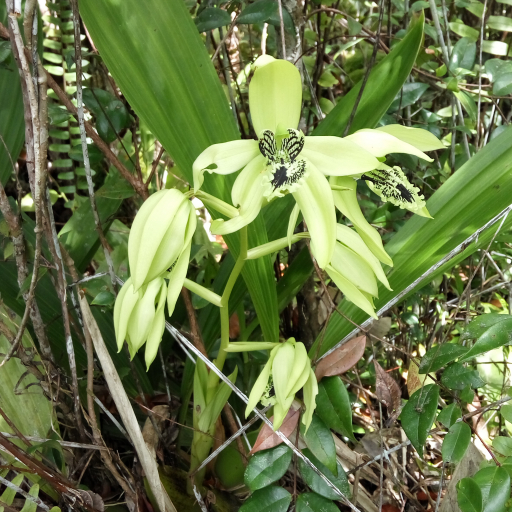
Plant Overview
Often called the "Black Orchid," this Bornean native is the epitome of exotic drama. Its ghostly pale green petals contrast sharply with a velvety, jet-black center, making it a prized jewel among orchid collectors. In its native Indonesia, it is so revered that it serves as the floral emblem for the province of East Kalimantan, where it is known as Anggrek Hitam.
🔍 How to Identify
- 🌸 The "Black" Lip: The most striking feature is the violin-shaped labellum (lip) marked with intricate, coal-black veins and ridges that look like they were painted with ink.
- 🍃 Ribbed Foliage: It produces large, leathery, and pleated leaves that can grow quite long, emerging from the top of its water-storing bulbs.
- 🍐 Flattened Pseudobulbs: Look for bright green, oblong pseudobulbs that are unusually flat compared to other orchid species; these act as the plant's hydration reservoirs.
🏡 In Your Garden
- 🪜 The "Walking" Habit: This orchid is a wanderer. It has a long creeping rhizome (stem), meaning new bulbs grow several inches away from the old ones. It will quickly "climb" out of a standard pot, so it is best grown in long wooden baskets or mounted on large pieces of cork bark.
- ☁️ Tropical Humidity: Hailing from swampy lowland forests, it craves high humidity and consistent warmth. It doesn't have a true "dormancy" period, so while you should let it breathe, it never wants to be bone-dry.
- 🍯 Scented Blooms: When it flowers in late spring or summer, it releases an intense, honey-like fragrance that can fill an entire room or greenhouse.
⚠️ Safety & Toxicity
- ✅ Safe Status: Coelogyne pandurata is considered non-toxic to humans.
- 🐾 Pet Friendly: It is generally safe for cats and dogs. However, because the leaves are quite fibrous, if a pet decides to chew on them, it might cause minor indigestion or vomiting simply due to the texture.
✨ Fun Fact
🎻 The species name pandurata comes from the Latin word pandura, which refers to a stringed instrument similar to a lute or violin. This describes the unique, narrowed "waist" of the flower's black-marked lip.

Detailed Care Instructions
To successfully grow a Coelogyne Pandurata plant, also known as the black Orchid, follow these steps:
- Light: Provide bright but indirect light for your Coelogyne Pandurata plant. It should receive filtered sunlight or bright shade, avoiding direct sunlight as it can damage the leaves. An east or west-facing window is ideal.
- Temperature: Maintain moderate temperatures for the plant, typically between 65-80°F (18-27°C). This orchid species prefers slightly cooler temperatures at night, which can promote blooming.
- Humidity: Coelogyne Pandurata plants thrive in high humidity. To increase humidity, you can place the pot on a tray filled with water and pebbles. Grouping other plants around it or using a humidifier can also help.
- Watering: Orchids, including Coelogyne Pandurata, require proper watering. Water the plant once a week, allowing the potting mix to slightly dry between waterings. Ensure good drainage by using a well-draining orchid potting mix.
- Fertilizer: Feed your Coelogyne Pandurata orchid with a balanced orchid fertilizer. Dilute it to half-strength and apply every two weeks during the growing season (spring and summer). Reduce or halt fertilization during dormancy.
- Potting: Repot your Coelogyne Pandurata orchid every 1-2 years. Choose a pot that allows for good drainage, and use a mix specially formulated for orchids. Only repot when the plant has outgrown its current pot.
- Air circulation: Ensure proper air circulation around your orchid. Stagnant air can lead to fungal diseases. Gentle air movement from a fan can be beneficial.
- Blooming: Coelogyne Pandurata orchids may take several years to bloom from seed. Ensure proper care, and the plant will reward you with large, fragrant flowers. Cooler temperatures at night can help encourage blooming.
Remember that each orchid may have specific preferences and needs, so it's essential to monitor your Coelogyne Pandurata plant closely and make any necessary adjustments to its care.
Coelogyne Pandurata plant requires regular watering to survive and thrive. It is essential to water this plant carefully to avoid overwatering or underwatering. One can use a watering can or sprayer to water the plant, ensuring that the water reaches the roots.
To water the plant, one must ensure that the soil is dry before watering. This can be checked by inserting a finger into the soil up to about an inch deep. If it feels dry, it is time to water. However, if it still feels moist, it is better to wait a few more days before watering.
While watering, one should ensure that water is applied evenly throughout the soil. Also, the water should not be too cold, as it can shock the roots and cause damage to the plant. It is recommended to use lukewarm water for watering the Coelogyne Pandurata plant.
The plant should be watered just enough to moisten the topsoil. Overwatering can lead to root rot, which can be detrimental to the plant's health. Therefore, it is essential to allow the water to drain properly, and one must avoid leaving the plant in standing water.
During the winter season, the plant requires lesser water than in summers. As the temperature drops, the plant's growth slows down, and the watering frequency should also reduce.
Proper watering is essential for the Coelogyne Pandurata plant's growth and development. It ensures that the plant receives the necessary nutrients and stays healthy.
To fertilize your plant, use a balanced fertilizer with an N-P-K ratio of 20-20-20. Dilute the fertilizer to half the recommended strength and water the plant with the solution every two weeks during the growing season (spring and summer). Avoid fertilizing during the dormant season (fall and winter). Additionally, make sure to flush the soil with water after fertilizing to prevent salt buildup.
Coelogyne Pandurata plant prefers a well-draining and loose soil mix. It is recommended to use a blend of fine bark, sphagnum moss, charcoal, and perlite. The fine bark provides good aeration to the roots, while the sphagnum moss helps to retain moisture. The charcoal helps to prevent the soil mix from becoming stagnant, and the perlite provides additional drainage. It is also important to ensure that the soil mix is not too compacted to allow for good air circulation around the roots. Additionally, the plant should be planted in a pot with drainage holes to prevent water from accumulating in the soil and causing root rot.
Coelogyne Pandurata is an orchid that can be propagated through division. To propagate this plant, carefully remove it from its pot and gently separate the plant into sections with a clean, sharp knife. Each section should have at least one healthy growth and a good root system. Repot each section into a clean container filled with a well-draining orchid mix and water thoroughly. Provide proper care including adequate light, humidity, and fertilization to ensure successful propagation.








