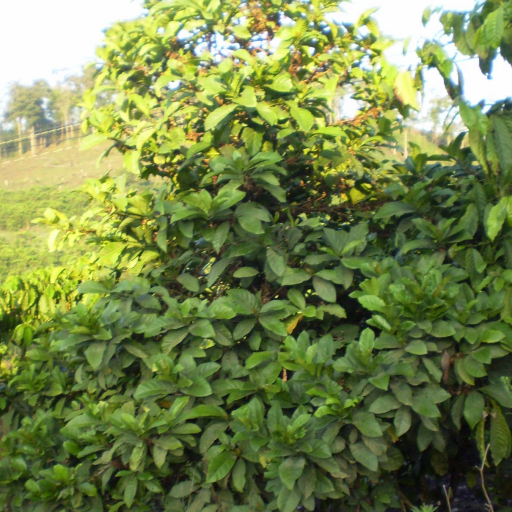
Plant Overview
The "Titan of the Coffee World," Coffea liberica is a bold and hardy species that famously saved the global coffee industry in the 1890s when a blight wiped out nearly all Arabica plants. Originating from the lowland forests of West Africa, it is known for producing beans with a distinct, smoky, and floral flavor profile that polarizes coffee enthusiasts. Unlike its smaller cousins, this plant grows into a massive, towering tree, earning it the nickname "Big Bean" coffee in many regions.
🔍 How to Identify
- 🍃 Enormous Leaves: The leaves are significantly larger than those of Arabica or Robusta, possessing a thick, leathery texture and a wavy margin.
- 🌸 Star-Shaped Blooms: It produces clusters of white, highly fragrant flowers that smell strongly of jasmine and citrus.
- 🍒 Asymmetrical Beans: The coffee cherries and the seeds (beans) inside are teardrop-shaped and notably larger than other species, often featuring a unique "hook" at one end.
🏡 In Your Garden
- 🌳 Vertical Ambition: This is not a typical shrub; in the wild, it can reach heights of 20 meters (65 feet). If grown at home, it requires significant vertical space or regular pruning to keep it manageable.
- 🏜️ Hardy Resilience: It is much more resistant to pests and "coffee leaf rust" than other varieties. It thrives in hot, humid lowland environments and is less picky about soil quality, provided it has room for its deep taproot.
- 💧 Lowland Lover: Unlike Arabica, which prefers high altitudes, Liberica loves the heat and humidity of tropical lowlands, making it a great choice for warm, coastal-style gardens.
⚠️ Safety & Toxicity
- 🐾 Pet Warning: Like all coffee plants, the leaves, stems, and beans contain caffeine. While humans enjoy the stimulant, it is toxic to dogs, cats, and horses if ingested in significant quantities.
- 👶 Kid-Safe but Stimulating: The bright red cherries are tempting to children; while the fruit pulp is technically edible, the high caffeine concentration in the seed can cause heart palpitations or jitters in small children.
✨ Fun Fact
In the Philippines, Coffea liberica is known as "Kapeng Barako." The word Barako translates to "Stud" or "Wild Boar," reflecting the strong, masculine, and powerful flavor and aroma associated with this unique brew!

Detailed Care Instructions
To grow Coffea Liberica plants, you can follow these steps:
- Climate: Coffea Liberica plants prefer warm and humid climates. They thrive in tropical regions with an average temperature of 70-80°F (21-27°C).
- Soil: Use well-draining soil with a pH level between 6 and 6.5. A mixture of loam, peat moss, and sand works well. Make sure the soil is rich in organic matter.
- Planting: Start by germinating Coffea Liberica seeds. Soak the seeds in water for 48 hours before planting. Sow the seeds in pots or containers filled with moist soil, burying them at a depth of 1 inch (2.5 cm). Keep the pots in a warm place with indirect sunlight.
- Light: Coffea Liberica plants require bright but indirect light. Place them in an area where they can receive morning or filtered sunlight.
- Watering: Keep the soil consistently moist but not waterlogged. Water the plants regularly, making sure the soil doesn't dry out completely between waterings. Avoid overwatering as it can lead to root rot.
- Fertilizer: Feed the plants with a balanced slow-release fertilizer every 2-3 months. You can also use organic fertilizers like compost or fish emulsion.
- Pruning: Prune the plants to keep them at a manageable size and to promote bushier growth. Remove any dead, diseased, or damaged branches.
- Pests and diseases: Watch out for pests like aphids, mealybugs, and spider mites. Treat infestations with neem oil or insecticidal soap. Coffea Liberica plants can also be susceptible to diseases such as coffee rust, so maintain good air circulation and avoid overhead watering.
- Harvesting: It takes about 3-5 years for Coffea Liberica plants to reach maturity and produce cherries. Harvest the ripe cherries by handpicking or by using a small rake. Process the cherries by removing the pulp and drying the beans.
- Enjoying the coffee: Once the beans are dried, roast them to your desired level and grind them for brewing. Enjoy your own homegrown Coffea Liberica coffee.
Remember, Coffea Liberica plants can be quite large, so make sure you have enough space for them to grow. Additionally, it's important to note that Coffea Liberica has larger and milder tasting beans compared to Coffea Arabica and Coffea Robusta, which are more commonly cultivated.

Place in a window with dappled sun or a spot in the middle of a room. Or directly in a window facing west or east.

To properly water this plant, it is important to understand its watering needs. The plant prefers to be kept consistently moist, but not overly saturated, as it can be prone to root rot. One method of ensuring proper watering is to wait until the top inch of soil feels dry to the touch before watering thoroughly. It is also important to make sure the plant is not sitting in standing water, as this can lead to root rot. Over time, it is important to monitor the plant's growth and adjust watering frequency as needed.
To fertilize this plant, use a balanced fertilizer with equal amounts of nitrogen, phosphorus, and potassium. Apply the fertilizer once every two months during the growing season. Water the plant before and after fertilizing to prevent damage to the root system. Avoid over-fertilizing as it can burn the roots and cause damage to the plant. Use a slow-release fertilizer to provide nutrients to the plant over a longer period of time.
The ideal soil for Coffea Liberica should be well-draining, rich in organic matter, and slightly acidic. It should have a pH range of 6.0-6.5. It is recommended to use a mix of peat moss, perlite, and compost to provide the plant with the necessary nutrients and moisture retention. The soil should also be loose enough to allow for proper root development and aeration. It is important to avoid using heavy soils or soils with a high clay content, as they can restrict root growth and water drainage.
One way to propagate this plant is by taking cuttings from the stem. To do this, select a healthy stem with several leaves that is at least 4 inches long. Using a sharp knife or scissors, cut the stem just below a node (the point where a leaf is attached to the stem). Remove any leaves from the lower half of the stem, leaving only a few at the top. Dip the cut end of the stem into rooting hormone powder, then plant it in a pot filled with moist potting soil. Keep the soil moist and place the pot in a warm, bright location, but out of direct sunlight. In a few weeks, new growth should appear, indicating that the cutting has rooted. Once the new plant has established roots, it can be transplanted to a larger pot or planted in the ground.








