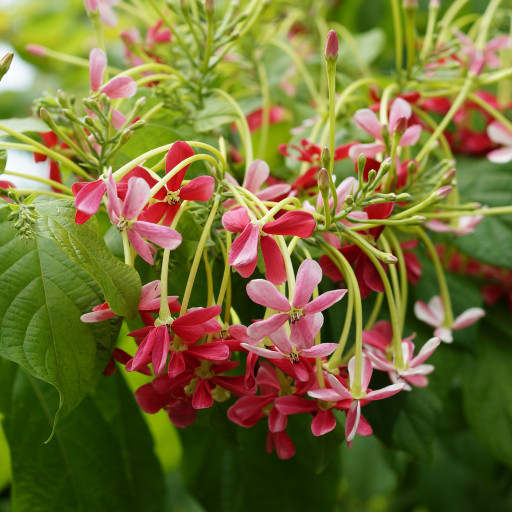
Plant Overview
Often called the Rangoon Creeper or the "Drunken Sailor," Combretum indicum is a spectacular climbing vine famous for its "perfume-shop" fragrance. Its most enchanting trait is its triple-color transformation: a single cluster will host white, pink, and deep red blossoms all at once as the flowers age over three days.
🔍 How to Identify
- 🌸 The Color-Shifting Bloom: Flowers emerge pure white at night, turn pink by the following morning, and deepen into a rich crimson by the second or third day.
- 🍃 Elliptical Foliage: The leaves are vibrant green, heart-shaped at the base, and grow in opposite pairs along a woody, vigorously climbing stem.
- 🎺 Trumpet Shape: Each individual flower sits at the end of a long, slender green tube, hanging in heavy, pendulous clusters that sway in the breeze.
🏡 In Your Garden
- 🧗 The Need for Support: This is a heavy-duty climber. To prevent it from overtaking your garden floor, provide a sturdy trellis, fence, or arbor where it can display its cascading "floral waterfall."
- ✂️ Vigorous Personality: It is a fast grower that loves tropical humidity. You’ll need to prune it regularly after the flowering season to keep it from wandering into your neighbor’s yard or swallowing nearby shrubs.
- ☀️ Sun Seeker: While it can survive in partial shade, the "Drunken Sailor" only puts on its full color-changing show when it receives plenty of direct sunlight.
⚠️ Safety & Toxicity
- 🌿 Low Risk: Generally considered non-toxic to touch, and it is even used in traditional herbal medicine in its native regions.
- 🤢 Seed Caution: The seeds, while sometimes used medicinally to treat parasites, can cause nausea, hiccups, or abdominal pain if ingested in large quantities. Keep the curious seed pods away from children and pets.
✨ Fun Fact
The flower changes color to communicate with pollinators! The white, fragrant stage at night attracts specialized moths, while the daytime pink and red stages signal to bees and butterflies that the nectar is ready for them.

Detailed Care Instructions
| Humidity | Normal |
| Lighting | Full Sun |
| Difficulty | Medium |
| Hibernation | Cold Period |
| Hardiness Zones | 10 - 11 |
To grow Combretum Indicum, also known as the Chinese honeysuckle or Rangoon creeper, you can follow these steps:
- Choose a suitable location: Combretum Indicum thrives in a sunny location with well-drained soil. Make sure the area has enough space for the plant to spread, as it can grow up to 40 feet.
- Prepare the soil: Ensure the soil is fertile, rich in organic matter, and well-drained. If the soil is heavy, you can incorporate some sand or compost to improve drainage.
- Start from seeds or cuttings: You can start growing Combretum Indicum from seeds or cuttings. If using seeds, soak them in warm water overnight before planting. For cuttings, take 6- to 10-inch long pieces from healthy plants and remove the lower leaves.
- Planting: Dig a hole in the prepared soil that is slightly larger than the plant's root system. Place the seed or cutting in the hole and cover it with soil. Space multiple plants at least 10 feet apart.
- Watering: Water the newly planted Combretum Indicum regularly to keep the soil consistently moist. Once established, the plant is drought-tolerant and requires less frequent watering.
- Provide support: As the plant grows, it needs support to climb. You can install a trellis, fence, or other types of support for the plant to attach itself to.
- Pruning: Regular pruning helps in maintaining the shape and size of the plant. Prune out any dead or damaged branches and trim it back to control its growth and prevent it from becoming invasive.
- Fertilization: Apply a balanced slow-release fertilizer in spring to promote healthy growth and flowering.
- Pest and disease control: Monitor the plant for pests like aphids, mealybugs, or caterpillars. Treat infestations with appropriate insecticides or use organic pest control methods. Combretum Indicum is generally disease-resistant but can sometimes be affected by root rot or fungal diseases. Avoid overwatering and provide good air circulation to minimize disease risks.
- Winter protection: If you live in a frost-prone region, protect the plant during winter by covering it with mulch or moving it indoors.
By following these steps and providing proper care, you can successfully grow Combretum Indicum and enjoy its vibrant flowers.

Place in a window with dappled sun or a spot in the middle of a room. Or directly in a window facing west or east.

To water this plant, ensure that the soil is completely dry before watering it thoroughly. Water should be provided directly at the base of the plant, allowing it to be absorbed by the roots and not on the leaves or foliage. It is important to avoid overwatering, as this can lead to root rot. This plant prefers well-draining soil and may need to be watered more frequently during hot, dry weather.
Begin fertilizing the plant in early spring, before new growth appears. Use a slow-release, balanced fertilizer, and apply it to the soil around the base of the plant, following the manufacturer's instructions. Water the plant thoroughly after fertilizing, making sure that the soil is moist but not waterlogged. Repeat the fertilizer application once or twice during the growing season, depending on the plant's growth rate. Avoid fertilizing during the winter months when the plant is dormant.
It is recommended to use well-draining soil for the Combretum Indicum plant. The soil should be rich in nutrients and organic matter. It is best to avoid heavy clay soils, as they can retain too much moisture and suffocate the roots of the plant. A pH range of 6.0-7.5 is ideal for this plant. It is also important to ensure that the soil is not compacted, as it can interfere with root growth and development. Adding perlite or sand to the soil can improve drainage. Overall, the soil should provide a balanced mix of moisture retention, drainage, and nutrient availability to support healthy growth of the Combretum Indicum plant.
Combretum Indicum plant can be propagated through stem cuttings. Select healthy branches that are about 8-10 inches long with a few leaves. Carefully remove the leaves from the bottom two-thirds of the stem. Dip the cut end of the stem in rooting hormone powder and plant it in a pot filled with moist potting soil.
Cover the pot with a plastic bag to create a mini greenhouse effect and place it in a warm, well-lit spot that gets indirect sunlight. Keep the soil moist but not waterlogged. After about 4-6 weeks, check for roots by gently tugging on the stem. If you feel resistance, roots have formed and you can remove the plastic bag and begin to gradually acclimate the plant to normal conditions.
Once the plant has established itself, transplant it to a larger pot or into the ground if your climate is suitable for this plant. To ensure healthy growth, make sure the plant receives adequate sunlight, water, and nutrients.








