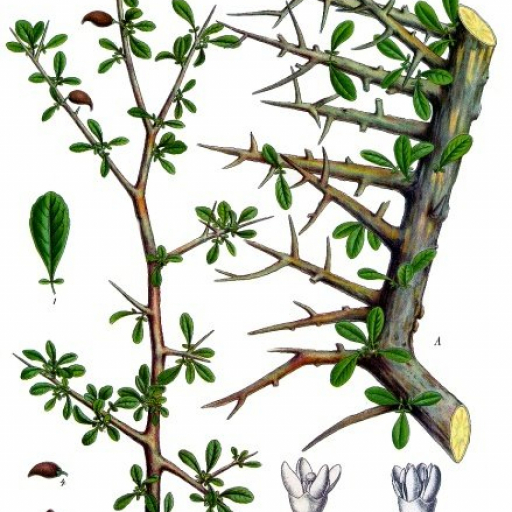
Plant Overview
Known as the source of one of the world’s most legendary resins, Commiphora myrrha—or simply Myrrh—has been traded for over 4,000 years. Often called "The Bitter Gum," this gnarled desert survivor was once more valuable than its weight in gold. It tells a story of ancient trade routes, sacred incense, and the harsh, beautiful landscapes of the Horn of Africa and the Arabian Peninsula.
🔍 How to Identify
- 🌳 Growth Habit: A sturdy, stunted tree or large shrub that rarely exceeds 15 feet. It features jagged, zig-zagging branches that often end in sharp, intimidating thorns.
- 🍃 Foliage: The leaves are tiny, grayish-green, and usually grow in groups of three (trifoliate). They are often sparse, a clever adaptation to prevent water loss in blistering heat.
- 💧 The Resin: The most famous feature is not seen but "bled." When the papery bark is wounded, it exudes a pale yellow liquid that hardens into dark, reddish-brown "tears" or lumps of aromatic resin.
🏡 In Your Garden
- 🏜️ Drainage is Vital: This plant evolved in rocky, desert hills. If you are growing it in a container, it absolutely demands "cactus-style" gritty soil. It hates "wet feet," and its roots will rot quickly if the soil retains too much moisture.
- ☀️ Sun Worshiper: To thrive, Myrrh requires intense, direct sunlight. If kept as a patio plant or indoor specimen, it needs the brightest spot available to mimic the scorching sun of Ethiopia or Oman.
- 🌵 Drought Logic: Like many succulent-adjacent trees, it enters a dormant state when water is scarce, dropping its leaves to protect its core moisture. Do not be alarmed if it goes "bald" during a dry spell; it is simply resting.
⚠️ Safety & Toxicity
- 🧴 Skin Sensitivity: While the resin is used in perfumes and soaps, the raw sap can cause contact dermatitis (skin rashes) in some people. Always wear gloves if pruning or harvesting.
- 🤰 Strict Warning: In traditional medicine, Myrrh has been used as a uterine stimulant. It should never be ingested or used as an essential oil by pregnant individuals, as it can pose a risk to the pregnancy.
- 🐾 Pet Safety: Keep this plant away from curious pets. While not highly toxic, the resin and thorny branches can cause mouth irritation or stomach upset if chewed.
✨ Fun Fact
The name Myrrh comes from the ancient Semitic root murr, which literally translates to "bitter." In ancient Egypt, it was an essential ingredient in "Kyphi," a complex, sacred incense burned in temples to welcome the sunset every evening.

Detailed Care Instructions








