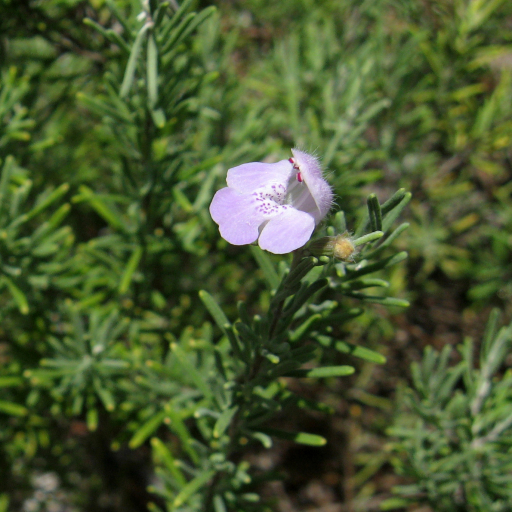
Plant Overview
Known affectionately as False Rosemary or Beach Rosemary, this resilient evergreen shrub is a master of survival along the Gulf Coast dunes. Though it looks and smells remarkably like the culinary rosemary used in kitchens, it belongs to its own unique genus, Conradina. It is a "pioneer species," often being one of the first plants to reclaim sandy, scorched landscapes where little else can grow.
🔍 How to Identify
- 🌿 Silvery Foliage: The leaves are narrow, needle-like, and covered in fine, greyish hairs that give the plant a "hoary" or dusty appearance (which is what the species name canescens refers to).
- 🌸 Lavender Blooms: In spring and fall, the shrub erupts with small, two-lipped flowers that are usually pale violet or blue, often featuring tiny dark purple spots inside the throat.
- 🔲 Mint-Family Stems: If you feel the younger stems, they are distinctly square-shaped, a classic trademark of the Lamiaceae (Mint) family.
🏡 In Your Garden
- 🏖️ The Sand Lover: This plant thrives in "starvation" conditions. It specifically requires well-draining, sandy soil and will quickly suffer from root rot if placed in heavy clay or overly fertilized garden beds.
- 🧂 Salt Tolerance: It is an ideal choice for coastal properties because it is highly resistant to salt spray and wind, acting as a beautiful, fragrant buffer for seaside landscapes.
- 🦋 Pollinator Paradise: Because it blooms when many other plants are dormant, it serves as a critical nectar source for native bees and migrating butterflies.
⚠️ Safety & Toxicity
- ✅ Low Risk: Conradina canescens is generally considered non-toxic to humans, dogs, and cats.
- 👅 Not for Cooking: Although the crushed leaves release a delightful rosemary-like aroma, this is an ornamental plant. It lacks the specific oils that make culinary rosemary tasty and should not be used as a substitute in food.
✨ Fun Fact
The genus Conradina is one of the rarest groups of plants in the mint family; many of its "cousin" species are federally endangered and found only in tiny, specific pockets of the Florida Panhandle!

Detailed Care Instructions
To grow Conradina Canescens (also known as false rosemary or gray conradina), you can follow these steps:
- Location: Choose a suitable location that provides full sun exposure. These plants thrive in bright sunlight.
- Soil preparation: Conradina Canescens prefers well-draining soil. Prepare the soil by removing any weeds or grass and loosening it with a garden fork or tiller. The addition of organic matter, like compost, can help improve drainage and fertility.
- Planting: If planting in pots, ensure they have drainage holes. If planting in the ground, dig a hole slightly larger than the plant's root ball. Place the plant in the hole and fill it with soil, gently firming it around the base.
- Watering: Irrigate the newly planted Conradina Canescens thoroughly, allowing the water to penetrate the root zone. After that, water the plant regularly, keeping the soil consistently moist but not soggy.
- Mulching: Apply a layer of organic mulch around the base of the plant to help conserve moisture, suppress weeds, and protect the roots during extreme temperatures.
- Pruning: Regular pruning encourages bushier growth and helps maintain the plant's shape. You can pinch off the tips of the stems to promote branching and prevent legginess.
- Fertilizing: Conradina Canescens generally doesn't require much fertilizer. If desired, you can apply a slow-release balanced fertilizer according to the manufacturer's instructions once or twice a year, preferably in early spring or late winter.
- Pest and disease control: Keep an eye out for common garden pests like aphids or spider mites. Treat infestations with appropriate organic or chemical controls. Gray conradina is relatively disease-resistant but may be susceptible to root rot if the soil remains overly wet.
- Overwintering: In colder climates, false rosemary may need protection during winter months. Applying a layer of mulch around the base of the plant or covering it with a frost cloth can help safeguard it from freezing temperatures.
- Propagation: Conradina Canescens can be propagated from seeds or cuttings. Seeds can be sown indoors in early spring or fall. Softwood cuttings taken in summer can also be rooted in a well-draining propagation mix.
Remember to familiarize yourself with any local regulations regarding the propagation and cultivation of native plants.

Place in a bright room that is sun drenched almost all day. Or directly in a south-facing window.

To water this plant, it is important to first ensure that the soil is not completely dry. Check the moisture level by inserting your finger into the soil up to the first knuckle. If the soil feels dry, it is time to water.
Use room temperature water and pour it slowly into the pot until it starts to drain out of the bottom. Be sure not to overwater, as that can lead to root rot.
Water once per week, or more frequently during hot, dry weather. As the plant matures and grows larger, you may need to increase the frequency of watering.
It is also important to ensure that the plant has adequate drainage, as waterlogged soil can be harmful to its health. Consider planting in a pot with drainage holes and using well-draining soil.
To fertilize this plant, use a balanced, all-purpose fertilizer with an N-P-K ratio of 10-10-10 or similar. Apply the fertilizer during the plant's active growing season, which is typically in the spring and summer months. Be sure to follow the instructions on the fertilizer packaging for the correct dosage and application method. Avoid over-fertilizing, as this can lead to burned or damaged roots.
Conradina canescens is a type of plant that has specific soil requirements to ensure its optimal growth. The soil to use with this plant should be composed of well-draining, sandy loam. It should also have a slightly acidic pH between 5.5 and 6.5. This type of soil provides good drainage and allows the roots to breathe easily. Additionally, it should be free of any toxic substances, such as excess salt, chemicals, or pollutants that could harm the plant. The soil should be kept slightly moist at all times, but not too wet as this can cause root rot. Adding organic matter, such as compost or leaf mold, can improve soil quality and provide the necessary nutrients for the plant.
Conradina canescens can be propagated through stem cuttings. The first step is to sterilize a pair of pruning shears to avoid any transfer of disease or pathogens. Choose a healthy stem with 3-4 nodes and cut it at a 45-degree angle, just below a node. Remove any leaves from the lower half of the stem, leaving only a few leaves at the tip. Dip the cut end in rooting hormone powder, tapping gently to remove any excess. Plant the cutting in a well-draining soil mix, and water it thoroughly. Cover the cutting with a plastic bag or clear plastic wrap to retain moisture and create a humid environment. Place the cutting in bright, indirect light, and mist it regularly to keep the soil moist. After a few weeks, the cutting should develop roots and can be transplanted into its permanent location.








