Plant Overview
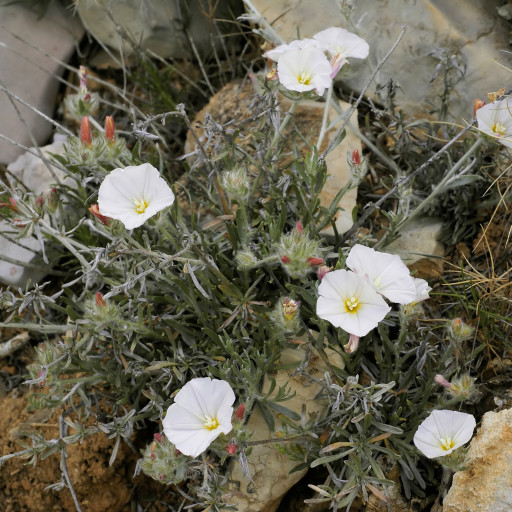
Often called the Silverbush, this Mediterranean native looks as though it has been dipped in liquid moonlight. Unlike its unruly "Bindweed" cousins that take over gardens, this shrub is a perfectly behaved gentleman, forming a shimmering mound of silk-textured leaves and elegant white trumpets. It is a favorite for coastal landscapes, as it thrives in salty air and intense sun where other plants might wilt.
🔍 How to Identify
- 🌿 The Foliage: The leaves are lance-shaped and densely covered in fine, silky hairs that give the entire plant a metallic, silvery-grey sheen.
- 🌸 The Blooms: Funnel-shaped flowers emerge from delicate pink-tinged buds, opening into brilliant white petals with a sunny yellow "eye" at the center.
- 📏 The Habit: It grows as a compact, rounded evergreen shrub, typically reaching about 2 feet in height but spreading wider to create a dense ground cover.
🏡 In Your Garden
- ☀️ Sun Reflection: Those signature silver hairs aren't just for looks; they act like tiny mirrors, reflecting intense heat and UV rays to help the plant survive scorching droughts.
- 💧 Dry Feet Only: Hailing from rocky Mediterranean cliffs, this plant has a "death wish" if placed in heavy, soggy soil. It requires exceptional drainage and thrives in gravel gardens or containers.
- ✂️ Pruning Nuance: It resents being hacked back into old, woody stems. To keep it tidy, give it a light "haircut" immediately after the main spring flowering to encourage fresh, silvery growth.
⚠️ Safety & Toxicity
- 🐾 Low Risk: The Silverbush is generally considered non-toxic to humans and pets.
- 🤢 Mild Caution: Like many members of the Convolvulaceae family, ingesting large amounts may cause mild stomach upset or nausea. It is best used as an ornamental rather than a culinary addition.
✨ Fun Fact
The flowers are "heliotropic" and a bit shy—they open wide to greet the bright morning sun but will tightly fold themselves back into spirals if the sky becomes too cloudy or as soon as the sun begins to set.

Detailed Care Instructions
| Humidity | Normal |
| Difficulty | Medium |
| Hibernation | Cold Period |
| Temperature | 18°C - 28°C |
| Hardiness Zones | 9 - 11 |
To grow Convolvulus Cneorum, also known as Silver Bush, you can follow these steps:
- Choose a location: Convolvulus Cneorum prefers full sun or partial shade. Make sure the selected area has well-draining soil.
- Soil preparation: Prepare the soil by loosening it with a garden fork or tiller. Add organic matter like compost or aged manure to improve soil fertility and drainage.
- Planting: Dig a hole twice as wide and deep as the plant's root ball. Place the plant in the hole, ensuring the top of the root ball is level with or slightly above the soil surface. Backfill the hole with soil and gently firm it around the plant.
- Watering: Water the plant thoroughly after planting and keep the soil consistently moist but not waterlogged. Once established, Convolvulus Cneorum is drought tolerant, but regular watering during dry spells can promote better growth.
- Mulching: Apply a layer of organic mulch around the plant to help retain moisture, suppress weeds, and regulate soil temperature.
- Pruning: Prune Convolvulus Cneorum regularly to maintain its shape and promote bushiness. Pruning can be done in late winter or early spring before new growth appears.
- Fertilizing: Apply a balanced slow-release fertilizer during the growing season to ensure optimal growth. Follow the instructions on the fertilizer packaging for dosage and application frequency.
- Pests and diseases: Monitor the plant regularly for pests such as aphids or whiteflies. Use insecticidal soap or organic insecticides if necessary. Convolvulus Cneorum is generally disease-resistant, but if you notice any signs of disease, treat it promptly with appropriate fungicides.
- Winter care: In areas with freezing temperatures, provide protection during winter. Apply a thick layer of mulch around the base of the plant to insulate the roots, or consider moving container-grown plants to a protected area.
By following these steps, you can successfully grow Convolvulus Cneorum and enjoy its beautiful silver foliage and white flowers.

Place in a bright room that is sun drenched almost all day. Or directly in a south-facing window.

To water this plant, it is important to consider the soil moisture level and weather conditions. The plant prefers well-draining soil and doesn't tolerate waterlogged soil.
A good practice is to water the plant deeply once a week during the growing season. It is better to saturate the soil thoroughly, then let it dry out before watering again.
During the colder months, water less frequently, allowing the soil to partially dry out before watering again. This is because the plant becomes dormant during winter and doesn't require as much water.
Avoid watering the plant during rainy periods or when the soil is already wet to prevent root rot and other diseases. It's also important to water the soil at the base of the plant rather than from above, to prevent water from collecting in the foliage, which can cause diseases.
To fertilize this plant, apply a slow-release granular fertilizer in the spring before new growth appears. Alternatively, you can feed it with a liquid fertilizer every two weeks during its growing season. Be careful not to over-fertilize as this can lead to excessive foliage growth at the expense of flower production. Always follow the manufacturer's instructions on the fertilizer label and water the plant thoroughly after fertilizing.
When choosing soil for this particular plant, it is important to consider its specific needs. It requires well-draining soil that is moderately fertile and rich in organic matter. The pH level of the soil should be slightly acidic to neutral. Additionally, it is best to avoid soils that are heavy or compacted, as they can lead to root rot and other issues. A mix of sand, loam, and peat moss can provide a suitable growing medium for this plant. It is also important to make sure the soil is kept moist but not waterlogged, as excessive moisture can be detrimental to the plant's health.
To propagate this plant, take cuttings from the parent plant that are approximately 4-6 inches long. Remove the lower leaves from the stem and dip the cut end in a rooting hormone powder. Place the cutting into a pot filled with a well-draining soil mix. Water the soil well and cover the pot with a plastic bag to create humidity. Place the pot in bright, indirect light and keep the soil moist but not waterlogged. In a few weeks, roots should begin to form and new growth should emerge. Once the plant has established roots and new growth, it can be transplanted into a larger pot or into the garden.








