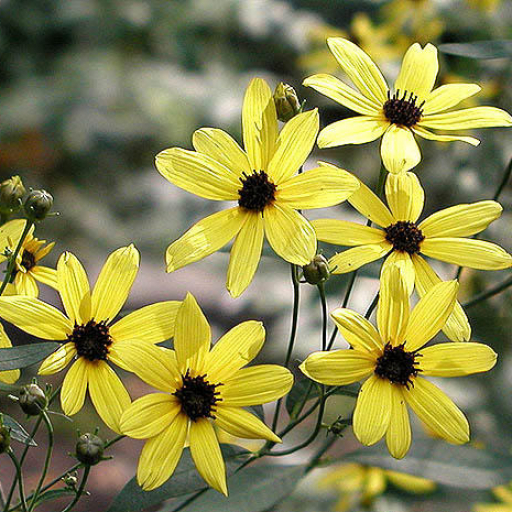
Plant Overview
Often called the "Giant Tickseed," Coreopsis tripteris is the undisputed skyscraper of the prairie world. While most of its cousins hug the ground in tidy mounds, this native North American powerhouse reaches for the clouds, often towering over the gardener’s head. It is a late-summer star, turning meadow-style gardens into a sea of swaying gold just as other flowers begin to fade.
🔍 How to Identify
- 📏 Towering Stems: It is exceptionally tall, reaching heights of 4 to 8 feet on smooth, sturdy, bamboo-like stalks.
- 🌿 Three-Parted Leaves: The species name tripteris refers to its unique leaves, which are divided into three narrow, lance-shaped segments.
- 🌻 Lemon Blooms: It produces dozens of 2-inch wide, butter-yellow daisy-like flowers with smooth petals and a distinct dark brown central disk.
🏡 In Your Garden
- 📍 The "Back of Border" King: Because of its massive height, this plant should always be placed at the very back of a garden bed. It provides a living green wall that acts as a perfect backdrop for shorter perennials.
- 🦅 Bird & Bee Buffet: It is a vital resource for late-season pollinators. Once the flowers fade, leave the stalks standing; goldfinches and other songbirds rely on the "tick-like" seeds as a high-energy winter food source.
⚠️ Safety & Toxicity
- ✅ Non-Toxic: Coreopsis tripteris is generally considered safe and non-toxic for humans, cats, and dogs.
- 🌱 Sap Sensitivity: While not poisonous, some individuals with very sensitive skin may experience mild redness if they handle the crushed stems or sap extensively without gloves.
✨ Fun Fact
If you crush the fresh leaves or stems of the Tall Tickseed, they release a surprising and pleasant aroma that smells remarkably like anise or black licorice!

Detailed Care Instructions
To grow Coreopsis tripteris (also known as tall tickseed or tall coreopsis) successfully, follow these steps:
- Select a suitable location: Coreopsis tripteris prefers full sun but can tolerate some light shade. Choose a well-draining spot with fertile soil.
- Prepare the soil: Loosen the soil with a garden fork or tiller. Incorporate organic matter such as compost or well-rotted manure to improve soil fertility and drainage.
- Planting: Coreopsis tripteris can be started from seeds or transplants. If using seeds, sow them directly into the prepared soil in early spring or late fall. Lightly cover the seeds with soil, as they require light to germinate. If using transplants, set them into the soil, ensuring they are at the same depth as they were in their pots.
- Watering: Keep the soil consistently moist until the plants are established. After that, Coreopsis tripteris is fairly drought-tolerant and only requires watering during prolonged dry spells. Water deeply but infrequently to encourage deep root growth.
- Mulching: Apply a layer of organic mulch around the plants to conserve moisture, suppress weeds, and regulate soil temperature.
- Fertilizing: Coreopsis tripteris doesn't require heavy fertilization. If desired, you can apply a balanced, slow-release fertilizer in spring to promote healthy growth.
- Pruning: Coreopsis tripteris generally doesn't require extensive pruning. However, you can deadhead the spent flowers throughout the blooming season to encourage continuous flowering.
- Pests and diseases: Coreopsis tripteris is relatively resistant to pests and diseases. However, it may occasionally encounter common garden pests such as aphids or spider mites. Monitor the plants regularly and address any infestations accordingly.
- Propagation: Coreopsis tripteris can be propagated by division in early spring or early fall. Lift the plant carefully, divide it into clumps, and replant each clump in a suitable location.
- Winter care: Coreopsis tripteris is a hardy perennial and can survive winter temperatures. However, adding a layer of mulch around the plants in cold regions can provide extra protection.
By following these care guidelines, you should be able to grow and enjoy the beautiful Coreopsis tripteris plant in your garden.

Place in a bright room that is sun drenched almost all day. Or directly in a south-facing window.

To water this particular plant, you should first check the soil moisture level by sticking your finger about an inch deep into the soil near the base of the stem. If the soil feels dry, it is time to water the plant. Use a watering can or hose to gently water the soil around the base of the plant, taking care not to splash water onto the leaves or flowers. Allow the water to soak into the soil until the surface appears moist but not saturated. It is important not to overwater this plant, as it prefers well-draining soil that is not overly wet. Repeat this watering process as needed, based on the plant's individual needs and the weather conditions in your area.
To fertilize the plant, use a balanced fertilizer with equal amounts of nitrogen, phosphorus, and potassium. Apply the fertilizer according to the manufacturer's instructions during the growing season, typically from spring until fall. Avoid over-fertilizing, as this can cause the plant to become too lush and reduce its overall health. Instead, stick to a schedule of regular, moderate feedings to provide the plant with the nutrients it needs to thrive. Water the plant well after fertilizing to help the nutrients soak into the soil and reach the roots.
The best soil for this plant is well-draining and slightly acidic in nature. It should have a pH between 6.0 and 7.0. The soil should be loamy with good organic content, such as compost or well-rotted manure. The ideal soil should be able to retain moisture without becoming waterlogged or overly damp. It should be friable, crumbly, and easily penetrable by the plant's roots. To enhance soil drainage, adding sand or perlite to the soil mixture will be beneficial. Furthermore, adding a slow-release fertilizer will also be beneficial.
To propagate this plant, begin by selecting a healthy specimen with a strong root system. Prepare a well-draining potting mix, and sterilize a sharp pair of pruning shears. Carefully remove a stem cutting of approximately 4-6 inches in length, making sure to cut just below a node. Remove any leaves from the bottom half of the cutting. Dip the cut end of the stem into rooting hormone, then plant it in the prepared potting mix. Water the cutting thoroughly, and cover it with a plastic bag to create a humid environment. Place the cutting in a bright, warm location out of direct sunlight. Keep the potting mix consistently moist but not saturated, and mist the cutting daily. Within a few weeks, the cutting should begin to form roots. Once the roots are several inches long, transplant the new plant into a larger container or into your garden.








