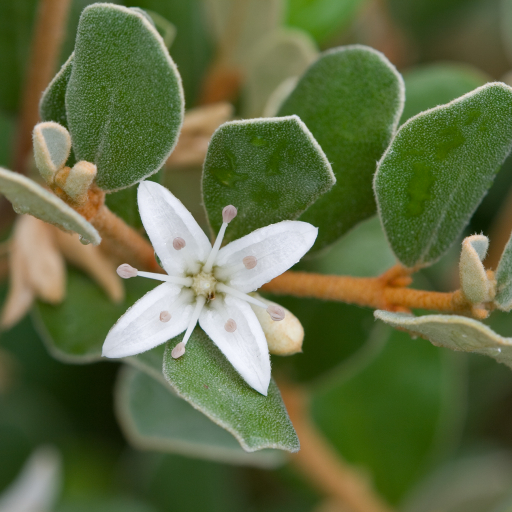
Plant Overview
Commonly known as the White Correa or Cape Barren Tea, this coastal champion is a staple of Australian seaside gardens. With its velvety, silver-toned foliage and starry white blooms, it looks like a soft cloud anchored to the earth. It is prized by gardeners for its "bulletproof" nature and its ability to thrive where other plants would wilt under salty sea breezes.
🔍 How to Identify
- 🍃 Foliage: The leaves are small, rounded, and leathery. They have a distinct grey-green upper surface and a pale, felt-like underside that catches the light.
- 🌸 Starry Blooms: Unlike many other Correas that have drooping, bell-shaped flowers, Correa alba produces upright, four-petaled white flowers that open wide like tiny stars.
- 🌳 Growth Habit: It naturally forms a dense, mounding shrub. In the wild, it stays low to hug the ground, but in a garden, it can reach about 1.5 meters in height.
🏡 In Your Garden
- 🌊 Coastal Specialist: This plant is evolutionarily "armored" against salt spray and harsh winds. If you have a seaside garden where the air is salty, this is one of the most reliable choices you can make.
- ✂️ Shape & Structure: It responds beautifully to pruning. Because of its dense growth, it is often used as a native alternative to Box hedging or can be clipped into "spheres" for a modern, architectural look.
- 🐝 Pollinator Magnet: While the flowers look simple to us, they are a rich source of nectar for honeyeaters and small native bees, bringing life and movement to your yard.
⚠️ Safety & Toxicity
- 🛡️ Safe Status: Correa alba is generally considered non-toxic and is a safe choice for family gardens.
- 🐶 Pet & Child Friendly: There are no known records of this plant being poisonous to dogs, cats, or humans. However, as with any ornamental plant, it is best to discourage pets from chewing on the leathery leaves to avoid mild stomach upset.
✨ Fun Fact
☕ The Shipwreck Tea: Early European explorers and shipwreck survivors in Australia used the dried leaves of this plant as a substitute for traditional tea. This historical quirk earned it the nickname "Cape Barren Tea," named after the islands in the Bass Strait where it grows in abundance.

Detailed Care Instructions
To grow Correa Alba (White Correa), follow these steps:
- Choose a suitable location: Correa Alba prefers a sunny or partially shaded spot in the garden. It can tolerate a range of soil types but prefers well-draining soil.
- Prepare the soil: Before planting, prepare the soil by loosening it with a garden fork or tiller. Remove any weeds or grass from the planting area.
- Select healthy plants: Purchase healthy Correa Alba plants from a reputable nursery or garden center. Look for plants with green foliage and no signs of disease or pest damage.
- Dig a hole: Dig a hole in the planting area that is slightly wider and deeper than the root ball of the plant.
- Plant the Correa Alba: Place the Correa Alba plant into the hole, ensuring that the top of the root ball is level with or slightly above the surrounding soil. Backfill the hole with soil and gently firm it around the plant.
- Water: After planting, thoroughly water the Correa Alba plant to settle the soil and encourage root establishment. Provide regular watering during dry periods to keep the soil moist but not waterlogged.
- Mulch: Apply a layer of organic mulch around the base of the plant to help retain moisture, suppress weeds, and regulate soil temperature. Keep the mulch a few inches away from the stem to prevent rotting.
- Prune: Prune Correa Alba after flowering to maintain its shape and encourage compact growth. Remove any dead or damaged branches and shape the plant as desired.
- Fertilize: Correa Alba generally does not require heavy fertilization. However, you can apply a slow-release, balanced fertilizer in early spring to promote healthy growth.
- Monitor for pests and diseases: Regularly inspect the plant for pests like aphids or scale insects. If necessary, treat with organic or chemical pest control methods. Additionally, watch for signs of diseases such as powdery mildew or root rot and take appropriate actions if detected.
With proper care and attention to watering, feeding, and pruning, Correa Alba should thrive and provide you with attractive white flowers and green foliage.

Place in a bright room that is sun drenched almost all day. Or directly in a south-facing window.

Correa Alba plant requires regular watering to maintain its healthy growth. It is important to water the plant deeply, allowing the water to penetrate the soil and reach the roots. The frequency of watering will depend on the climate and the soil conditions. In general, the plant should be watered when the soil feels dry to the touch.
To water the Correa Alba plant, fill a watering can with room temperature water. Pour the water directly onto the soil at the base of the plant, avoiding getting water on the leaves or stems. Avoid watering at the hottest time of the day when the water can evaporate quickly. Water in the early morning or late afternoon when the sun is not at its strongest.
It is important not to overwater the plant, as this can cause damage to the roots and lead to root rot. If the soil feels wet or the surface of the soil appears moist, wait a few more days before watering again.
In addition to regular watering, the Correa Alba plant benefits from mulching to retain moisture in the soil. Apply a layer of organic matter, such as compost or bark chips, around the base of the plant to help keep the soil moist and cool.
Overall, careful and consistent watering is key to keeping the Correa Alba plant healthy and flourishing.
To fertilize this plant, use a balanced fertilizer with equal amounts of nitrogen, phosphorus, and potassium. Apply the fertilizer once a month during the growing season, which is typically from spring to autumn. Ensure that the soil is moist before applying the fertilizer. Avoid applying fertilizer during the dormant season, which is usually during the winter months. Over-fertilization may cause damage to the plant, so follow the recommended dosage for your specific type of fertilizer.
Correa Alba plant requires a well-draining soil that is rich in nutrients. The soil should be slightly acidic, with a pH range between 5.0 to 6.5. The ideal soil mix for this plant should consist of a combination of sandy loam, peat moss, and compost. It is essential to ensure that the soil is well-draining as the plant cannot tolerate waterlogged soil. If the soil is heavy and clayey, it would be advisable to add sand or perlite to improve the drainage. The soil should also be kept moist but not waterlogged, as excessive watering can lead to root rot. Adding a layer of mulch around the plant can help retain moisture in the soil and also suppress weed growth.
To propagate this plant, start by taking stem cuttings from a healthy specimen. Using clean, sharp pruning shears, cut a stem that is approximately 4-6 inches long, making sure to cut just below a node where leaves emerge. Remove the lower leaves from the stem, leaving only a few at the top.
Dip the cut end of the stem in rooting hormone powder to encourage root growth, then plant it in a well-draining potting mix. Water the cutting thoroughly, then cover it with a clear plastic bag or dome to create a humid environment. Place the cutting in a bright, but indirect light location.
Check the cutting regularly to ensure it stays moist but not waterlogged, and remove any dead leaves or stems as necessary. After a few weeks, check for root development by gently tugging on the stem. If there is resistance, the roots have begun to form.
Once the cutting has established roots, it can be transplanted into a larger pot or into the ground in a suitable location.








