Plant Overview
Often called the Turkish Hazel or Turkish Filbert, this tree is the "stately aristocrat" of the hazelnut family. Unlike its shrubby cousins that tangle into thickets, Corylus colurna grows into a grand, perfectly symmetrical pyramid that looks like it belongs in a royal garden. It is a resilient survivor, frequently chosen by city planners for its ability to thrive in tough urban environments while looking effortlessly elegant.
🔍 How to Identify
- 🌳 The Silhouette: It forms a distinct, narrow conical shape when young, maturing into a broad, formal pyramid that rarely needs pruning.
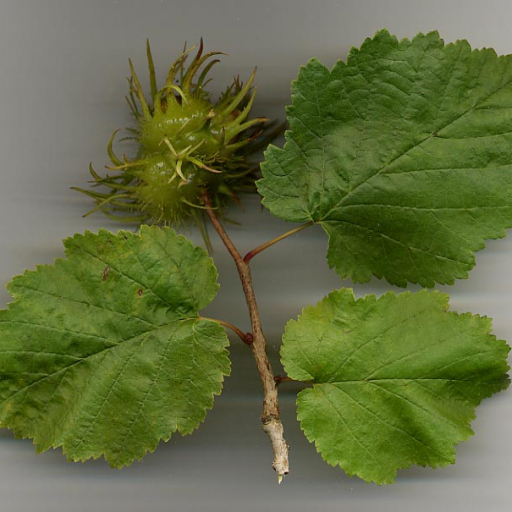
- 🍃 The Foliage: The leaves are broadly heart-shaped with "double-toothed" edges, feeling soft and slightly hairy to the touch. They turn a pleasant yellow-green in the autumn.
- 🥜 The Nut Husks: This is the giveaway! The nuts grow in clusters, each encased in a bizarre, deeply fringed, and "bristly" husk that looks like a tangled green beard.
- 🪵 The Bark: As the tree ages, the bark becomes pale gray and beautifully corky, developing flaky ridges that provide great visual interest during the winter.
🏡 In Your Garden
- 🏙️ Urban Warrior: This tree is incredibly tolerant of air pollution, drought, and heat. It’s an ideal "set it and forget it" specimen for front yards or street-side planting where other trees might struggle.
- 🚫 No Suckers: Unlike the common hazelnut, the Turkish Hazel grows on a single trunk and does not send up annoying "sucker" shoots from the base, making it much easier to maintain.
- 🌱 Deep Roots: It develops a strong taproot, which makes it very wind-resistant but also means it dislikes being moved once it is established. Choose its "forever home" carefully!
⚠️ Safety & Toxicity
- ✅ Safe & Edible: The nuts are entirely edible and have a sweet, mild flavor. However, they are smaller and have much thicker shells than the hazelnuts you find in the grocery store.
- 🤧 Pollen Alert: In late winter or early spring, the tree produces long, dangling yellow "catkins" (male flowers). While beautiful, they release a significant amount of pollen which can trigger hay fever for allergy sufferers.
- 🐾 Pet Friendly: The tree is non-toxic to dogs, cats, and horses.
✨ Fun Fact
The Turkish Hazel is a true "living fossil" of the Ottoman Empire, where it was prized for centuries for its timber. Today, it is so sturdy that it is often used as "rootstock"—growers graft more delicate commercial hazelnut varieties onto the hardy trunk of the Turkish Hazel to give them a stronger foundation.

Detailed Care Instructions
| Lighting | Full Sun |
| Hardiness Zones | 4A - 7B |
To grow a Corylus Colurna plant, also known as a Turkish Filbert or Turkish Hazel, here are the steps you can follow:
- Climate and soil: The Corylus Colurna plant thrives in temperate regions and prefers climates with cold winters and hot summers. It tolerates a variety of soils including clay, loam, and sandy soils with good drainage.
- Sunlight: Choose a planting location that receives full sun to partial shade. Ensure that the area has good air circulation.
- Planting: Dig a hole that is as deep as the root ball and slightly wider. Place the plant in the hole and backfill with soil, pressing it gently to remove air pockets. Water thoroughly after planting.
- Watering: Water the plant regularly, especially during the first year to establish a strong root system. Provide enough water to keep the soil moist, but not waterlogged.
- Mulching and fertilizing: Apply a layer of organic mulch around the base of the plant to help conserve moisture and suppress weeds. Fertilize in spring with a balanced, slow-release fertilizer suitable for shrubs.
- Pruning: Prune damaged or dead branches, as well as any overcrowded or crossing branches, during the dormant season. Proper pruning helps maintain the plant's shape and overall health.
- Pests and diseases: The Corylus Colurna plant is generally resilient and not prone to many pests and diseases. However, it can be affected by aphids or caterpillars. Regularly inspect the plant for signs of pest infestation and use appropriate insecticides if necessary.
- Support: Consider providing support, such as stakes or trellises, especially when the plant is young, to ensure proper growth and prevent damage by wind.
Remember to check the specific needs of the Corylus Colurna plant in your region and adjust the care accordingly. Patience is key, as it may take a few years for the plant to reach its mature size.

Place in a bright room that is sun drenched almost all day. Or directly in a south-facing window.

In order to properly water the tree with the scientific name Corylus Colurna, it is important to consider a few factors. First, check the soil moisture level by inserting a finger one inch deep into the soil. If the soil feels dry, it is time to water the tree.
When watering, aim to saturate the soil deeply, rather than just surface watering. This will encourage the roots to grow deeper and establish a stronger foundation for the tree. The frequency of watering will depend on the weather conditions and soil drainage. In general, it is better to water deeply less frequently than to give the tree frequent light waterings.
Be sure to avoid overwatering, as this can lead to root rot and other issues. It is also important to avoid watering the tree from above, as this can cause water to collect in the crevices of the bark and lead to disease or pest problems. Instead, water the tree at the base.
If possible, use a soaker hose or drip irrigation system for more efficient and targeted watering. Mulching around the base of the tree can also help retain moisture in the soil.
Overall, it is important to monitor the tree's soil moisture and adjust watering as necessary to ensure good health and growth.
To fertilize the mentioned plant, use a slow-release, balanced fertilizer in the early spring, before new growth appears. Apply the fertilizer according to the package instructions, making sure to distribute it evenly around the base of the plant. Be careful not to apply too much, as this can damage the roots. Water the plant thoroughly after fertilizing to help the nutrients soak into the soil. Avoid fertilizing in late summer or fall, as this can encourage new growth that may not have time to harden off before winter.
The ideal soil for Corylus Colurna should have a pH level of 6-7.5, be well-draining, and high in organic matter. It should also have a good nutrient balance with plenty of nitrogen, phosphorus, and potassium. A mixture of loam, sand, and humus can be used for planting this plant. Avoid using heavy clay soil as it can retain too much water and lead to root rot. Additionally, adding compost to the soil can help improve its structure and provide essential nutrients to the plant. It is also recommended to check the soil quality regularly and make necessary amendments to maintain the ideal growing conditions.
To propagate this plant, first, take some hardwood cuttings in the dormant season, which is usually between late autumn and early winter. The cuttings should be around 20-30cm long and have a diameter of about 1cm. Next, make a clean cut at the base of each cutting and remove any leaves from the lower part.
Then dip the base of the cutting in rooting hormone powder or liquid to help stimulate root growth. After that, prepare a potting mix by mixing equal parts of potting soil and perlite or sand.
Wet the potting mix and insert the cuttings in the moist soil so that about two-thirds of the cutting is buried in the soil.
Cover the pot with a clear plastic bag or use a propagator to maintain humidity and keep the soil moist.
Place the pot in a bright spot but out of direct sunlight.
After a few weeks, check the cuttings for root growth by gently tugging on the base. If there is resistance, it means roots have formed.
Once there are visible roots, remove the plastic bag or propagator and gradually move the pot to a more sunny spot.
Once the plants have grown larger and stronger, they can be repotted into larger containers or planted into the ground.








