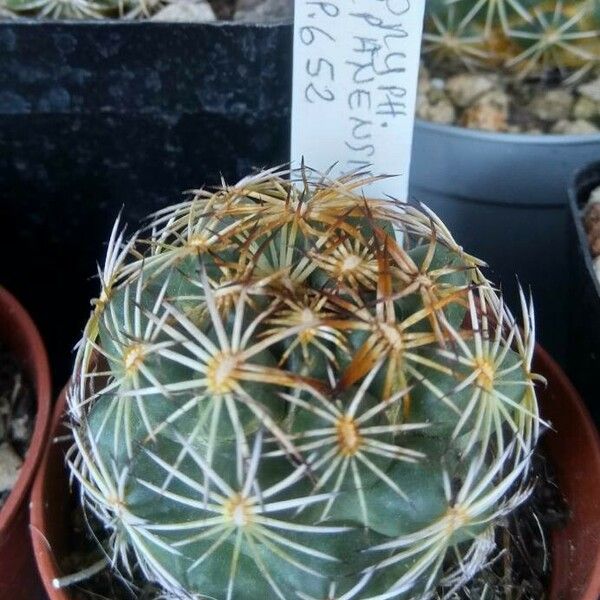
Plant Overview
Known as the Jalpan Beehive Cactus, this Mexican treasure hails from the rugged, limestone-rich landscapes of Querétaro. It is a charming, clumping cactus that forms tight-knit families of golden-spined spheres, looking very much like a cluster of tiny, prickly hives nestled among the rocks. While it might look tough, it is a slow-growing favorite for collectors who appreciate geometric perfection.
🔍 How to Identify
- 🌵 Body Shape: It begins as a single globe but matures into a cylindrical shape, eventually "offsetting" to create a dense mound of multiple heads.
- 🍍 Tubercles: Unlike many cacti with long vertical ribs, this species is covered in nipple-like bumps called tubercles, which are arranged in a beautiful, mathematical spiral.
- ⚔️ Spine Pattern: Each tubercle is armed with a starburst of light-colored radial spines and a slightly darker, sturdier central spine that points outward.
- 🌼 Crown Blooms: In mid-to-late summer, it produces large, silky yellow flowers that emerge exclusively from the very top (the "apex") of the plant.
🏡 In Your Garden
- ☀️ Sun & Color: This cactus craves high-intensity light. Plenty of sunshine ensures the spines grow thick and colorful; in shade, the plant may "stretch" (etiolate) and lose its compact beehive look.
- 🪨 The Taproot Trap: It possesses a thick, carrot-like taproot that stores water. This makes it incredibly drought-tolerant but very prone to rot if the soil stays damp. Always use a gritty, mineral-heavy cactus mix and a pot with excellent drainage.
- 💤 Winter Rest: To encourage those beautiful yellow blooms, it needs a cool, completely dry "rest period" during the winter months.
⚠️ Safety & Toxicity
- 🩹 Physical Hazard: It is not chemically toxic, but its spines are stiff and sharp. It can cause painful punctures if handled without gloves or if a pet decides to investigate too closely.
- 🐾 Pet Safety: The Jalpan Beehive is considered non-toxic to cats and dogs. The primary danger is physical—keep it on a high shelf to avoid accidental "run-ins" with curious paws or noses.
✨ Fun Fact
The name Coryphantha is derived from the Greek words koryphe (top) and anthos (flower). This refers to the genus's unique habit of flowering only from the very center of the crown, unlike its cousins, the Mammillaria, which flower in a ring around the middle!

Detailed Care Instructions








