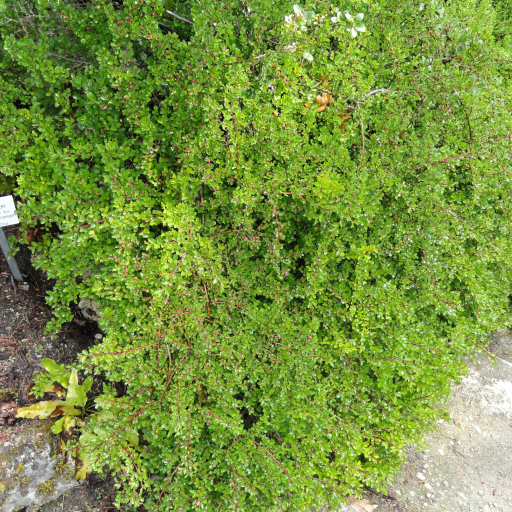
Plant Overview
Often called the "Creeping Cotoneaster," this hardy deciduous shrub acts like a living carpet for your landscape. Native to the rocky highlands of western China, it is beloved for its prostrate growth habit, literally "hugging" the ground and following the contours of rocks and slopes. As the seasons turn, it transforms from a quiet green mat into a brilliant bonfire of scarlet leaves and persistent red berries.
🔍 How to Identify
- 🍃 Rippled Foliage: The tiny, dull-green leaves are unique for their "undulate" or wavy margins, which give the plant a textured, ruffled appearance.
- 🌸 Blossoms: In late spring, the plant is dotted with small, star-shaped flowers that are white with a delicate pink blush, hiding amongst the leaves.
- 🍒 Bright Pomes: By late summer, the plant produces small, round, bright red fruits that resemble miniature apples and often stay on the branches through the winter.
🏡 In Your Garden
- 🧱 Rock Garden Specialist: True to its name (adpressus means "pressed against"), this plant is the perfect choice for cascading over stone walls or softening the edges of a rocky outcrop.
- ⛰️ Erosion Control: Its stems have a clever habit of rooting wherever they touch the ground, creating a dense, woody network that is excellent for stabilizing steep banks and preventing soil runoff.
- ✂️ Low Maintenance: Unlike many shrubs, it rarely needs pruning; it naturally maintains a height of only about 1 foot while spreading wide to suppress weeds.
⚠️ Safety & Toxicity
- 🐾 Toxic to Pets: Like many members of the rose family, the berries and leaves contain cyanogenic glycosides. If ingested in large quantities by dogs, cats, or horses, it can cause respiratory distress or stomach upset.
- 👶 Child Safety: The bright red berries can be very attractive to children; ensure they are taught not to eat them, as they are not edible and may cause vomiting.
✨ Fun Fact
The genus name Cotoneaster is a bit of a linguistic "burn"—it is derived from the Latin cotoneum (quince) and the suffix -aster (meaning "a poor imitation of"). Essentially, early botanists thought it looked like a "low-quality quince!"

Detailed Care Instructions
To grow Cotoneaster adpressus, also known as creeping cotoneaster, follow these steps:
- Choose a suitable planting location: Cotoneaster adpressus thrives in well-draining soil that is slightly acidic to neutral. It prefers full sun to partial shade and can tolerate a wide range of climates.
- Prepare the planting area: Remove any weeds or grass from the planting area. Loosen the soil to a depth of about 12 inches and mix in compost or well-rotted manure to improve fertility and drainage.
- Dig the planting hole: Dig a hole slightly larger than the root ball of the plant. The hole should be deep enough for the plant to sit at the same level it was growing in the container.
- Plant the cotoneaster: Place the root ball in the hole and backfill with the amended soil. Gently firm the soil around the base of the plant to remove any air pockets. Water thoroughly after planting.
- Watering: Water the plant regularly during the first growing season to establish a healthy root system. Cotoneaster adpressus prefers moist but not waterlogged soil. Water deeply when the top inch of soil feels dry.
- Mulching: Apply a layer of organic mulch around the base of the plant to help conserve moisture, suppress weeds, and regulate soil temperature. Keep the mulch a couple of inches away from the stem to prevent collar rot.
- Pruning: Cotoneaster adpressus benefits from periodic pruning to maintain its shape and promote healthy growth. Prune in late winter or early spring before new growth emerges. Remove dead or damaged branches and thin out any overcrowded growth.
- Fertilizing: Fertilizing is usually not necessary for cotoneaster adpressus. However, if you notice slow growth or yellowing leaves, you can apply a slow-release balanced fertilizer in early spring.
- Pest and disease control: Cotoneaster adpressus is generally resistant to most pests and diseases. However, it can be susceptible to fire blight and aphid infestations. Monitor the plant regularly and take appropriate measures if any issues arise.
- Propagation: Cotoneaster adpressus can be propagated through semi-hardwood cuttings taken in late summer or by sowing seeds in the spring. Follow proper propagation techniques for the best chances of success.
By following these guidelines, you can successfully grow Cotoneaster adpressus and enjoy its beautiful spreading habit and attractive berries.

Place in a bright room that is sun drenched almost all day. Or directly in a south-facing window.

To properly water the plant species in question, it is important to follow a few key guidelines. One should always check the moisture level of the soil before watering, as overwatering can lead to root rot and other issues. It is best to water deeply and allow the soil to dry out slightly between waterings, rather than watering frequently with shallow amounts of water. The plant should also be watered at the base, rather than from above, to avoid getting water on the leaves and causing fungal diseases. The amount and frequency of watering may vary depending on the climate, soil type, and other environmental factors.
To fertilize this plant, use a balanced, slow-release fertilizer once every spring. Be careful not to over-fertilize, as this can lead to excessive growth and a weak root system. Follow the package instructions for application rates, and water the plant thoroughly afterwards. Additionally, you can add a layer of compost or organic matter to the soil every year to provide additional nutrients.
The ideal soil to use for this plant is well-draining soil that is rich in organic matter. The pH level of the soil should be slightly acidic to neutral, with a range of 5.5 to 7.0. It should be nutrient-rich, with added fertilizer or compost.
Avoid using heavy clay soils or those that are prone to waterlogging, as this can lead to root rot and other issues. The soil should also be loose and friable, allowing oxygen and moisture to move through easily.
When planting, it is recommended to add a layer of mulch around the base of the plant to help retain moisture and prevent weed growth. Regular watering is also necessary, particularly during periods of drought or extreme temperatures.
Overall, providing the right soil conditions is essential for the health and growth of Cotoneaster Adpressus, helping it to produce vibrant foliage and abundant blooms.
Propagation of this plant can be achieved through a number of methods, including cuttings, layering, and seed propagation. Cuttings should be taken from semi-ripe wood in the summer and rooted in a suitable rooting medium, such as perlite or vermiculite mixed with sand. Layering can also be effective, with a low branch being bent down to the ground and covered with soil until it roots. Seed propagation can be done by harvesting the seeds in the fall and planting them in a well-draining soil mix in a seed tray. The tray should be kept moist and placed in a warm location until the seeds germinate. After germination, the seedlings can be transplanted into individual containers and grown until they are large enough to be planted in their final location.








