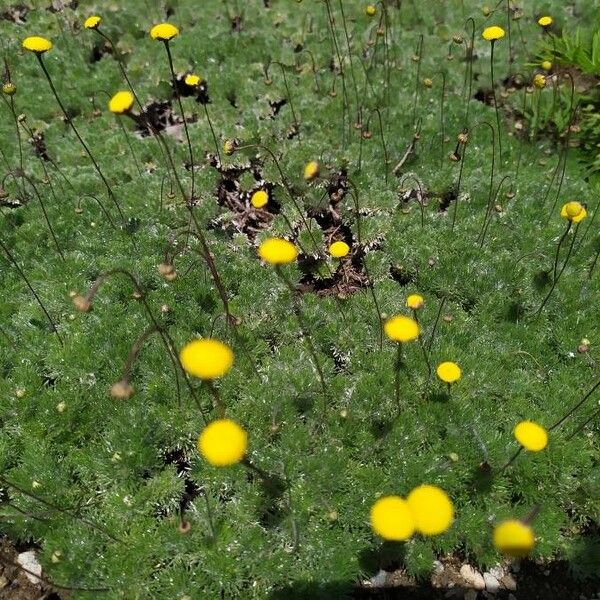
Plant Overview
The Cotula Hispida, affectionately known as the "Silver Button" or "Silver-leaved Brass Buttons," is a charming alpine native from the high-altitude grasslands of South Africa. With its shimmering, metallic foliage and bright sunny blooms, it looks like a patch of frost that has somehow survived the summer heat. It is a favorite for rock gardeners who want a plant that looks delicate but possesses the rugged soul of a mountain survivor.
🔍 How to Identify
- 🌿 The Foliage: The leaves are the star of the show—finely divided, feathery, and covered in soft, silky white hairs that give the entire plant a striking silver-blue or pewter sheen.
- 🌼 The Flowers: Rising just above the foliage on thin stems, the flowers are small, perfectly round, bright yellow "buttons" that lack the traditional outer petals found on daisies.
- 📏 Growth Habit: It forms a low, dense, spreading mat, rarely exceeding 4-6 inches in height, making it an excellent "filler" for cracks between stepping stones or garden edges.
🏡 In Your Garden
- ☀️ The Sun’s Reflection: That beautiful silver color isn't just for show; the tiny hairs reflect sunlight and trap moisture. To keep this silver "glow" intense, place it in the brightest spot possible; in shade, it tends to turn a duller green and become leggy.
- 🏜️ The Drainage Rule: Because it hails from rocky mountain slopes, its greatest enemy is soggy soil. It thrives in gritty, poor soils where water drains away instantly. If its "feet" stay wet during the winter, the crown is likely to rot.
- 🌱 Crevice Filling: It is a slow to moderate spreader. While it isn't aggressive like some groundcovers, it will happily tuck itself into stone walls or alpine troughs, creating a soft, tactile cushion.
⚠️ Safety & Toxicity
- ✅ Safe Status: Cotula hispida is generally considered non-toxic to humans, cats, and dogs. It is a "friendly" addition to sensory gardens due to its soft texture.
- 🧤 Skin Sensitivity: While not poisonous, the fine hairs that give the plant its silver color can occasionally cause very mild skin irritation or "itchiness" in gardeners with extremely sensitive skin. Wearing gloves during heavy pruning is a simple precaution.
✨ Fun Fact
The silver hairs on the leaves act as a natural "sunscreen" and windbreaker! By creating a layer of still air against the leaf surface, the plant prevents precious moisture from being sucked away by the harsh mountain winds of its native South African home.

Detailed Care Instructions
To grow Cotula Hispida, also known as the brass buttons plant, you can follow these steps:
- Propagation: Start by obtaining Cotula Hispida seeds or a small plant from a nursery. You can also propagate the plant through division, taking a small section from an existing plant.
- Soil: Cotula Hispida thrives in well-draining soil. Make sure the soil is fertile with a pH range of 6.0 to 7.5. Amend the soil with organic matter to improve its drainage and nutrient content.
- Planting: Choose a suitable location where the plant receives full sun to partial shade. Prepare the planting hole slightly larger than the root ball. Place the plant in the hole, ensuring it sits at the same depth as it was growing previously. Fill the hole with soil and gently press it around the plant to secure it.
- Watering: Cotula Hispida requires regular watering, especially during the growing season. Keep the soil consistently moist, avoiding both waterlogging and allowing it to dry out completely. Adjust the frequency of watering based on the weather conditions and the moisture level of the soil.
- Fertilization: Apply a slow-release balanced fertilizer once a month during the growing season (spring and summer). Follow the instructions on the fertilizer packaging for proper application rates. Avoid over-fertilizing, as this can lead to weak growth.
- Mulching: Mulching around the plant helps conserve moisture, suppress weed growth, and regulate soil temperature. Apply a layer of organic mulch, such as straw or wood chips, around the plant while leaving a small area around the stem clear.
- Maintenance: Regularly remove any weeds or unwanted vegetation growing around the Cotula Hispida plant. Prune the plant after flowering to maintain a compact and tidy appearance. You can pinch back the growing tips to promote bushiness.
- Pests and diseases: Cotula Hispida is generally resistant to pests and diseases. However, keep an eye out for common garden pests like aphids or snails. Monitor the plant regularly and take appropriate action if you notice any infestations.
Remember to research any specific care requirements for Cotula Hispida in your particular climate or growing conditions, as variations may exist.

Place in a bright room that is sun drenched almost all day. Or directly in a south-facing window.

Cotula hispida plant requires regular watering to survive. Before watering the plant, ensure that the top layer of soil is dry to the touch. Over-watering the plant can cause root rot, so it is important not to let the soil become waterlogged. When watering, apply water at the base of the plant and avoid getting water on the foliage. During the winter months, reduce watering to avoid excessive moisture in the soil.
To fertilize this plant, first choose a balanced fertilizer with equal parts nitrogen, phosphorus, and potassium. When applying the fertilizer, be careful not to get any on the leaves or stem as this can burn the plant. Using a watering can or hose attachment, thoroughly water the soil around the plant before applying the fertilizer. Follow the instructions on the packaging to determine the appropriate amount of fertilizer to use. It is recommended to fertilize this plant every other month during the growing season (spring and summer) and to avoid fertilizing in the winter when the plant is not actively growing.
Cotula Hispida plant grows best in well-drained soil with good aeration. The soil should be slightly acidic with a pH range of 6.0 to 6.5. It is recommended to use a soil mixture that is rich in organic matter and nutrients, such as compost or a commercial potting mix. The soil should also be kept consistently moist, but not waterlogged, as this can lead to root rot. It is important to avoid using heavy clay or sandy soils as they can affect the plant's growth and health.
To propagate this plant, you will need to take stem cuttings from the parent plant. Use a clean, sharp pair of scissors or pruning shears to cut off a 4-6 inch piece of stem from the parent plant. Make sure that the stem has several healthy leaves on it.
Next, remove the lower set of leaves from the stem cutting, leaving only a few leaves at the top. This will help the cutting focus its energy on growing new roots, rather than supporting too many leaves.
Dip the cut end of the stem cutting into rooting hormone powder, which will help encourage the plant to produce roots. Then, insert the cutting into a pot filled with moist, well-draining soil. Make sure to bury the cut end of the stem slightly into the soil.
Cover the pot with a clear plastic bag to create a greenhouse effect that will help the cutting retain moisture. Place the pot in a warm, bright location, but out of direct sunlight.
Check the cutting regularly to make sure that the soil remains moist, but not overly wet. After several weeks, you should start to see roots forming in the soil. Once the cutting has established a good root system, you can transplant it into a larger pot or plant it in the garden.








