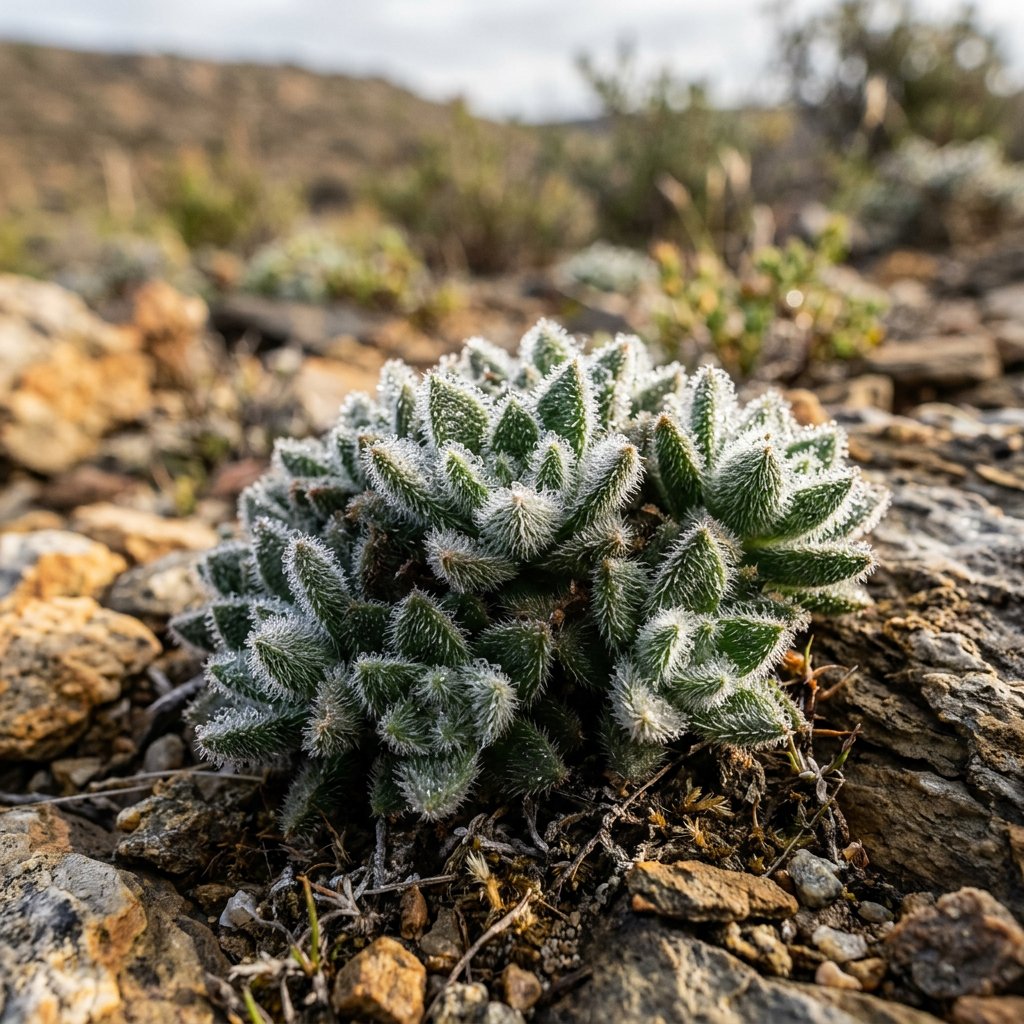
Plant Overview
Often called the "Fuzzy Crassula," this South African beauty looks like it has been dusted with a permanent layer of silver frost. Its botanical name is a bit of a tongue-twister, chosen because its pointed leaves mimic those of the Mesembryanthemum (Ice Plant) family. It is a resilient, architectural succulent that adds a soft, velvety texture to any indoor collection or rock garden.
🔍 How to Identify
- ❄️ Fuzzy Texture: The most striking feature is the dense coating of fine, white bristly hairs (trichomes) that give the plant a "glittery" or "frozen" appearance.
- 📐 Leaf Shape: The leaves are fleshy, lance-shaped, and slightly curved, growing in an upright, bushy fashion that becomes more woody at the base as it matures.
- 🌸 Winter Blooms: During the cooler months, it sends up tall stalks topped with small, bell-shaped flowers that are typically cream or white.
🏡 In Your Garden
- ☀️ Built-in Sunscreen: Those tiny white hairs aren't just for show; they act as a natural umbrella, reflecting harsh UV rays and trapping a layer of cool air against the leaf to prevent moisture loss.
- 🚿 The "Dry Leaf" Rule: Because of its fuzzy coat, this plant is highly susceptible to rot if water gets trapped between the leaves. It is best to water at the soil level or use a "bottom-watering" method to keep the foliage dry and pristine.
- 🪴 Growth Habit: Unlike some trailing Crassulas, this variety grows into a miniature shrub. It’s perfect for adding height to succulent arrangements without worrying about it "stretching" too quickly.
⚠️ Safety & Toxicity
- 🐾 Pet Safety: This plant is generally considered non-toxic to cats, dogs, and horses, making it a "safe" choice for households with curious pets.
- 👶 Touch Friendly: Unlike cacti with hidden spines, the bristles on this Crassula are soft to the touch, making it a great sensory plant for children to explore.
- 🤢 Mild Warning: While not poisonous, ingesting any succulent can cause mild digestive upset, so it's still best kept out of reach of nibbling toddlers.
✨ Fun Fact
The name Mesembryanthemoides literally means "looking like a Mesembryanthemum." It’s a classic example of convergent evolution, where two different plant groups evolve the same look to survive the same harsh, arid environments!

Detailed Care Instructions
| Humidity | Normal |
| Lighting | Full Sun |
| Soil Type | Gritty, Mostly Inorganic, Quickly Draining |
| Difficulty | Medium |
| Plant Type | Broadleaf Perennial Evergreen |
| Hibernation | Cold Period |
| Mature Size | About 12″ Inches Tall |
| Native Area | South Africa |
| Sun Exposure | Full Sun, Partial Shade |
| Hardiness Zones | 9-12 |
To grow Crassula Mesembryanthemoides, also known as the baby necklace succulent, follow these steps:
- Choose a suitable pot: Select a well-draining pot with drainage holes to ensure excess water can escape. A clay or terracotta pot is recommended as it allows the soil to dry out more quickly.
- Soil mix: Prepare a well-draining succulent or cactus potting mix. You can also mix regular potting soil with perlite or pumice to improve drainage.
- Planting: Gently remove the plant from its nursery pot and place it in the center of the new pot. Ensure that the top of the root ball is level with the rim of the pot. Backfill with the prepared soil mix, pressing it gently around the base of the plant.
- Light: Crassula Mesembryanthemoides thrives in bright, indirect sunlight. Place the plant near a south or west-facing window where it can receive at least 4-6 hours of sunlight per day.
- Watering: Water the plant thoroughly but allow the soil to dry out completely between waterings. Overwatering can lead to root rot, so it's better to underwater than overwater. Test the moisture level by sticking your finger about an inch into the soil; if it feels dry, it's time to water.
- Temperature: This plant prefers moderate to warm temperatures between 65-80°F (18-27°C). Protect it from extreme cold or heat.
- Fertilizer: Feed the plant with a balanced, diluted succulent fertilizer during the growing season (spring and summer) according to package instructions. Avoid fertilizing during the winter months.
- Propagation: Crassula Mesembryanthemoides can be propagated through stem or leaf cuttings. Simply allow the cuttings to callous over for a few days, then place them in well-draining soil mix. Keep the soil slightly moist until roots develop.
Remember to observe your plant and adjust its care routine accordingly. With proper care and conditions, the Crassula Mesembryanthemoides should grow well and develop its unique trailing habit.

Place in a bright room that is sun drenched almost all day. Or directly in a south-facing window.

To water this plant, you should first check the soil to ensure that it has completely dried out before watering again. When watering, slowly pour water onto the soil around the base of the plant, being careful not to splash any water onto the leaves. Allow the water to soak through the soil and then wait for any excess water to drain away before replacing the plant in its regular location. It is important not to overwater this plant as it can lead to root rot.
To fertilize this succulent plant, use a balanced fertilizer once a month during the growing season (spring and summer). Dilute the fertilizer to half the recommended strength and water the plant thoroughly after applying the fertilizer. Avoid fertilizing in the dormant season (fall and winter) as the plant does not require as much nutrients during this time. It is also important to ensure that the soil is well-draining and that the plant is not over-watered, as excess moisture can lead to root rot.
The ideal soil for this plant should be well-draining and porous to prevent waterlogging, as the plant is susceptible to root rot. It should also have good aeration and be slightly acidic with a pH range of 6-7.5. A mixture of coarse sand, perlite, and peat moss is recommended for optimal growth. Organic matter can also be added to the soil to improve its fertility and moisture-retaining capacity. It is important to avoid using heavy soils or ones that are rich in nutrients as this may lead to over-fertilization and stunted growth. Additionally, the soil should be lined with a layer of gravel or stones at the bottom to facilitate drainage and prevent moisture buildup.
To propagate this succulent plant, you can start by taking a stem cutting from a healthy mature plant. Look for a stem that is at least 3 inches long and has several sets of leaves. Using a sharp, clean knife, cut the stem at a 45-degree angle.
After cutting the stem, let it dry out for a day or two. This will allow the cut to callus over, which will help prevent rotting when planted.
Next, prepare a pot or container with well-draining soil. You can use a mix of succulent soil and perlite or sand. Make a hole in the soil and insert the stem cutting, burying it about an inch deep.
Water the cutting sparingly, waiting until the soil is dry before watering again. Place the pot in a bright, but not direct, sunlight and keep in a warm environment.
In a few weeks, you should see new growth appearing from the stem cutting. As it grows, you can start to water it more frequently and eventually transplant it into a larger pot once it has established roots.
Remember to keep an eye out for any signs of rot or pests, and adjust your care accordingly. With proper care, this succulent plant should thrive and grow into a beautiful addition to your collection.
Common pests of the crassula mesembryanthemoides include Mealybugs. Make a habit of checking your crassula mesembryanthemoides frequently for pests so that any infestations can be caught and managed early.








