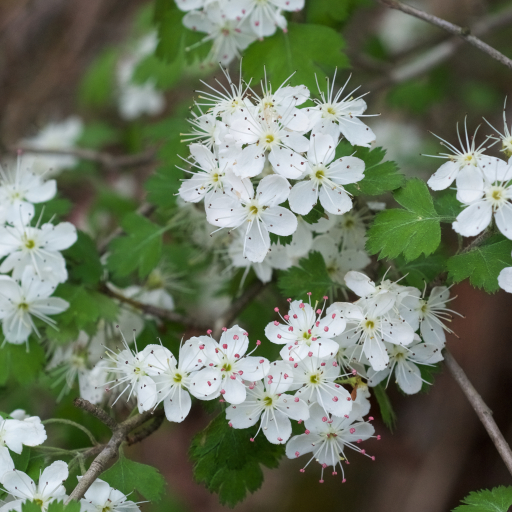
Plant Overview
Known as the Parsley Hawthorn, Crataegus marshallii is widely considered the most elegant member of the hawthorn family. Native to the Southeastern United States, this small, deciduous tree earns its nickname from its uniquely delicate, fern-like foliage that bears a striking resemblance to garden parsley. It is a storyteller’s tree, often found gracing the edges of swamps and quiet southern woodlands with its lacy canopy and twisted, picturesque trunk.
🔍 How to Identify
- 🍃 Lacy Foliage: The most identifying feature is the leaves; they are small, deeply lobed, and finely cut, looking much more like parsley or a fern than a typical tree leaf.
- 🌸 Jeweled Blooms: In spring, it produces clusters of white flowers with distinct, bright red-to-purple anthers that look like tiny rubies scattered across the petals.
- Bark & Thorns:** The bark is smooth and grey, often exfoliating to reveal patches of orange-brown beneath. It does possess small, slender thorns hidden among the branches.
🏡 In Your Garden
- 🦋 The Pollinator Hub: This tree is a biological "grocery store." It is a larval host for several butterflies, including the Gray Hairstreak, and its nectar-rich flowers are a favorite for native bees.
- 💧 Moisture Lover: Unlike some of its drought-tolerant cousins, the Parsley Hawthorn thrives in moist, acidic soils. It is perfect for that "damp spot" in your yard where other trees might struggle with wet feet.
- 🌳 Understory Specialist: It is one of the few hawthorns that performs beautifully in partial shade, making it an excellent choice for planting beneath the canopy of larger oaks or pines.
⚠️ Safety & Toxicity
- 🟢 General Safety: Crataegus marshallii is generally considered non-toxic to humans, dogs, and cats. The small red fruits (haws) are technically edible and are often used in traditional jellies.
- 📍 Physical Hazard: The primary safety concern is the thorns. While smaller and less aggressive than other hawthorns, they are sharp and can cause puncture wounds. Avoid planting this tree directly next to narrow walkways or children's play areas.
✨ Fun Fact
The Parsley Hawthorn belongs to the Rosaceae (Rose) family. If you look closely at the white blossoms in the spring, you will notice they are essentially miniature, five-petaled wild roses!

Detailed Care Instructions
To grow Crataegus Marshallii, also known as Marshall's hawthorn, you can follow these steps:
- Select a suitable planting location: Crataegus Marshallii prefers full sun to partial shade and can adapt to various soil types. However, well-draining soil is essential for its healthy growth.
- Obtain young plants: Purchase Crataegus Marshallii plants from local nurseries or reputable online sellers. Alternatively, you can collect seeds from wild plants if available in your area.
- Prepare the soil: Before planting, remove any weeds or unwanted vegetation from the planting area. Loosen the soil to a depth of about 12 inches (30 cm) and amend it with organic matter, such as compost, to improve drainage and fertility.
- Dig a suitable hole: Dig a hole twice as wide and just as deep as the root ball of the plant. Gently loosen the roots if they are tightly bound in a pot.
- Plant the Crataegus Marshallii: Place the plant in the hole, ensuring that the top of the root ball is level with the ground. Backfill the hole with soil, firming it gently around the roots to eliminate air pockets. Water thoroughly after planting.
- Watering and mulching: Keep the soil consistently moist but not waterlogged. Water deeply once a week during dry periods, especially in the first year after planting. Apply a layer of organic mulch, such as wood chips or bark, around the base of the plant to retain moisture and suppress weed growth.
- Pruning: Regular pruning is generally not required for Crataegus Marshallii, but you can remove any dead, damaged, or crossing branches to maintain a healthy and attractive shape.
- Fertilizer: In most cases, Marshall's hawthorn does not require additional fertilization, as it can obtain necessary nutrients from the soil. However, if the plant appears weak or growth is stunted, you can apply a slow-release, balanced fertilizer according to the package instructions.
- Pest and disease management: Crataegus Marshallii is generally resistant to many pests and diseases. However, it is still advisable to inspect the plant regularly for signs of aphid infestations, scale insects, or leaf spot diseases. If necessary, treat with suitable insecticides or fungicides following the product instructions.
- Monitor and care: Regularly monitor the plant for signs of stress, such as wilting or yellowing leaves, and address any issues promptly. Provide support, like stakes or ties, if needed to help the young plant establish and withstand strong winds.
Remember to be patient as Crataegus Marshallii can take several years to reach its full height and develop its characteristic white spring blooms and red berries.

Place in a window with dappled sun or a spot in the middle of a room. Or directly in a window facing west or east.

The best way to water this plant is to ensure that the soil remains consistently moist but not waterlogged. Water should be applied to the base of the plant and care should be taken not to wet the foliage as this can encourage disease. During warm, dry weather, the frequency of watering may need to be increased. Mulching around the base of the plant can help to retain moisture in the soil. It is important to monitor the soil moisture level regularly to avoid over or under-watering the plant.
To fertilize this plant, you should apply a slow-release fertilizer in early spring. Use a balanced fertilizer with equal amounts of nitrogen, phosphorus, and potassium. Apply the fertilizer evenly around the base of the plant, taking care not to let it touch the stem or foliage. Water the plant lightly after fertilizing to help the nutrients absorb into the soil. Avoid fertilizing the plant during its dormant period in winter, as this could cause damage.
The best soil type for Crataegus Marshallii is a well-draining soil with a pH range of 5.5 to 7.5. The soil should be rich in organic matter and provide good aeration. It is important to avoid using heavy clay soils that are prone to waterlogging as they can cause root rot and other plant diseases. A mix of topsoil, sand, and compost is ideal for providing good drainage and nutrients to the plant. Additionally, adding a layer of mulch around the base of the plant helps retain moisture and regulate soil temperatures.
To propagate this plant, take a cutting from a healthy, mature plant in the late winter or early spring. The cutting should be approximately 12 inches long and have several nodes. Remove the leaves from the bottom half of the cutting and dip the cut end in rooting hormone. Plant the cutting in a well-draining potting mix and keep it moist. Place the pot in bright, indirect light and mist the cutting often to keep it hydrated. After a few months, the cutting should begin to grow roots. Once the roots are established, transplant the new plant into a larger pot or into the ground.








