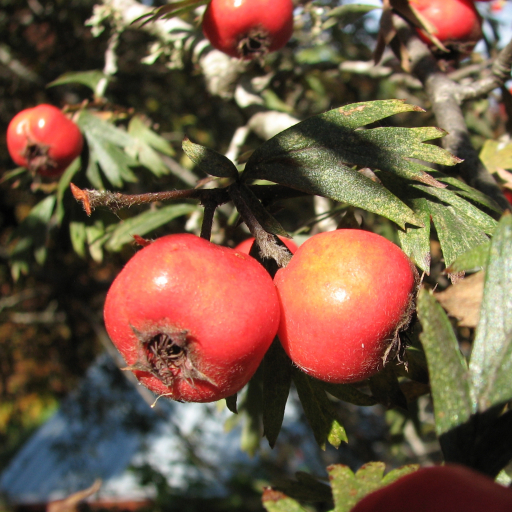
Plant Overview
Often called the Oriental Hawthorn or the "Silver Hawthorn," this elegant Mediterranean native is a standout in the rose family. Known for its shimmering, velvet-textured foliage and clusters of bright orange-red fruit, it has long been a staple in ancient landscapes from Turkey to the Caucasus. In folklore, Hawthorns are often seen as guardians of the garden, thought to protect the home from spirits while providing a bounty for the local birds.
🔍 How to Identify
- 🍃 The Foliage: Unlike common hawthorns, the leaves are deeply lobed and covered in fine, silvery hairs that give the tree a soft, frosted appearance from a distance.
- 🌸 The Blooms: In late spring, it erupts in dense clusters of white, five-petaled flowers that provide a vital nectar source for early-season pollinators.
- 🍎 The Fruit: It produces "haws" (berries) that are larger and meatier than those of its cousins, ripening to a rich orange-red or yellowish hue in the autumn.
- ⚔️ The Framework: It typically grows as a small, rounded tree or a large shrub, featuring gnarled branches that may be armed with sharp, sturdy thorns.
🏡 In Your Garden
- ☀️ Sun and Space: This tree is a sun-lover that thrives in open, airy spots. It is exceptionally drought-tolerant once established because its silver-haired leaves are designed to reflect heat and trap moisture.
- 🕊️ Wildlife Magnet: It is a "one-stop shop" for biodiversity; the dense, thorny branches offer perfect nesting sites for small birds, while the late-season berries are a high-energy snack for migrating species.
- ✂️ Low Maintenance: It is incredibly hardy and adapts to poor or chalky soils, though it hates "wet feet." Avoid planting it in areas where water pools, as it prefers sharp drainage.
⚠️ Safety & Toxicity
- 🛡️ Physical Hazard: While not chemically poisonous, the thorns are long and sharp. Use caution when pruning and keep it away from high-traffic paths where children or pets might run.
- 🍒 The Fruit: The fleshy part of the berry is edible and often used in jellies, but the seeds (like those of apples) contain amygdalin. While a few swallowed seeds are harmless, they should not be crushed or consumed in large quantities.
- 🐾 Pet Safety: It is generally considered non-toxic to dogs and cats, though the thorns can cause painful punctures to paws or noses.
✨ Fun Fact
- 📜 Ancient Gourmet: The Oriental Hawthorn is one of the few hawthorn species with fruit delicious enough to eat raw. In some Mediterranean cultures, the berries are traditionally ground into a sweet paste or used to flavor wines and liqueurs!

Detailed Care Instructions

Place in a bright room that is sun drenched almost all day. Or directly in a south-facing window.

Some plants require more regular watering than others, which should be done every few days. It's critical to maintain the soil moist all of the time. The water requirements of the same plant placed in pots with varying sizes will differ. Because the water in the smaller pot evaporates faster than the water in the larger pot, it will require more watering. Regardless of pot size, the surface should constantly be maintained moist.








