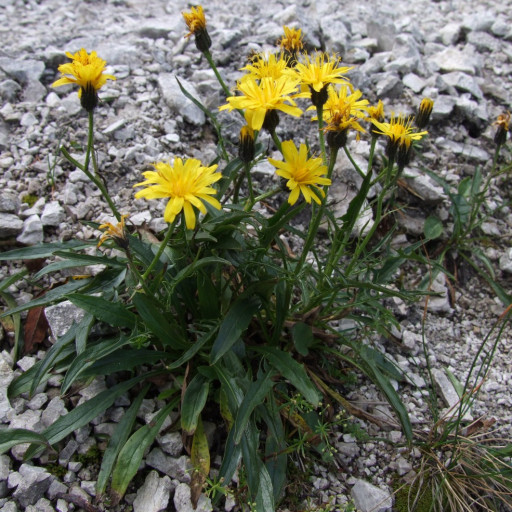
Plant Overview
Often called the "Dandelion’s taller cousin," Hawksbeard (Crepis) is a resilient wildflower that brings a splash of gold to meadows and roadsides. Its name stems from an ancient folk belief that hawks would eat the plant to sharpen their eyesight. While many gardeners treat it as a common weed, it is actually a vital nectar source for early-season pollinators.
🔍 How to Identify
- 🌼 The Bloom: Bright yellow, daisy-like flower heads. Unlike the single-stemmed Dandelion, Hawksbeard stems usually branch out to hold multiple flowers at once.
- 🍃 The Foliage: Long, toothed leaves that form a "rosette" at the base of the plant. Some species have smaller, narrower leaves that clasp the upright stems.
- ☁️ The Seed Head: After flowering, it develops a fluffy white ball of seeds (pappus), similar to a dandelion, designed to be carried away by the slightest breeze.
🏡 In Your Garden
- 🌱 The Taproot Factor: Hawksbeard grows a deep, sturdy taproot that allows it to survive in compacted soil and through dry spells. This means it "hates" being moved—if you try to transplant it, the root will likely snap, and the plant will wilt.
- 🐝 Pollinator Buffet: If you are practicing a "No Mow May" or rewilding a corner of your yard, this plant is a hero. It is a preferred food source for several species of solitary bees and hoverflies.
⚠️ Safety & Toxicity
- 🐾 Pet Safe: Hawksbeard is generally considered non-toxic to dogs, cats, and livestock. In fact, many tortoises and rabbits find the leaves to be a delicious snack.
- 🌿 Milky Sap: If you break the stem, a white, milky latex will leak out. While not typically poisonous, this sap can be sticky and may cause very mild skin irritation for those with sensitive skin or Aster-family allergies.
✨ Fun Fact
The genus name Crepis comes from the Greek word for "sandal" or "slipper." It is believed this refers to the shape of the fruit or the way the basal leaves can sometimes flatten against the ground like a sole.

Detailed Care Instructions
| Lighting | Full Sun |

Place in a bright room that is sun drenched almost all day. Or directly in a south-facing window.

Watering the plant Crepis requires giving it a sufficient amount of moisture to maintain its health and growth. It is essential to avoid over-watering the plant as it can lead to root rot and other diseases that can ultimately kill the plant. To water Crepis, one should ensure that the soil is dry to the touch, and the pot has proper drainage.
Once you have checked the soil's moisture level, water the plant slowly and thoroughly to ensure that the roots receive adequate moisture. It is advisable to water Crepis early in the morning or late in the evening, when the temperature is cooler.
Avoid watering the foliage, as it can lead to fungal problems. Instead, water the plant at the base or root level, directing the water carefully to avoid splashing onto the leaves or stems. It is also crucial to avoid allowing water to collect in saucers, which can cause root rot.
During the cold season or winter, it is essential to monitor the watering frequency of Crepis, as the plant requires less water during this period. One can reduce the watering frequency to once every two weeks or as needed.
With appropriate watering, the plant will establish healthy roots and produce beautiful flowers that enhance the beauty of your garden.
The best type of soil to use for planting the Crepis plant is well-draining and nutrient-rich. It should have a pH level of around 6.0 to 7.0 and should be loose and airy to promote healthy root growth. Sandy or loamy soils are ideal for Crepis plants because they provide adequate drainage and allow air to circulate through the soil easily. It is important to avoid soil that is heavy in clay or has poor drainage, as this can lead to root rot and other issues with plant health. Adding organic matter such as compost or aged manure can help improve the soil structure and provide essential nutrients for the plant's growth and development.







