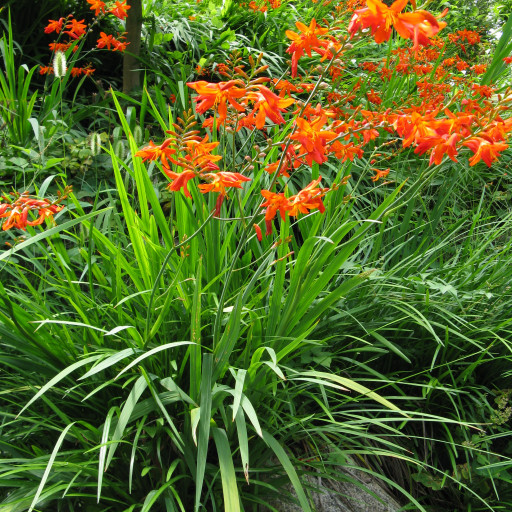
Plant Overview
Often called "Falling Stars," Crocosmia X Crocosmiiflora is a vibrant Victorian-era hybrid that brings a burst of fiery color to the late-summer garden. This resilient perennial is famous for its elegant, arching wands of orange flowers that seem to float above its sword-like foliage. While it is a beloved staple in cottage gardens for its "plant it and forget it" nature, its vigorous growth means it can quickly transform from a bright accent to a dominant groundcover.
🔍 How to Identify
- 🍃 Foliage: The leaves are long, slender, and sword-shaped, standing upright in dense, pleated clumps that look very similar to an Iris.
- 🔥 Flowers: Bright orange, copper, or red trumpet-shaped blooms sit in two rows along wiry, arching stems that "zig-zag" slightly at the tips.
- 🥔 Roots: It grows from small, onion-like bulbs called corms; uniquely, these corms often grow in vertical chains stacked on top of one another underground.
🏡 In Your Garden
- ☀️ Sun & Bloom: To get the best color, place it in full sun. While it will grow in the shade, the stems tend to become "floppy" as they stretch toward the light.
- 🚜 Vigorous Spread: This plant is a colonizer. It spreads via underground runners, making it excellent for filling large gaps or stabilizing slopes, but it can crowd out smaller, delicate neighbors.
- ✂️ Maintenance: After the first frost turns the leaves brown, you can cut the foliage back to the ground. It is remarkably hardy and will reliably return every spring from its underground corms.
⚠️ Safety & Toxicity
- 🐾 Low Risk: This plant is generally considered non-toxic to cats, dogs, and horses, though ingesting any plant material can cause mild digestive upset in pets.
- 🌿 Ecological Warning: In certain temperate climates (like the UK and Ireland), this specific hybrid is considered an invasive species because it escapes gardens and chokes out native wildflowers in the wild.
✨ Fun Fact
The name Crocosmia comes from the Greek words krokos (saffron) and osme (smell). If you take the dried flowers and rub them between your fingers or drop them in warm water, they release a distinct aroma strongly resembling expensive saffron.

Detailed Care Instructions
To grow Crocosmia X Crocosmiiflora, also known as Montbretia, follow these steps:
- Choose a suitable location: Crocosmia plants prefer full sun but can tolerate some light shade. Ensure that the soil is well-draining to prevent the plant from sitting in water.
- Prepare the soil: Amend the soil with organic matter such as compost or well-rotted manure to improve its fertility and drainage. Remove any weeds or debris from the planting area.
- Planting: Dig a hole that is approximately twice the size of the plant's root ball. Place the plant in the hole at the same depth as it was in its container or nursery. Backfill the hole with soil, firming it gently around the roots. Space multiple plants about 12-18 inches apart.
- Watering: Water the plant immediately after planting, thoroughly saturating the soil. After that, water consistently to keep the soil evenly moist, especially during the plant's active growth period. Reduce watering during dormancy.
- Mulching: Apply a layer of organic mulch around the base of the plant, leaving a gap around the stem to prevent rot. Mulching helps retain moisture, suppresses weed growth, and moderates soil temperature.
- Fertilizing: Crocosmia plants benefit from a balanced fertilizer in early spring, just as new growth emerges. Use a slow-release granular fertilizer or apply liquid fertilizer according to the manufacturer's instructions. Avoid over-fertilizing, as it can lead to excessive foliage growth and fewer flowers.
- Supporting the plant: Some Crocosmia varieties have tall flower spikes that may require support to prevent them from flopping over. Insert stakes or other forms of support near the plant, being careful not to damage the roots. Secure the plant to the support using soft ties or plant clips.
- Deadheading and division: To encourage prolonged blooming, remove faded flowers by cutting the stems back to the base. In late winter or early spring, when the plant is dormant, you can divide overcrowded clumps. Dig up the entire clump, divide it into smaller sections, and replant them, ensuring each new division has some healthy roots.
- Winter care: Most Crocosmia varieties are hardy in USDA zones 5-9 and can survive winter without protection. However, in colder regions, you can cover the plant's root zone with a thick layer of mulch or straw for added insulation.
By following these steps, you should be able to successfully grow Crocosmia X Crocosmiiflora and enjoy its beautiful blooms.

Place in a bright room that is sun drenched almost all day. Or directly in a south-facing window.

To properly water this plant, you should be mindful of its soil moisture level. It is important to allow the soil to dry out slightly between watering but not to the point of becoming completely dry. The frequency of watering will depend on the plant's environment and the season. During the summer months, you may need to water more frequently than during the winter months. When watering, you should aim to achieve even distribution throughout the plant's roots and avoid getting water on the leaves. Overwatering can lead to root rot, so it's better to water infrequently and deeply rather than shallowly and frequently. It's also a good idea to add a layer of mulch around the plant to help retain moisture. Finally, it's important to use a well-draining soil mix when planting to prevent waterlogging.
For best results, it is recommended to fertilize this plant once a month during the growing season. Use a balanced fertilizer with equal parts nitrogen, phosphorus, and potassium. Apply the fertilizer at the base of the plant and water thoroughly afterward. Avoid over-fertilizing as this can lead to excessive foliage growth at the expense of flower production. Additionally, it is important to ensure that the plant is well-watered and receives adequate sunlight to promote healthy growth and blooming.
The ideal soil to use with the plant in question is one that is well-draining, loose, and rich in organic matter. It should have a slightly acidic to neutral pH (between 6.0 to 7.0). Avoid using heavy clay or compacted soils that do not drain well, as this may cause the plant's roots to become waterlogged and ultimately lead to root rot. Organic fertilizers or amendments can be added to the soil prior to planting to help improve its fertility and texture. Soil moisture should be consistently moist, but not overly saturated, to ensure healthy growth and blooming.
To propagate this plant, you will need to identify the healthy, mature plant and select a section that has multiple shoots and a healthy root system.
Using a sharp, sterile knife, carefully separate the section from the main plant, taking care not to damage the roots.
Prepare a pot of well-draining soil and make a hole in the center.
Plant the section in the hole and gently firm the soil around it.
Water the plant thoroughly and place it in a bright, but not direct sunlight.
Keep the soil moist, but not waterlogged, and the temperature consistent.
In a few weeks, new growth should emerge and the plant will begin to establish itself.
Once the new plant has grown strong roots and several new shoots, it can be transplanted into a larger pot or into the garden.
Common pests of the montbretia include Spider mites, aphids, thrips, snails. Make a habit of checking your montbretia frequently for pests so that any infestations can be caught and managed early.








